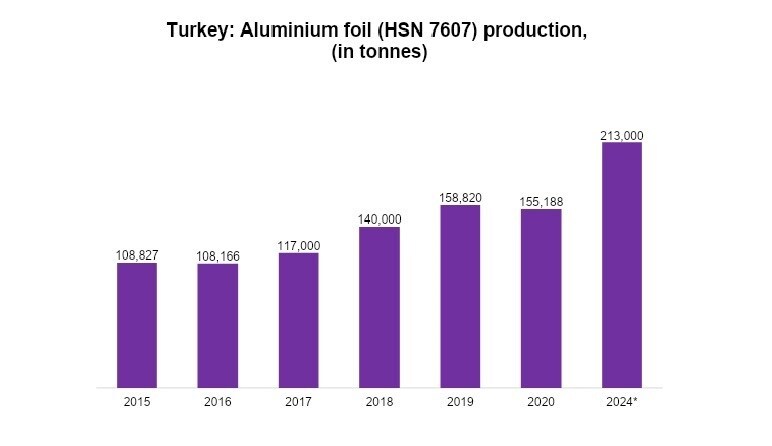
Turkey’s aluminium foil industry has expanded quietly but consistently over the past few years. Production increased steadily over the period, rising 26.3 per cent from 155.18 thousand tonnes in 2020 to 196 thousand tonnes in 2023, before recording a further 8.7 per cent year-on-year increase to 213 thousand tonnes in 2024. Roughly half of this output is shipped overseas, with the remainder absorbed by the domestic market.
That balance has helped Turkey to become of the top exporters of aluminium foil in the global aluminium foil market which is valued at USD 38.55 billion in 2024 and forecast to grow at a 5.05 per cent CAGR through 2030. To access the data, download: Aluminium Foil and its End Uses Current Trends and Forecast till 2030.
Foil export picture of Turkey
Export performance reflects both Turkey’s strength and its exposure to shifting demand. The export recorded were 120.468 thousand tonnes in 2023 and were valued at USD 508 million. This increased by 12.8 per cent in 2024 to 135.879 thousand tonnes and exports were valued at 6.7 per cent more at USD 542 million.
In 2025, the level of exports for the period from January to October stood at 104.678 thousand tonnes, valued at USD 503 million. Month to month performance has shown a mixed picture. Shipments were down by a significant 12.9 per cent in February, although the trend picked up by 4.1 per cent in March and further by 6.1 per cent in April. However, the positive trend lost some impetus in May, with exports falling by 5.6 per cent, followed by a more drastic contraction of 21.4 per cent in June. The trend picked up in August and again exports were down by 5.9 per cent in September and followed by a fall of 5.1 per cent in October, hinting at some weakening trend toward the end of the period. If this trend continues for the next two months, the export will almost match the last two years.
Imports ease as domestic supply strengthens
On the import side, Turkey imported 48.406 thousand tonnes of aluminium foil in 2023, with a value of USD 266 million. The imports grew marginally in 2024 to 51.843 thousand tonnes, valued at USD 260 million.
In 2025, the import quantities from January to October were recorded at 38.923 thousand tonnes, despite the value being at USD 249 million. The imports showed varied trends but tended to decrease in volume. The imports showed an increase of 12.1 per cent from January to February and then declined by 6.5 per cent in March. In April, the imports showed a temporary increase with the volumes rising by 18.1 per cent, followed by a decrease of 3.3 per cent in May and then 6.1 per cent in June. Following this, the import volumes witnessed a sharp decrease by 20.4 per cent from June to August. This was followed by another sharp decrease of 19.3 per cent in September. However, the import trends improved in October with the import volumes rising by 25.2 per cent from September.
The data underscores that Turkey is increasingly producing aluminium foil domestically rather than relying on imports, supported by the scale and capacity of its leading foil manufacturers, Assan Alüminyum and ASAŞ Alüminyum. To know about 2026 aluminium industry trend, visit: Global Aluminium Industry Outlook 2026.
Trade routes, key markets, and how foil is used at home
Germany, UK, US, and Italy continue to be the leading markets for Turkish exports. Exports to Germany amounted to 8.918 thousand tonnes in 2023, with a slight decrease to 8.695 thousand tonnes in 2024, and in 2025 till October it exported 7.1 thousand tonnes.
Exports to the UK increased from 8.297 thousand tonnes in 2023 to 12.94 thousand tonnes in 2024, and in 2025 till October it reached 10 thousand tonnes. The US ordered exports amounting to 29.18 thousand tonnes in 2023, which decreased to 19.68 thoiusand tonnes in 2024 and till October 2025 to 15.99 thousand tonnes.
On the other hand, exports to Italy increased from 12 thousand tonnes in 2023 to 16.16 thouisand tonnes in 2024, and 16.83 thousand tonnes in 2025, till October 2025.
What helped Turkey in export is its geographical location. It is located between Europe, the Middle East, and Asia which gives it an advantage in trade. Close distance through the Mediterranean facilitates access at a lower cost of haulage and thus supports large volumes of exports or re-exporting goods.
Easy access to energy sources contributes to controlling rolling and processing costs despite Turkey’s remoteness from prime smelting plants, which supply about 95 per cent of raw aluminium. Turkey’s labour and investments in technology enable rapid value addition, which entails backing and packaging of semifinished foils.
At home, aluminium foil demand is anchored by food packaging. Processed foods, meat and dairy rely on foil for hygiene and shelf-life extension, while pharmaceutical blister packs depend on its barrier properties against moisture and oxygen. This segment provides steady demand, with prices reaching about USD 4,915 per tonne by September 2025 amid higher supply-chain costs.
Household use remains strong as well, driven by urban lifestyles, e-commerce penetration and heightened hygiene awareness since the pandemic. Beyond this, foil finds applications in construction and HVAC insulation, automotive heat shields, and consumer goods such as containers and laminates. Where domestic processing capacity falls short, imports help bridge the gap, blending with local output to meet these varied, high-barrier end uses.















_md.webp)