AL Circle analysis: From cans and NEVs to extrusion, shifting end-use demand reshapes aluminium’s growth story

The image used in this article is generated with an AI tool and does not depict any real-time moment
The aluminium industry is entering the second half of 2026 with demand signals moving in different directions. Beverage cans are finding new consumption opportunities in Brazil, extrusion demand remains resilient in key markets, and aluminium producers are benefiting from firmer prices. At the same time, tariffs and trade-policy uncertainty are adding cost pressure, while automakers and packaging companies are placing greater emphasis on aluminium’s role in lower-carbon products.
Demand: New consumption patterns open fresh opportunities
Brazil’s beverage can market is maintaining a positive trajectory in 2026, with 16.4 billion cans sold in the first half and full-year growth expected in the low single digits. The more interesting development, however, is the changing beverage mix.
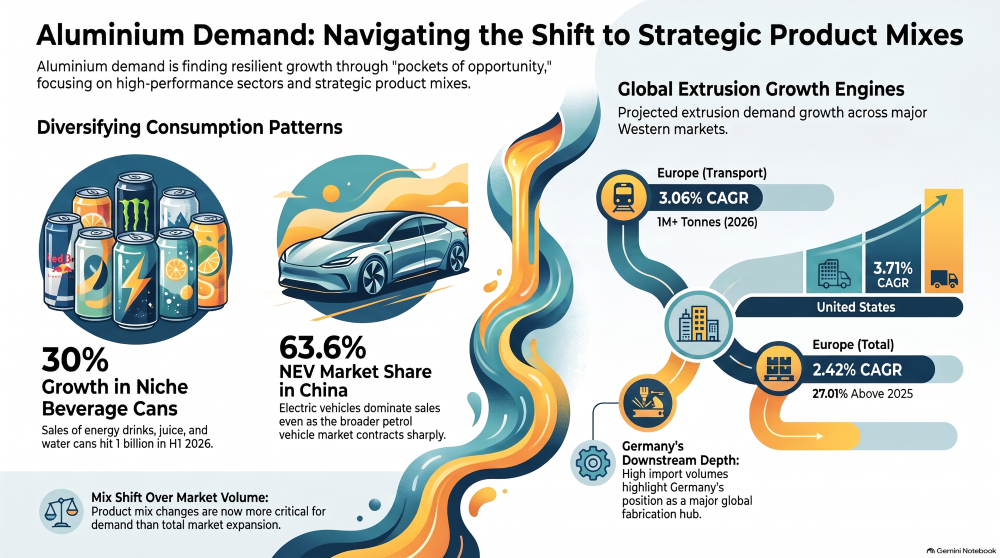
Beer and soft drinks continue to form the core of can consumption, but energy drinks, non-alcoholic beer, juice and water are gaining momentum. Sales across these categories increased by about 30 per cent in the first half, taking their combined volume to 1 billion cans in a six-month period for the first time.
At the same time, China’s passenger vehicle market is undergoing a similarly change. NEV retail sales reached 399,000 units between August 1 -16 representing a 15 per cent year-on-year decline, but sales were 1 per cent higher than in the corresponding period of July. The wider passenger-vehicle market contracted much more sharply, with sales falling 22 per cent year on year to 628,000 units.
NEVs nevertheless captured 63.6 per cent of passenger-vehicle retail sales during the period, as higher fuel costs put additional pressure on petrol vehicles.
Key takeaways
- The demand story is becoming more diversified: newer beverage categories and NEVs are creating additional aluminium opportunities beyond established consumption patterns.
- Market share is becoming as important as volume growth: China’s vehicle data shows that aluminium-intensive applications can strengthen their position even when overall market volumes decline.
- The strongest opportunities may increasingly come from changing product mixes rather than headline market expansion.
To know the global production, demand and consumption forecasts of aluminium extrusions, explore our report "The World of Aluminium Extrusions to 2035 - Demand Forecast | Price Benchmarking | Plant Economics | Strategic Growth Sectors"
Extrusion demand is revealing the next pockets of growth
The European extrusion market continues to show room for expansion despite a challenging operating environment. Usage is forecast to rise from 3.48 million tonnes in 2025 to 3.56 million tonnes in 2026, an increase of 2.30 per cent. By 2035, demand is projected to be 27.01 per cent above 2025 levels, implying a CAGR of approximately 2.42 per cent between 2025 and 2035.
Transport is emerging as one of the stronger areas within the market. European transport extrusion usage is expected to increase from 970,000 tonnes in 2025 to 1 million tonnes in 2026, with demand forecast to grow at approximately 3.06 per cent CAGR through 2035.
Germany remains central to the European downstream market, although its trade structure is weighted heavily towards imports. The country imports roughly twice as much basic aluminium extrusion under HS 7604 as it exports, consistent with its position as a major fabrication and OEM centre.
The first half of 2026 showed some improvement in trade activity. Exports rose from 74,114 tonnes in Q1 to 77,863 tonnes in Q2, while imports increased from 139,304 tonnes to 147,743 tonnes. Despite the quarterly increase, Q2 imports were 4.2 per cent lower year on year, while exports were 3.6 per cent higher.
The US offers another substantial growth market. Aluminium extrusion demand is estimated at 3.0 million tonnes in 2025 and is projected to reach 4.2 million tonnes by 2034, representing a CAGR of 3.71 per cent from 2026 to 2034. Transportation and building and construction together account for around 65 per cent of North American extrusion usage.
Key takeaways
- Transport is emerging as a particularly important demand engine for extrusion, giving the sector a stronger growth profile than the broader European market.
- Germany’s import-heavy structure continues to underline the depth of its downstream aluminium demand, even as trade volumes fluctuate.
- The US combines scale with growth potential, making North American extrusion an increasingly relevant part of the global downstream picture.
- The opportunity is becoming more selective: application mix and regional positioning appear increasingly important to extrusion growth.
Firmer market conditions are strengthening the earnings picture
The improvement in aluminium market conditions is becoming visible in company financial results. Press Metal Aluminium Holdings Berhad reported a 42 per cent increase in core profit after tax and minority interest in Q2 FY2026, supported by higher realised aluminium prices and lower alumina costs.
Profit before tax rose 78.9 per cent to MYR 1.16 billion (USD 287.64 million), compared with MYR 647.47 million (USD 160.55 million) in the corresponding quarter a year earlier.
P.A. Resources also ended FY26 on a stronger footing. Fourth-quarter revenue increased 25.2 per cent year on year to MYR 204.8 million (USD 50.8 million), from MYR 163.5 million (USD 40.5 million), helped by higher sales volumes in extrusion and fabrication. The stronger performance gives P.A. Resources momentum for its MYR 100 million (USD 24.8 million) expansion plan and its effort to diversify beyond its core solar-sector business.
Key takeaways
- The earnings recovery is being supported by both sides of the margin equation: stronger aluminium prices and lower alumina costs are working together to lift profitability.
- Volume growth is adding another layer of support for downstream players, as seen in P.A. Resources’ extrusion and fabrication business.
- The current earnings environment provides greater scope for expansion, although the durability of price and input-cost advantages remains an important consideration.
Trade policy is reshaping the cost of aluminium-intensive supply chains
The improving market picture is being complicated by a more uncertain trade environment. The latest US-Canada escalation is affecting aluminium alongside CO2, cement, building materials and electronics.
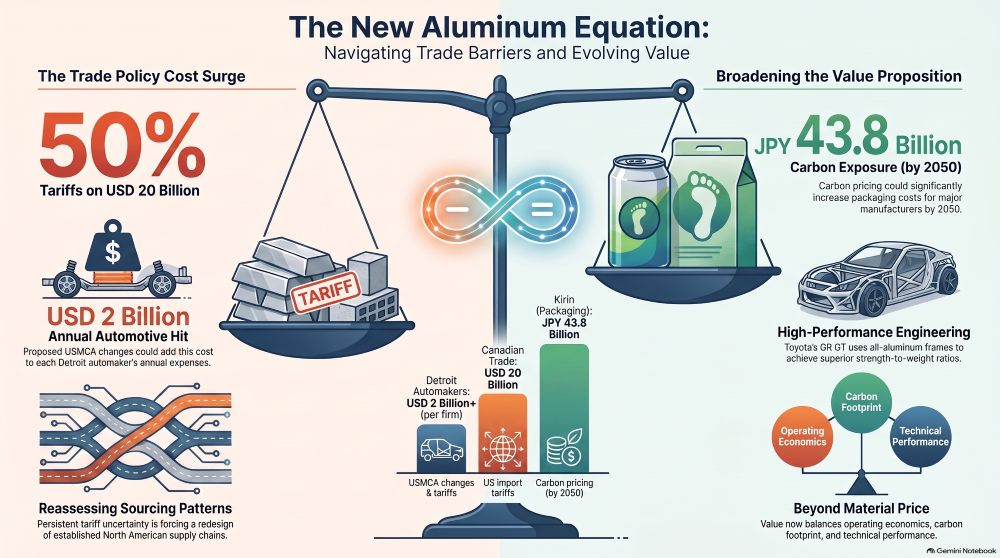
The US imposed 50 per cent tariffs on roughly USD 20 billion of Canadian goods on August 22, while Canada plans dollar-for-dollar retaliation from September 8.
The automotive sector faces an additional layer of uncertainty from proposed changes to the USMCA. Detroit automakers are already dealing with tariffs on steel, aluminium, vehicles and vehicle parts imported from Mexico and Canada. Estimates from two automakers suggest that the proposed changes could add at least USD 2 billion in annual costs for each Detroit automaker, on top of existing tariff-related expenses.
Connect with verified aluminium extrusion buyers and suppliers through the AL Biz marketplace.
Key takeaways
- Trade policy is increasingly becoming part of the aluminium cost equation, rather than remaining a separate geopolitical consideration.
- The pressure is particularly significant for integrated manufacturing chains, where aluminium tariffs can feed into vehicle and component costs further downstream.
- Persistent tariff uncertainty could accelerate the reassessment of established North American sourcing patterns, particularly where cost margins are already tight.
Industry's value equation is widening from cost to carbon and performance
Corporate developments are also showing how the aluminium industry's value proposition is evolving.
Ardagh Holdings is exploring a potential transaction involving Ardagh Metal Packaging. Advisers are considering the sale of some or all of its indirectly held stake in AMP to a third-party buyer. Another option would involve Ardagh Holdings acquiring the AMP shares it does not currently own before selling the entire company.
Meanwhile, Kirin is examining greater use of recycled and lower-carbon aluminium in packaging. Its considerations include GHG-free aluminium produced using renewable energy, lower-emission aluminium with a high recycling rate and potentially carbon-free aluminium cans. Under its sustainable scenario, the company estimates that carbon pricing could add JPY 43.8 billion (USD 275.4 million) to packaging costs by 2050.
In automotive applications, Toyota's GR GT illustrates another dimension of aluminium's value. The model uses an all-aluminium body frame made up of nine large aluminium castings connected with aluminium tubes and extrusions, creating a structure designed to combine low weight, strength and rigidity.
Key takeaways
- The aluminium value proposition is broadening: operating economics, carbon intensity and technical performance are increasingly influencing material decisions.
- Lower-carbon aluminium is moving closer to a commercial consideration, particularly as customers assess future carbon-pricing exposure.
- High-performance applications continue to demonstrate aluminium’s ability to command value through engineering benefits, rather than material cost alone.
- Corporate decisions across the value chain increasingly reflect the need to balance cost, ownership structure, sustainability and product differentiation.

The latest developments point to an aluminium industry entering a more selective phase of growth. Demand is broadening into new beverage and automotive applications, while transport, construction and other downstream sectors continue to support extrusion consumption. Stronger aluminium prices and lower input costs are also improving the financial position of producers.
But the market is becoming more complicated at the same time. Tariffs are changing supply-chain economics, corporate structures are being reassessed, and carbon performance is gradually becoming part of the material-selection equation.
Tasmania’s Kings Outdoor Living embraces aluminium with Capral support for locally made shade and shelter systems
Next articleJura Z10’s new Aluminium Champagne finish brings luxe in coffee breaks
Grow with
AL Circle