What could be a viable solution for the United States to meet its current aluminium demand when the country is suffering from a domestic primary aluminium production shortage and high import costs due to a 50 per cent tariff on the metal? Recycling it is! Rightfully, Trond Olaf Christophersen, chief financial officer of Hydro, has pointed out, “If the US administration wants to improve self-reliance on aluminium, the quickest way to do it will be to keep more of the scrap in the US and support recycling capacity.”
Recycling – the answer to demand-production mismatch
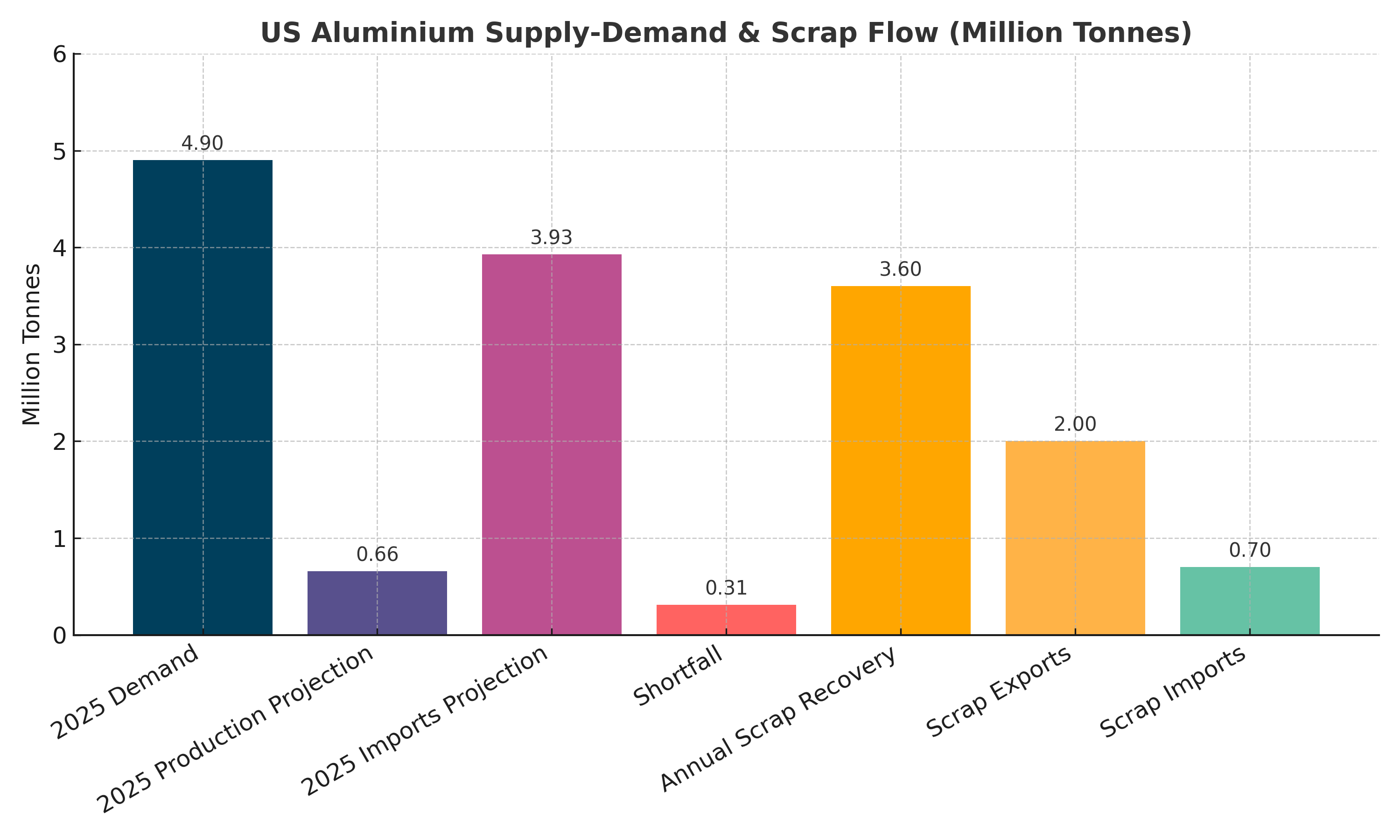
By the end of 2025, the United States primary aluminium demand is projected to reach 4.9 million tonnes. Yet until April 2025, the country’s production stood at only 222,000 tonnes, down by 2.2 per cent from 227,000 tonnes during the corresponding period of the previous year. At the current pace of 55,000 tonnes a month, annual output will barely touch 660,000 tonnes. The production has been declining since years now from 750,000 tonnes in 2023 to 675,000 tonnes in 2024.
Factoring in imports, although they showed an upward trend year-over-year in the first four months of 2025, standing at 1.31 million tonnes versus 1.24 million tonnes, reflected declines in most of the months in 2025, from 335,000 tonnes in January to 298,000 tonnes in February, and from 438,000 tonnes in March to 238,000 tonnes in April. The monthly average came in at 327,250 tonnes, which could lead to an annual output of 3.93 million tonnes, but only if the trend persists because April saw a sharp M-o-M fall of 46 per cent, largely attributed to the rise in Midwest aluminium premium, an additional cost of acquiring primary aluminium in the US Midwest beyond the global LME aluminium price. Compared to the premium of USD 497 per tonne in January 2025, it rose to USD 868 per tonne at the end of April, reflecting an increase of 75 per cent in four months. Currently, the premium has exceeded USD 1,500 per tonne, which may further choke off imports and tighten the domestic market more.
Still, if imports hold at the monthly average of 327,250 tonnes, amounting to 3.93 million tonnes for the year, and domestic production reaches 660,000 tonnes, the combined total of 4.59 million tonnes would still fall short of the 4.9-million-tonne demand. And if the high costs and supply deficit continues in the market, downstream manufacturers may seek alternatives, that could lead to potential “demand destruction.”
Recycling – a quick fix to high-tariff and energy-intensive aluminium
In this scenario, the quick fix is only recycling. The scrap that ends up in landfills or gets exported should be saved. The United States recovers 3.6 million tonnes of aluminium from scrap (from both new and old) annually, and it exports over 2 million tonnes of scrap. If the country stops exporting scrap and recycles domestically to make primary product, it will be able to meet its primary aluminium demand. In addition, the United States also imports scrap of about 700,000 tonnes annually.
Until April 2025, the country imported 276,000 tonnes of scrap compared to 212,000 tonnes in the earlier year, while it recovered 1.222 million tonnes of aluminium from scrap as against 1.19 million tonnes a year ago. Both imports and domestic recovery increased year-over-year, while exports declined from 675,000 tonnes to 664,000 tonnes, signalling that Washington may finally be waking up to scrap’s strategic value.
Moreover, aluminium scrap is tariff-free that makes a significant economic incentive for domestic recycling plants, allowing them to sell remade metal at the high prices commanded by tariff-protected primary aluminum.
The trade dynamic is already noticeably changing. The country that exported 2 million tonnes of scrap in 2024 has begun to reduce its import volume because of diversion to feed local recycling capacity.
“There is a clear incentive to export scrap from Europe to the U.S.,” said Hydro’s Christophersen, though he noted that volatility in the transatlantic trade environment is limiting those flows.
“We’re not seeing a lot of scrap exports [from Europe at the moment] because the trade environment is so volatile and are fully dependent on where Europe ends up when it comes to tariff [with] the U.S.,” he added. “That will decide whether this continues to be incentive or not.”
According to Hydro, recycling all the scrap in the US would be the equivalent of building four new primary smelters and could satisfy “roughly half the import need that the US currently has.”
What more? Building an aluminium recycling plant only requires 10 per cent of the capital expenditure and can be completed in one to two years, while a a traditional smelter takes five-to-six-year timeline. Cost-wise, setting up a recycling facility in the US costs around USD 365 million to USD 2.5 billion, while setting up a primary smelter involves an investment of USD 4 billion to USD 6 billion.
Well, keeping in mind the ongoing energy crisis in the US, aluminium recycling facility would be the most viable option because the energy required to recycle aluminum is 8.3 gigajoules per tonne, compared to 186 gigajoules per tonne for primary production.
So, the US tariff can also be seen as a policy that, while inflicting short-term pain and putting billions of dollars in investments at risk, is inadvertently steering the aluminium industry toward a more sustainable and self-reliant future.
To get full insights into aluminium recycling market, read our report: "World Recycled ALuminium Market Analysis Industry forecast to 2032"














_md.webp)








