Oceania's H1 2026 primary aluminium production rises 2.2% Y-o-Y to 943,000t as Q2 recovery offsets weather-hit Q1

The image used in this article is generated with an AI tool and does not depict any real-time moment
The first quarter of 2026 brought a temporary setback for Oceania's primary aluminium production, but it did not define the first half of the year. Although production declined from the last year Q4, due to upstream supply disruptions and seasonal operational factors, the region regained momentum in Q2, 2026 as output strengthened.
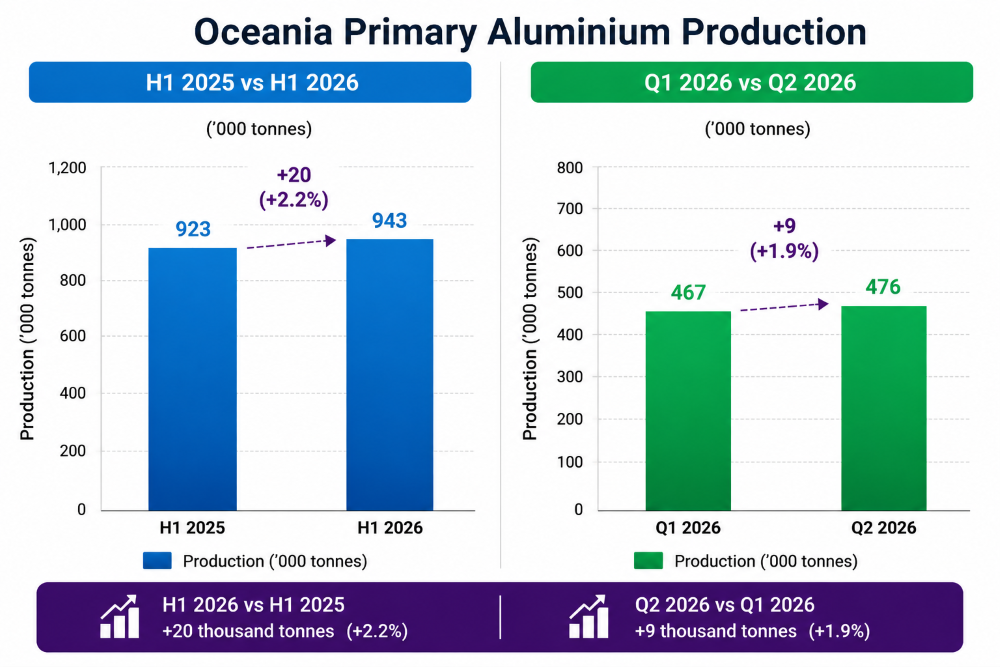
Oceania's primary aluminium production rebounded in the second quarter of 2026, rising to 476,000 from 467,000 in the first quarter, representing a 1.9 per cent quarter-on-quarter increase.
On a year-on-year basis, Oceania's primary aluminium production reached 943,000 in H1 2026, compared with 923,000 in H1 2025, an increase 2.2 per cent.
Higher quarterly output drove first-half growth
The stronger first-half performance was underpinned by higher production in both quarters of 2026 compared with the corresponding period of 2025. Production increased from 458,000 in Q1 2025 to 467,000 in Q1 2026, while Q2 2026 output rose to 476,000 from 465,000 in Q2 2025. The year-on-year gains in both quarters lifted H1 2026 production to its highest first-half level across the period shown.
Quarter-on-quarter, production followed a mixed trend during the first half of 2026. After reaching 481,000 in Q4 2025, production declined to 467,000 in Q1 2026, down by 14,000, or 2.9 per cent. Production then recovered to 476,000 in Q2 2026, an increase of 9,000, or 1.9 per cent, from the previous quarter. Despite the recovery, production remained 5,000, or 1.0 per cent, below the Q4 2025 level.

Weather and seasonal factors disrupted the opening quarter
The decline between Q4 2025 and Q1 2026 was not driven by weaker demand or smelter shutdowns. Instead, industry reports and company disclosures indicate that temporary upstream supply disruptions and seasonal operating factors were the primary reasons behind the decline.
Heavy rainfall at Rio Tinto's Weipa bauxite operations during January and February, followed by Tropical Cyclone Narelle in March, disrupted bauxite mining and logistics. Although Rio Tinto stated that its integrated aluminium business remained resilient, the adverse weather affected raw material availability and interrupted normal upstream operations.
The disruption extended further along the value chain as weather-related interruptions also affected Pacific alumina refineries, temporarily reducing the supply of alumina-the essential feedstock for aluminium smelters. Although refinery operations recovered later, these disruptions weighed on aluminium production during the first quarter.
Seasonal factors also contributed to the softer quarterly performance. Q1 comprises 90 days, compared with 92 days in Q4, while maintenance activities are generally more common at the beginning of the year.
Despite lower total production, the daily average output remained broadly unchanged at 5.2 in both Q4 2025 and Q1 2026, suggesting that the decline from 481,000 to 467,000 was largely a calendar effect rather than a deterioration in smelter operating performance.
Monthly production analysis
Monthly production reflected the industry's gradual recovery through the first half of the year. Output stood at 164,000 in January before falling to 144,000 in February, a decrease of 12.2 per cent, month on month. Production then rebounded to 159,000 in March, increasing by 10.4 per cent, from February.
Output eased slightly to 156,000 in April, 1.9 per cent, from March, before rising to 161,000 in May, an increase of 3.2 per cent, month on month. Production edged lower to 159,000 in June, declining 1.2 per cent, from May, bringing the first half to a close with output comfortably above the corresponding period of 2025.
Explore: The most comprehensive and forward-looking industry-focused report – Global Bauxite & Alumina Market Forecast to 2036: Supply–Demand, Trade Flows & Price Outlook
Power agreements and investments will shape the industry's future
Although production recovered during the first half of 2026, but securing long-term and competitively priced electricity remains one of the biggest challenge for Oceania's aluminium industry.
Tomago Aluminium's 586,000-tonne-per-year smelter in Australia faces uncertainty beyond 2029, as its current electricity supply agreement expires in December 2028. It is working with the Australian and New South Wales governments on a long-term renewable power solution to keep operations running beyond 2028. Under the agreement, the company plans to invest at least AUD 1 billion over the next decade in capital expenditure, major maintenance and decarbonisation, reinforcing the smelter's long-term sustainability while creating scope for incremental expansion.
Meanwhile, the immediate risk of closure at Rio Tinto's 192,000-tonne-per-year Bell Bay smelter has been avoided after the Tasmanian government agreed to extend its power supply contract until December 2026, having previously been scheduled to expire at the end of 2025. Together, these developments highlight the growing challenge of securing reliable and competitively priced electricity once existing contracts come to an end.
Despite these challenges, aluminium producers continue to invest in the region's long-term future. At the Boyne Island smelter in Queensland, Rio Tinto, together with the Australian and Queensland governments, announced a AUD 2 billion partnership to secure the future of the smelter through 2040. The investment is aimed at strengthening renewable electricity supply and maintaining the smelter's competitiveness rather than expanding production capacity.
Unlock key insights from leading companies and experts across the aluminium ecosystem with our e-Magazine - Mine to Market: ALuminium Producers & Manufacturers 2026
Australia’s 2026 aluminium exports hit 566kt as unwrought holds 99.8% dominance
Next articleGeopolitical tensions keep aluminium prices volatile, while long-term demand outlook remains firm
Grow with
AL Circle