From 1.27Mt to 1.02Mt: How China’s aluminium extrusion export equation changed in 2025
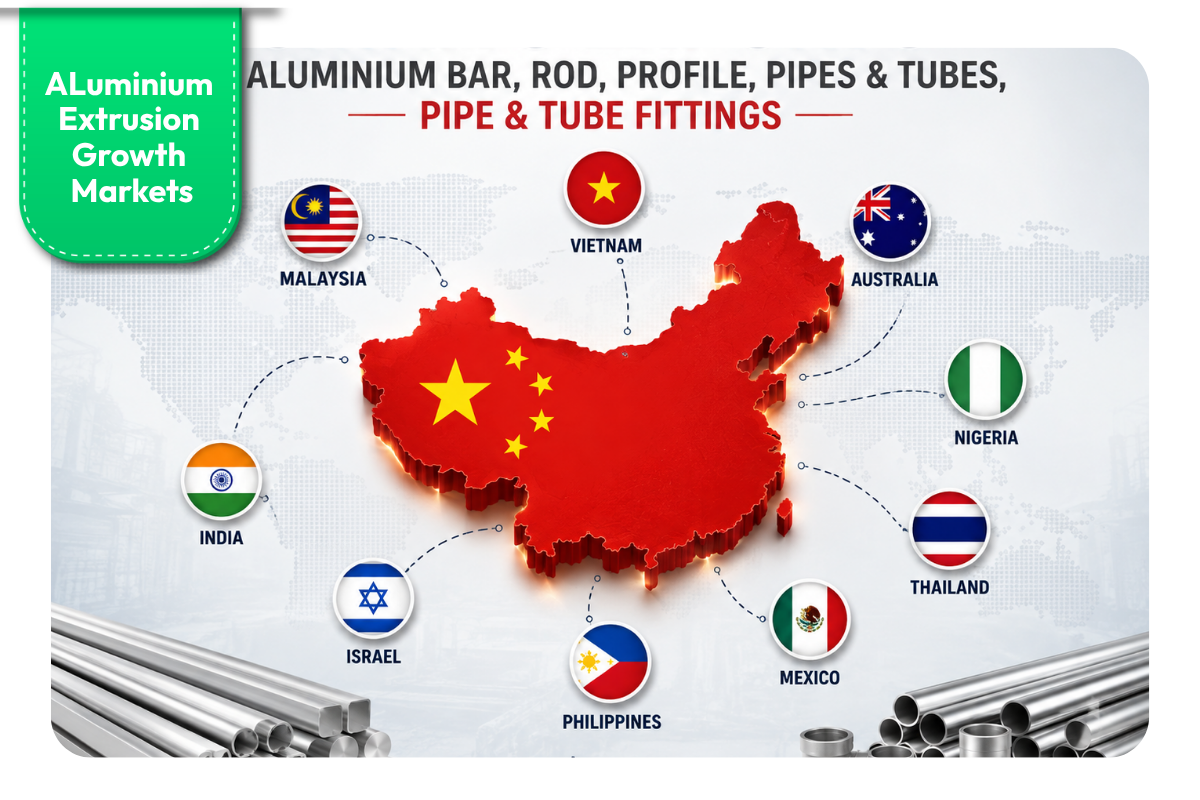
The image used in this article is generated with an AI tool and does not depict any real-time moment
Leading aluminium producer and exporter China has reported a 2025 trade trend where the trade indicator appears on a declining graph. The trade volume, inclusive of all aluminium products, dipped from 6.66 million tonnes in 2024 to 6.13 million tonnes exported in 2025. Out of the 2025 figure, aluminium bars, rods, profiles, pipes and tubes, and tube or pipe fittings accounted for 1.02 million tonnes or 16.64 per cent.
Zooming in on the year-to-date figures, China’s export chart has been like this:
YTD May 2026 – 408,773 tonnes, up 3.72 per cent Y-o-Y from 394,104 tonnes in YTD May 2025
YTD May 2025 – 394,104 tonnes, down 20.44 per cent Y-o-Y from 495,366 tonnes in YTD May 2024
The drastic dip can also be traced in China’s annual aluminium extrusion export volume, whereby China’s 1.02 million tonnes of exports indicated a 19.69 per cent Y-o-Y decline from the export figures of 1.27 million reported in 2024.
2025 – 1.02 million tonnes, down 19.69 per cent Y-o-Y from 1.27 million tonnes in 2024
2024 – 1.27 million tonnes, up 9.48 per cent Y-o-Y from 1.16 million tonnes in 2023
Unlock in-depth insights into the extrusion segment of the global aluminium industry with The World of Aluminium Extrusions – Industry Forecast to 2032
Trade trends in 2025 vs 2024 vs 2023
The following countries have been the top destinations for Chinese aluminium extruded products:

Barring only two countries, viz., Malaysia and Nigeria, China’s exports to the other seven destinations reflect a Y-o-Y drop, either major or modest, after surging in 2024.
While Nigeria has been gaining momentum in stabilising its aluminium industry and Malaysia has been expanding its aluminium downstream market, with both countries having China as their primary exporter, why have the other countries sustained such a drastic dip in trade?
Connect with verified aluminium extrusion buyers and suppliers through the AL Biz marketplace.
The aluminium export tax rebate paradox
China’s aluminium semi-finished products benefited for years from a 13 per cent export tax rebate, which helped exporters remain competitive in overseas markets through lower effective costs. The policy was withdrawn from December 1, 2024, covering major aluminium semi-finished products.
The impact was visible almost immediately. Exporters rushed to ship material before the policy took effect, while the higher post-rebate export cost subsequently weakened overseas shipments. Export profits, which had generally remained positive before the withdrawal, fell sharply after December 2024, with many producers entering losses during the initial adjustment period.
Inference: The rebate withdrawal did not simply reduce an incentive, but fundamentally altered the export economics of Chinese aluminium semis. The immediate result was a loss of export momentum and market rebalancing.
Domestic demand absorbed China’s larger aluminium output
The decline in exports can also be viewed from a domestic supply-demand angle. China’s primary aluminium production is approaching its long-standing 45-million-tonne annual ceiling, leaving limited room for further growth in primary metal availability.
At the same time, demand from manufacturing and energy-related sectors has strengthened, leaving less aluminium available for export.
This is particularly important for downstream aluminium products. China’s exports of bars, rods, profiles, pipes, tubes and fittings fell substantially in 2025, while domestic manufacturers continued to require aluminium for applications across automotive, new energy, infrastructure, construction and other end-use manufacturing segments.
The shift is therefore not simply an export decline. It indicates a gradual reallocation of aluminium towards the domestic market.
Inference: With primary aluminium production constrained and domestic demand gaining momentum, China’s downstream products exports witnessed a dip to fulfil domestic requirements.
AL Circle is coming up with a new Magazine "ALuminium’s Frontline: OEM Edition 2026" Feature your brand and opinion in the edition.
Higher LME and benchmark aluminium prices
The third factor is price rather than volume. As China's export availability declined and the global aluminium market tightened, benchmark prices moved higher. LME aluminium price chart recorded USD 2,920 per tonne on December 5, 2025, its highest level since May 2022, representing a 27 per cent increase from the 2025 low of USD 2,300 per tonne recorded in early April.
This leaves a direct impact on downstream products. Aluminium semis and extruded products are not priced independently of the primary metal benchmark. When the underlying aluminium price rises, the metal component of the downstream product cost rises automatically.
The higher benchmark also helped restore the economics of China's aluminium semi-finished exports. By Q1 2026, export profits had recovered to the high levels seen before the December 2024 rebate cancellation, as domestic and overseas aluminium prices moved higher.
Inference: The current Chinese aluminium trade equation is increasingly being shaped by a combination of lower export volumes and higher unit values. Even where physical shipments remain below earlier levels, rising LME and regional benchmark prices can raise the selling prices of downstream aluminium products, and lower the purchase levels due to that.
China is exporting less aluminium in several downstream categories, but the metal is becoming more valuable. The next question is whether the recovery in export profitability will eventually encourage shipments to pick up again, or whether China’s growing domestic demand and limited primary aluminium capacity will keep more of its aluminium within the country.

Aluminium extrusion market 2025-2035: Size, segmentation, cost drivers and outlook
Next article2A USA bets $32m on Auburn aluminium die-casting facility expansion
Grow with
AL Circle