Aluminium extrusion market 2025-2035: Size, segmentation, cost drivers and outlook
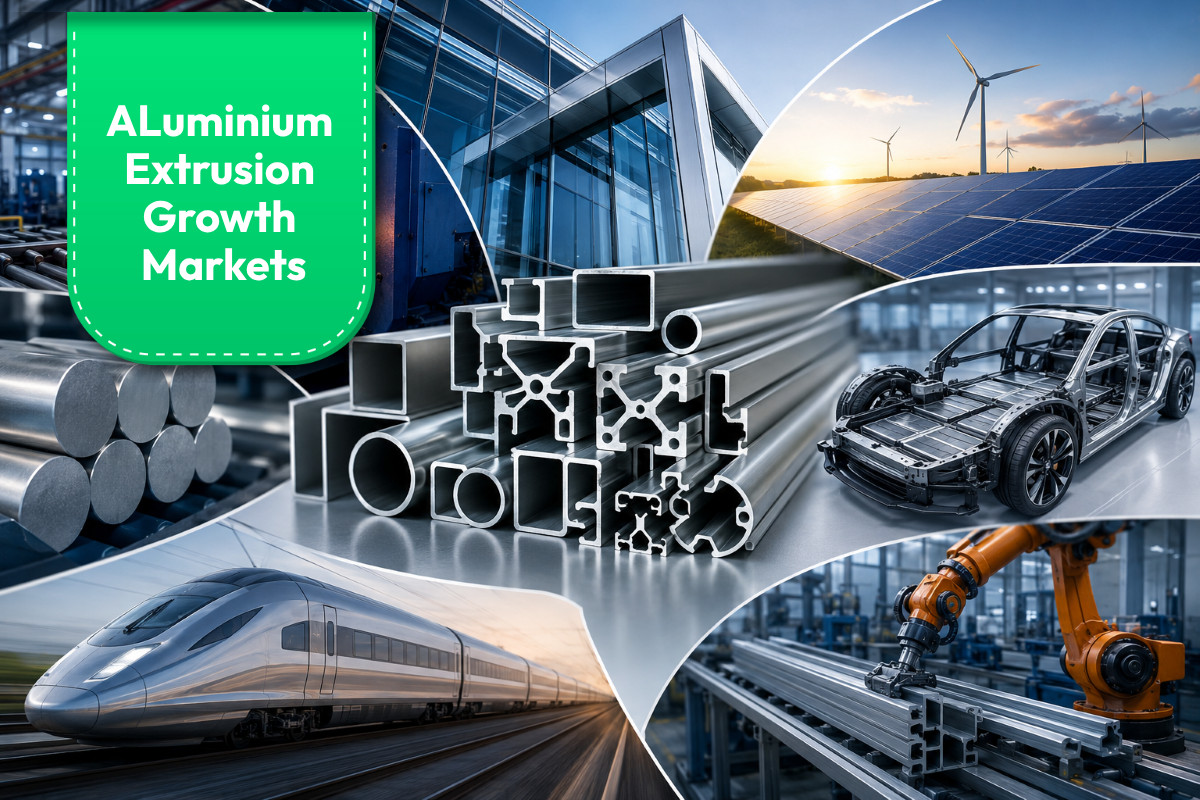
The global aluminium extrusion market is entering a sustained growth phase, driven by construction, transportation, renewable energy and advanced manufacturing. This overview covers market structure, segmentation, cost drivers and the strategic trends expected to shape the industry through 2035. For the full dataset covering capacity, production, consumption and country-level trade flows by alloy, temper, finish and end-use, readers can access AL Circle’s report, “The World of Aluminium Extrusions – Industry Forecast to 2032” or speak to our research desk.
The market at a glance
Building and construction remains the largest end-use sector, accounting for around 55 per cent to 56 per cent of global extrusion consumption, with applications ranging from fenestration and curtain walls to glazing, partitioning, formwork and scaffolding. Transportation follows at around 18 per cent and is among the faster-growing segments as vehicle lightweighting and electric vehicle adoption increase aluminium demand.
Asia Pacific dominates the market, with China accounting for 66 per cent of global extrusion usage in 2023 and the Rest of Asia Pacific contributing another 9 per cent. China also holds around 64 per cent of global extrusion capacity, making it the industry's largest production and consumption hub. Beyond construction and transportation, solar energy, electricity transmission and renewable energy infrastructure are creating additional demand, while sustainability is pushing extruders towards cleaner-energy billets, post-consumer scrap, recycling and more advanced production technologies.
|
Year |
Market size (USD) |
Notes |
|
2024 |
Nearly 100-105 billion |
Base year |
|
2025 |
Nearly 110 billion |
Current market |
|
2026 |
Nearly 118 billion |
Near-term |
|
2030 |
Nearly 150-160 billion |
Interim milestone |
|
2035 |
Nearly USD 195-235 billion |
AL Circle forecast horizon |
|
CAGR (2025-2035) |
6 to 8 per cent |
Value terms |
Because the traded value is billet-led, the headline number moves with the metal price plus regional premium. Read this alongside live primary aluminium prices.
Market structure and segmentation
By product form: Solid profiles lead by tonnage, while hollow and semi-hollow sections produced through porthole and bridge dies are gaining importance in structural, thermal-management and BEV applications.
By alloy and temper: The 6xxx series remains dominant, led by 6063 in architectural applications, while 6061, 6082 and 6005A serve structural and automotive requirements. The 1xxx series is gaining ground in conductive applications such as busbars and conductors, while 5xxx and 7xxx alloys serve higher-strength applications.
By surface finish and fabrication: Mill finish leads by volume, while anodised, powder-coated, thermal-break and value-added profiles command higher-value architectural and fabricated applications.
By end-use: Building and construction remains the largest market, covering fenestration, curtain walls, structural glazing and solar mounting. Transportation is the fastest-growing segment, supported by battery enclosures, trays, crash management systems, body-in-white and space-frame applications. Electrical and electronics demand comes from busbars, heat sinks and EV thermal-management systems.
By region: Asia Pacific accounts for about 74% of demand, led by China and supported by India, Japan, South Korea and Vietnam. North America is among the faster-growing markets, while Europe faces more mature demand and energy-related cost pressures. The Middle East is expanding its billet and extrusion capacity, supported by its access to relatively low-cost power.
Need a single region, alloy or temper? We build custom extrusion reports scoped to the country, alloy, finish or end-use, tailoring to your business niche and needs.
Cost structure and pricing dynamics
Billet is the foundation of extrusion economics. Global billet usage for extrusion reached 42.84 million tonnes in 2024, while billet quality directly affects finished-product quality. During extrusion, billets are heated above 375°C, and in some cases up to 500°C, before being pushed through dies using hydraulic presses ranging from 100 to 15,000 tonnes. This makes billet quality, energy use, die design, press capability and process control key determinants of conversion efficiency.
Energy costs and regional market conditions add further pressure. Geopolitical disruptions, economic slowdowns and high energy prices have affected supply chains, while producers are responding through automation, larger presses and greater use of post-consumer scrap and cleaner-energy billets. In North America, weaker demand and falling spot billet prices have coincided with new trade measures, including preliminary US countervailing duties on extrusion imports from China, Indonesia, Mexico and Turkey. These pressures are also encouraging investment in regional capacity and automated press lines.
Strategic trends to 2035
- BEV structural adoption: Extrusions are gaining ground in battery enclosures, trays, cooling systems and crash structures. Average aluminium extrusion content per BEV could rise from approximately 65 kg to 80 kg by 2030, while vehicle lightweighting can improve driving range by an estimated 10% to 15% for every 100 kg reduction in weight.
- Green building and solar: Construction will remain a core demand base, while solar panel frames and renewable energy infrastructure provide an important source of incremental extrusion demand.
- Low-carbon billet and sustainability: Greater use of post-consumer scrap and cleaner-energy billets is reshaping billet supply as producers respond to emissions regulations and carbon-neutrality targets.
- Press, die and process technology: Larger presses, automation, robotics, AI and digital process controls are improving efficiency, quality and the ability to produce increasingly complex profiles.
Estimate embedded emissions with the AL Circle CBAM calculator
Aluminium extrusion outlook that you cannot afford to miss
The aluminium extrusion industry is entering a period of structural transformation as demand expands across electric mobility, renewable energy, construction and advanced manufacturing. Global aluminium consumption is forecast to rise from 101.4 million tonnes in 2024 to 121 million tonnes by 2030, creating opportunities for extruders across both established and emerging applications.
But volume growth alone will not determine who captures the opportunity. Product differentiation, operational efficiency, digitalisation, recycling and low-carbon production will increasingly shape competitiveness as manufacturers navigate energy costs, geopolitical risks and changing customer requirements. The next phase of extrusion growth will therefore favour producers that can combine scale with technological capability, sustainability and the ability to serve higher-value applications.
Producers and competitive landscape
The industry has a broad global producer base, with more than 1,600 extrusion companies and around 49 million tonnes of global capacity in 2023. China is the dominant production hub, with more than 500 extrusion companies, over 30 million tonnes of capacity and China Zhongwang identified as its largest manufacturer at around 850,000 tonnes of annual capacity.
Major players across other regions include Hydro, Arconic, Kaiser Aluminium, Universal Alloy, Bonnell Aluminium, Constellium, Otto Fuchs, ST Extruded Produkt, Alumil, Grupa Kety, Gulf Extrusions, ALUPCO and BALEXCO. Competition is increasingly centred on capacity expansion, advanced presses, automation and sustainability, with producers investing in higher-capacity lines and cleaner billet sources.
Final take
The aluminium extrusion industry is moving from volume-driven growth towards a more application-focused, technology-led and sustainability-conscious phase. Rising demand from electric mobility, renewable energy and construction will create new opportunities, but competitiveness will increasingly depend on efficient production, advanced press capabilities, recycled and low-carbon billets, and the ability to meet increasingly specialised customer requirements. For producers, investing in these capabilities now will be critical to capturing the industry's next wave of growth through 2035. Unlock everything you need to know about the global aluminium extrusion industry from AL Circle’s report, “The World of Aluminium Extrusions – Industry Forecast to 2032”
Manaksia Aluminium Q1 profit jumps 83% to ₹28.5m as material costs fall
Next articleFrom 1.27Mt to 1.02Mt: How China’s aluminium extrusion export equation changed in 2025
Grow with
AL Circle