
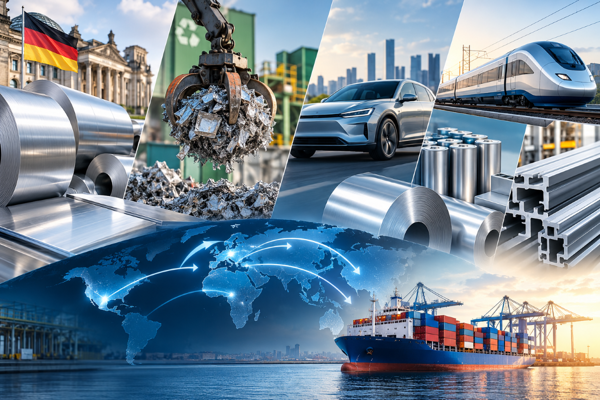
AL Circle analysis: Germany’s aluminium trade surplus, Novelis’ US expansion, Asia’s EV demand & India’s underutilised downstream capacity
Aluminium’s next growth phase is increasingly being shaped by downstream processing, supply-chain resilience and demand from specialised applications. Germany continues to generate a substantial trade surplus in flat-rolled products despite a shrinking primary aluminium base, while North America is investing in recycling and rolling. Across Asia, new manufacturing capabilities and growing demand from electric vehicles, railways and batteries are creating further opportunities. However, declining exports, underutilised capacity and uneven profitability show that investment alone does not guarantee success. For industry leaders, the challenge is to identify where demand is shifting, develop products that meet customer requirements and ensure that new investments translate into sustainable...
AL Circle Analysis: From Guinea to Gulf, how bauxite, tariffs and logistics redraw aluminium map
Aluminium markets in late 2026 are being shaped by more than the headline LME aluminium price. Bauxite security, alumina availability, geopolitical disruptions, tariff negotiations, logistics diversification and regional premiums are increasingly determining where metal moves and what buyers pay. From RUSAL reassessing Caribbean assets and Vedanta securing Odisha bauxite to Brazil extending mine life and EGA rebuilding its Guinea supply chain, producers are strengthening control over critical raw materials. At the same time, the US remains heavily dependent on imported bauxite and alumina, while Europe and Asia are experiencing sharply different premium dynamics. These developments point to a market where physical availability is becoming a regional factor even as aluminium itself remains...
Grow with
AL Circle

Aluminium and alumina lift Canadian manufacturing sales in February, primary metals hit record high
Canada’s manufacturing sector posted modest overall growth in February, but the aluminium and alumina industry carried the weight. According to Statistics Canada, total manufacturing sales rose by 0.2 per cent to CAD 72.9 billion, the sector’s highest level since September 2023. The increase was almost entirely driven by a sharp rise in primary metal sales, which grew by 8.3 per cent to reach a record CAD 6.9 billion. The main driver is the strong domestic and international demand for Canadian aluminium and alumina. Industry data shows that non-ferrous metals, particularly aluminium products, saw notable gains in both volume and value. Canadian producers benefitted from increased orders across key export markets, including the United States, Japan, and South Korea. In the United States,...

Q1 2025: Rio Tinto’s operational achievements on point with record-high bauxite production
Rio Tinto, the world’s second-largest metals and mining corporation, has reportedly demonstrated a positive start to 2025, achieving record-breaking quarterly bauxite output and setting a new monthly production high in March. Rightfully enough, Rio Tinto’s Chief Executive Jakob Stausholm said the company continued to deliver attractive growth in both operational and financial areas, generating substantial returns for shareholders and building a stronger and more diversified business. Production in focus In Q1 2025, Rio Tinto’s bauxite production reached 15 million tonnes, marking a significant Y-o-Y increase of 11.94 per cent from 13.4 million tonnes and a quarter-on-quarter decline of 3 per cent from 15.4 million tonnes. Alumina output was 2 million tonnes, up by 3 per cent Y-o-Y but...

Cheap Chinese aluminium is back! And it’s targeting Europe’s weakest link
When Romanian aluminium producer Alro sounds the alarm, it’s not just about Romania. It’s a signal to the entire European industrial complex: brace for a flood of cheap Chinese aluminium — and brace fast. Image source: Taihe Institute In a pointed public statement, Alro Chairman of the Board of Directors, Marian Năstase, warned of an imminent danger from Chinese aluminium imports priced below the cost of production. His message? Europe is sleepwalking into industrial decline while China quietly eats its lunch. “The [trade war] affects us, most of all, not necessarily because we cannot sell more on the American market, but because we will be invaded by goods from Asia, mainly Indonesia and China, which will come and suffocate the European market, no longer being able to go to the United...

Brazil’s bauxite-gallium pact potent for an inflexion point in the global aluminium production
In a landmark development for the metals sector, Brazilian Rare Earth (BRE) and Rio Tinto have signed a revised agreement to advance the Amargosa bauxite‑gallium project in Bahia, Brazil. This collaboration seeks to unlock one of the highest‑grade undeveloped gallium prospects in the world while securing a fresh source of bauxite, the critical feedstock for aluminium smelting. With global aluminium markets navigating tight supply dynamics, surging demand in green technologies and construction, and price volatility, the Amargosa pact arrives at a pivotal moment for the industry. Image source: https://www.ainvest.com/ The Amargosa project Located in north‑eastern Brazil, the Amargosa tenement neighbours BRE’s rare‑earth holdings and hosts both high-grade bauxite and significant gallium...

Ghana charts bold bauxite future with 6 million tonnes production target by GBC
Ghana is positioning itself to become a key player in the global bauxite industry while simultaneously developing a fully integrated aluminium sector. With an estimated 900 million tonnes of bauxite reserves primarily located in Awaso, Nyinahin, and Kyebi, the West African nation is committed to leveraging its natural resources to boost bauxite production and drive sustainable economic growth. In line with Ghana’s future roadmap, Ghana Bauxite Company Limited (GBC), jointly owned by Ofori-Poku Company Limited (OPCL) and the Government of Ghana, aims to achieve a production of 6 million tonnes of bauxte in a year by the end of 2025. Upgrading infrastructure and operational efficiencies would be the key requirement to attain the 6 million tonnes goal. GBC, by investing USD 122.97 million,...

Cracks in the supply chain? US delisting Chinese stocks could open new doors for aluminium businesses elsewhere
The latest shot fired in the ongoing US-China economic standoff could have far-reaching implications for the global aluminium industry. Speaking in no uncertain terms, Scott Bessent, an economic advisor to former President Donald Trump, stated that “all options are on the table,” including the delisting of Chinese companies from American stock exchanges. While the statement is loaded with geopolitical overtones, its economic reverberations are particularly significant for the global commodities market — aluminium being one of the most affected. Image for referential purposes only and does not depict original scenario (source: https://www.smallcase.com/) This development comes at a time when global markets are already battling fragile supply chains, and it could become a turning point for...

Thailand seeks to strengthen US trade ties by cutting tariffs. Is it aiming to grow as a key aluminium scrap hub amid China’s retreat?
While many countries are retaliating against the United States with counter-tariffs, Thailand is taking a different approach - considering reducing existing taxes on American goods. But why? The goal is to boost imports from the US and, in return, secure a favourable trade deal from the Trump administration. Image source: Trends Research & Advisory Thailand is among the countries hit with a steep tariff rate of 36 percent—significantly higher than expected. Despite this, Deputy Prime Minister Pichai Chunhavajira stated the Thai government was in no rush to initiate talks with the US. Rather, they chose to wait until their proposals were prepared. Mr Pichai will now take the proposals forward for negotiations. The Thai government aims to establish a balanced trade relation with the United...

Tariffs paused, and Sensex rose, but India’s metal markets are still jittery
The United States President, Donald J Trump, has announced a partial reprieve (a chunk of the additional ones, actually) from his reciprocal tariff imposition till July 9, 2025. India, which had been hit with a 26 per cent reciprocal tariff effective from April 9, has caught a temporary breather. But analysts warn — now is not the time for aluminium producers to let their guard down. The announcement to reprieve India and others from reciprocal tariff In a post on Truth Social, Trump declared, “Based on the fact that more than 75 countries have called representatives of the US to negotiate a solution and that these countries have not, at my strong suggestion, retaliated in any way, shape, or form against the United States, I have authorised a 90-day pause, and a substantially lowered...

Here’s why Germany is buying while the US and China snooze in the global bauxite market
March has ushered in a striking divergence in the global bauxite landscape — North America and Asia are grappling with bloated inventories and cooling offtake. Au contraire, Europe, led by Germany, is scrambling to source feedstock amid a sudden uptick in industrial appetite. ChemAnalyst’s latest analysis flags this three-way split as ’a phase of divergence’ for bauxite prices and availability. The US: Surplus meets scepticism On this side of the Atlantic, producers and traders are wrestling with rising stockpiles and diminishing downstream demand. American bauxite prices have slipped as domestic mills and importers bulk up on material even as aluminium smelters pause expansion plans. There have been expansions in production houses, such as Bengang Plates Co.’s joint venture with Ansteel...

Not 104%, but 129%! Will China see additional 50% duty? Impacts spread across borders…
China’s ‘blow-for-blow’ strategy in response to the United States' 34 per cent reciprocal duty apparently leads to the addition of another round of tariff to the existing thread. On Tuesday, April 8, the US government threatened to impose an additional 50 per cent tariff on all Chinese products in retaliation, bringing the total tariff on China to 104 per cent. But this figure is not the full story. When accounting for the 25 per cent tariff on aluminium and steel imports that the United States imposed in March, the total tariff on China rises to a staggering 129 per cent. Image generated by AI for representational purpose The latest threat of a 50 per cent tariff is scheduled to take effect at midnight (CST time zone) on April 9, 2025, which was set as a deadline for China to reverse its...

‘Zero for zero’ off the table: Trump denies industrial goods tariff negotiation with EU
On Monday in Luxembourg, European Commission President Ursula von der Leyen formally put a “zero‑for‑zero” offer on the table. The EU would eliminate its tariffs on US cars and other industrial goods if Washington reciprocates by dropping its own levies to zero. The proposal comes just days after President Trump announced a 20 per cent tariff on virtually all remaining EU imports and a 25 per cent rate on steel, aluminium and autos, a move Brussels says threatens integrated supply chains on both sides of the Atlantic. However, US President Donald Trump has declined the offer and stood by his previous decision, stating to reporters at the White House, “The European Union has been very, very bad to us; they don’t take our cars, like Japan in that sense, they don’t take our agricultural...

Top 5 aluminium can exporters to the US — And why America still imports
The US produces a large quantity of beverage cans domestically. But, it isn't enough to cater to the country's need. Import takes up a large portion of the aluminium trade in the stance of the United States. And among these inbound trade comes the aluminium can which is an intergral part of America's gastronomy as well as beverage industry. As the new tariffs are part of an aggressive tariff policy by US President Donald Trump that has impacted the global system of international trade, the Bureau of Industry and Security (BIS) announced the inclusion of two products to the additional 25 per cent Section 232 tariffs on aluminium-derived products. These products are classified as follows: HTSUS 7612.90.10 (empty aluminium cans) and HTSUS 2203.00.00 (beer). The newly added item in the list,...

Jan-Feb 2025: alumina production grows 4.4% worldwide, powered by China’s capacity expansion
During January-February 2025, the world's metallurgical-grade alumina production recorded an impressive increase of 4.41 per cent, reaching 23.015 million tonnes versus 22.043 million tonnes a year ago. In both January and February, the output increased Y-o-Y by 6.77 per cent and 1.89 per cent, totalling 12.149 million tonnes and 10.866 million tonnes, respectively. As per the data shown by the International Aluminium Institute, metallurgical-grade alumina production in February 2025 grew Y-o-Y from 10.664 million tonnes, despite a fewer operational day, with the daily average output reaching 388,100 tonnes versus 367,700 tonnes in February 2024. Thanks to China's expanded alumina refining capacity that drove the growth of global output, offsetting declines across all other major...

Indian aluminium’s RE open access as a part of heavy industries to benefit net-zero goals
In the dynamic industrial landscape of India, heavy industries such as aluminium, steel, and cement are on the brink of a renewable revolution. Traditionally reliant on captive coal generation, these sectors now face a transformative 20 GW solar open access opportunity, a prospect that promises to slash production costs and reduce carbon emissions by up to 29 million tonnes annually. For instance, the steel sector alone, which contributes around 9.4 GW to this market, could see production costs drop by up to 10 per cent in setups like standalone arc furnaces, thanks to a shift from expensive grid power to open-access solar. Meanwhile, cement and aluminium, despite their ongoing reliance on captive coal, add another 11 GW to the potential. Aluminium, a cornerstone of India’s power sector,...

Brazil’s aluminium can sales hit historic 34.8 billion units – resultant of GDP, sustainability, advertising & more
In an interview with AL Circle, Mr Cátilo Cândido, Executive President of the Brazilian Association of Aluminum Can Manufacturers (Abralatas), highlighted that Brazil's robust and dynamic economy—particularly the rising purchasing power of its population—drives the demand for soft drinks and, consequently, aluminium cans. With a GDP of USD 2.17 trillion and a per capita consumption of 165 12-can packs annually, Brazil is home to the world's fastest-growing aluminium can market. In 2024, Brazil reached a historic milestone, with aluminium can sales in the beverage sector totalling 34.8 billion units. This achievement positioned the country as the third-largest aluminium can market globally, according to Abralatas. The growth rate averaged 7.6 per cent year-on-year, surpassing the 5 per...

Will all EU votes favour countermeasures? 9 EU nations’ notion revealed as US tariffs take effect…
Voting is in the pipeline to decide the fate of US imports into the US. In an effort to determine whether the countermeasures to the United States steel and aluminium tariffs are going to turn into reality, each EU member is set to vote on April 09, announced a senior EU official. This image is created with the assistance of AI tool for referential purposes only The Commission’s proposal of counter-tariffing big tech companies such as Elon Musk’s social network X and search engine giant Google, as well as major financial institutions like J.P. Morgan and Bank of America, will only be approved as long as it is not opposed by a qualified majority of 15 member states encompassing 65 per cent of EU population. Ahead of the voting and shortly after the ‘liberation day’ tariff was announced,...

In the Indian tariff league, let’s analyse which wins: Tit-for-tat tax or Tariff 2.0
The trade battleground is heating up as US President Donald Trump announces reciprocal as well as a bout of tariff on ‘Liberation Day,’ and India has found herself at the centre of a high-stakes of the sparking trade war. The United States slapped with a 26 per cent tariff on Indian goods, and it seems the brunt is going to be strongest for gems and jewellery along with electronics product export. Is India’s aluminium industry bracing for impact, too? It shouldn’t, at least not yet, as the auto and auto parts have been exempted from the latest tariff announcements apart from the original 25 per cent slab. Alongside, amid the chaos, does India have an overall upper hand? Let’s find out. The US has been steadily tightening its tariff grip, as certain Indian goods already face a 25 per cent...

New US tariff on aluminium cans, beer and automobiles: who will shoulder the burden between exporters and consumers?
As the world awaited the United States' reciprocal tariffs on April 2, 2025, President Donald Trump caught everyone off guard with a new move: a 25 per cent duty on imported beer & aluminium cans and assembled automobiles & car parts. This did not mean that Trump exempted his trade partners from reciprocal tariffs; rather, he simply added another surprise to the mix. As per the report, tariff on beer and empty aluminium cans will take effect on Friday, April 4, at 12:01 a.m. Eastern Time, while cars and car parts will face the duty a day earlier. Already, this new tariff announcement has sent shockwaves through businesses worldwide, sparking speculation about the potential impacts on trade dynamics, price structures, and consumer sentiment. Concerns in the beer and can market In 2024, the...

