

AL Circle analysis: Germany’s aluminium trade surplus, Novelis’ US expansion, Asia’s EV demand & India’s underutilised downstream capacity
Aluminium’s next growth phase is increasingly being shaped by downstream processing, supply-chain resilience and demand from specialised applications. Germany continues to generate a substantial trade surplus in flat-rolled products despite a shrinking primary aluminium base, while North America is investing in recycling and rolling. Across Asia, new manufacturing capabilities and growing demand from electric vehicles, railways and batteries are creating further opportunities. However, declining exports, underutilised capacity and uneven profitability show that investment alone does not guarantee success. For industry leaders, the challenge is to identify where demand is shifting, develop products that meet customer requirements and ensure that new investments translate into sustainable...
AL Circle Analysis: From Guinea to Gulf, how bauxite, tariffs and logistics redraw aluminium map
Aluminium markets in late 2026 are being shaped by more than the headline LME aluminium price. Bauxite security, alumina availability, geopolitical disruptions, tariff negotiations, logistics diversification and regional premiums are increasingly determining where metal moves and what buyers pay. From RUSAL reassessing Caribbean assets and Vedanta securing Odisha bauxite to Brazil extending mine life and EGA rebuilding its Guinea supply chain, producers are strengthening control over critical raw materials. At the same time, the US remains heavily dependent on imported bauxite and alumina, while Europe and Asia are experiencing sharply different premium dynamics. These developments point to a market where physical availability is becoming a regional factor even as aluminium itself remains...
Grow with
AL Circle

Will a 15% customs duty strengthen India’s domestic aluminium industry and curb import pressure?
The proposed 15 per cent customs duty on aluminium and its downstream products is set to bring a new outlook to India’s aluminium sector, reshaping its trade dynamics and strengthening domestic resilience. In FY 2024–25, India’s aluminium production capacity, including downstream products, stood at 6.4 million tonnes, while domestic demand was 4.9 million tonnes — clearly showing that India can comfortably meet its own requirements and export the surplus. The country also exported 2.23 million tonnes of aluminium and downstream products during the fiscal year. However, despite this surplus, India imported around 3 million tonnes of aluminium — including primary, alloyed, unwrought, and fabricated forms. These imports, largely from China and Gulf-based producers, are not driven by a...

Ball Corporation Q3: A 144-year legacy holds with victorious survival amidst 2025 trade gusts
Just after Ball Corporation celebrated 90 years in the can manufacturing business, stakeholders cautiously rejoiced yet again as its third quarter felt a lot less like a wobble and more like a careful pivot wherein numbers whispered “steady” if anyone listened closely. Explore- Most accurate data to drive business decisions with 50+ reports across the value chain Why cautious? The turmoil of tariffs is yet to blow off. Then why rejoice? For the third quarter of 2025, which ended on September 30, 2025, Ball Corporation reported net earnings attributable to the company of USD 321 million, or total diluted earnings per share of USD 1.18 on sales of USD 3.38 billion. Dig beneath the headline and you find the shape of a business that is squeezing more activity from the same...

China Q1-Q3 GDP up 5.2 per cent energy and chemical demand shifts to high-end, green sectors
China's GDP expanded 5.2 per cent y-o-y in the first three quarters of 2025 (Q3: +4.8 per cent ), supported by resilient consumption and steady exports that offset persistent investment weakness. Energy and chemical demand are increasingly driven by advanced manufacturing and green transition needs, while upstream price recovery has raised concerns about profit divergence along the value chain. Explore- Most accurate data to drive business decisions with 50+ reports across the value chain Consumption Drives Growth as Investment Weakens Consumption was the main growth engine, contributing 53.5 per cent to GDP in the first three quarters (Q3: 56.6 per cent ) and adding 2.8 percentage points to overall growth. Service consumption grew 5.2 per cent, with double-digit gains in sports, culture...

India’s solar revolution finds its next frontier in Rajasthan’s 2.45 GW mega park
Rajasthan is spearheading India’s solar revolution with the launch of the country’s first mega solar park, the 2.45 GW Pugal Solar Park in Bikaner, integrated with a 5 GWh BESS. Developed by RSDCL under RRECL, the project marks a pivotal step in strengthening large-scale renewable infrastructure, supported by robust transmission development from RVPN and a full offtake guarantee from the State government. India's current renewable energy scenario India hit the total renewable energy (RE) capacity, in terms of installed power capacity, by almost 45 per cent by July 2025. This marks a high growth trajectory for solar energy, leading by 50 per cent, followed by hydro at 23 per cent and wind at 22 per cent. The government is incorporating initiatives, including the National Green Hydrogen...

World primary aluminium production growth eases to 1% in 9 months - hit by China's cap, high energy costs and much more
What is up with the primary aluminium production at the end of the third quarter 2025 - wonders many people, especially with China nearing its 45 million tonnes cap, Australia grappling with energy crisis, and North America shifting its focus to secondary aluminium. Till the end of June, the world primary aluminium production was found stable, although with a few random shifts in dynamics, standing at 36.5 million tonnes – up by 1.4 per cent from 36 million tonnes a year ago. Even the quarterly production climbed up the graph from 18.115 million tonnes in Q1 2025 to 18.377 million tonnes in 2025. Growth persists but at a cooler pace Now, it remains to be seen whether the trend will persist through Q3 or take a different course over the next three months. Ultimately, we will assess whether...

How submarine cables are connecting Africa and the world beneath the waves
Below the ocean’s surface lies one of the world’s most important but least visible infrastructures — a vast network of fiber-optic cables stretching more than 1.48 million kilometres across the seabed as of early 2025. These undersea lines carry close to 99 per cent of all global data traffic, forming the foundation of the digital economy. Every time someone makes a video call, sends a message, or completes an online transaction, that data races through this hidden network that silently binds continents together. Laid far beneath the waves, these cables have become the arteries of the modern world — fast, resilient, and absolutely indispensable. The invisible road of the internet Submarine cables send data as light signals through thin glass fibres, carrying enormous amounts of...

WEEKLY: Chinese alumina prices edge lower; stocks top three-year high
China's alumina prices in the spot market continued to fall last week, though at a slower pace, as overall supply remained abundant despite minor production disruptions in North China. Image for referential purposes only Explore- Most accurate data to drive business decisions with 50+ reports across the value chain Mysteel assessed the national average spot price for smelter-grade alumina with a purity exceeding 98.6 per cent at RMB 2,909 per tonne (USD 409 per tonne) on October 30, down by RMB 21 per tonne or 0.7 per cent from a week earlier. The drop was narrower than the 1 per cent decline recorded the previous week, Mysteel Global noted. The slower rate of decline reflected slightly better sentiment among some alumina producers and traders last week, supported by small-scale output...

Is the US fighting hard enough to keep its aluminium in-house from competitors like China?
Aluminium industry leaders say the United States is unwittingly ‘leaking’ a strategic resource by exporting vast quantities of scrap metal even as domestic makers scramble for feedstock. The Aluminum Association’s new “Scrap The Exports” campaign notes that the US currently exports roughly 2 million tonnes of aluminium scrap each year, nearly half of what the country recycles. Image source: https://www.aluminum.org/ Explore- Most accurate data to drive business decisions with 50+ reports across the value chain “Scrap aluminium is a vital feedstock for American manufacturers, especially at a time when US aluminium firms are investing and need reliable and affordable access to metal like never before,” says Charles Johnson, president and CEO of the Aluminum Association (AA). By losing...

Tariff turmoil: US push for self-reliance triggers a global rewire of medical supply chains
The United States’ tariff overhaul in 2025 has reshaped the landscape of the global medical equipment industry. What was intended to revive domestic manufacturing and lessen reliance on foreign suppliers has instead caused widespread disruption — pushing up hospital costs, straining supply chains, and forcing manufacturers to reconsider their global production strategies. Tariffs stretch across major partners The new framework, introduced on April 2, 2025, imposed a 10 per cent duty on nearly all imports, covering medical consumables, diagnostic equipment, and manufacturing machinery. The move ended decades of largely duty-free trade with long-standing partners such as the European Union. China remains the biggest target. Its medical exports to the US are now hit with tariffs of up to 245...

A glance of China oil market
On the demand end, the gasoline consumption will remain soft in the traditional seasonal low, while the gasoil consumption lacks strong support in the near term, with downstream players mostly on the sidelines. China's #92 gasoline prices edged down with a weekly cut of 0.76 per cent, and #0 gasoil prices were flat in the reporting period (October 24 - 30) compared with the previous session though the crude prices closed the session with growth. The Chinese government lowered the refined oil guiding retail prices in the last round of price adjustment, which prompted some end-market players to stockpile appropriately. But the demand end was relatively flat, and the transactions rarely improved. Some state-owned refineries' sales offices launched promotion campaign to boost the sales by...

Recycled ALuminium outlook: demand surge, capacity race, and the policy forces shaping it all
Over the years, the global aluminium recycling market is on an upward trajectory, with recycled aluminium usage standing at 27.7 million tonnes in 2023 and 28.4 million tonnes in 2024, driven by the growing focus on sustainability, renewable energy and circular economy practices. AL Circle’s comprehensive industry focus report, titled: “ World Recycled ALuminium Market Analysis Industry Forecast to 2032 ”, highlights that by the end of 2032, the global aluminium recycling market size is poised to grow at a CAGR of 4.62 per cent from USD 107.05 billion in 2023 to USD 160.8 billion. Demand forecast in line with usage What is driving this growth? Certainly, the growing demand for recycled aluminium and renewable energy products. Rusal forecasts the incremental global demand for aluminium is...

Trump’s new tariffs on MHD vehicles accelerate US domestic output
The Trump Administration has expanded the scope of US trade protection measures, introducing new Section 232 tariffs on medium- and heavy-duty vehicles (MHDVs), including trucks, buses, and related components. According to the US Department of Commerce, the decision addresses national security concerns arising from increasing import dependence in these critical industries. The administration concluded that reliance on foreign suppliers has weakened domestic manufacturing capacity essential for military logistics, emergency response, law enforcement, and infrastructure operations. New tariffs reshape the US heavy-vehicle industry Under the new order, MHDVs, including Class 3 to Class 8 vehicles such as large pickup and box trucks, and components such as engines, transmissions, and tires,...

DAILY: China's spot alumina prices halt nearly two-month decline
Mysteel's assessment of the national average spot price for metallurgical-grade alumina with purity exceeding 98.6 per cent remained unchanged from the prior day at RMB 2,909 per tonne (USD 409 per tonne) on Thursday, ending a persistent downtrend since September 2. The price stabilisation came amid steady offers across China's five major alumina production hubs. The assessed alumina prices for the same grade in Shandong, Henan, Shanxi, and Guizhou provinces and in the Guangxi autonomous region all held firm within the range of RMB 2,795–3,020 per tonne, according to Mysteel's daily price assessment. Most alumina producers and traders tabled firm offers for their alumina stocks in anticipation of a potential reduction in alumina supply in the near term following heavy air pollution alerts...

Strong industrial gains and persistent systemic gaps — inside the state of US aluminium recycling
The aluminium recycling landscape in the United States in 2025 presents a contradictory picture — one of notable progress alongside persistent challenges. Recent data from the International Aluminium Institute (IAI), the Aluminum Association, and other industry sources show that aluminium remains among the most recycled and valuable materials in the world. Yet, even with a strong industrial base, the country still faces hurdles. Uneven consumer participation, varying state policies, and an imbalanced scrap supply continue to slow America’s progress toward a fully circular economy. Industrial backbone, global ties Recycled aluminium now makes up more than 80 per cent of all aluminium produced in the US, showing how dependent the country has become on secondary metal coming from industries...

A billion-dollar plan or a trillion-dollar risk? Inside the US–Australia rare earth & critical minerals deal
The United States and Australia have officially shaken hands to boost the supply chain for rare earths and other essential minerals. This strategic agreement aims to lessen their dependence on China's market control. Australian Prime Minister Anthony Albanese pointed out that this partnership will support a series of "ready-to-go" projects valued at USD 8.5 billion. With the rising demand for rare earths and critical minerals, China has begun to limit access to these supplies in response to new US tariffs and ongoing tensions. China currently holds a staggering 70 per cent of the world's rare earth mining and an impressive 90 per cent of the processing of these essential materials. These rare earths are crucial for a wide range of products, from defence equipment to computer chips and...
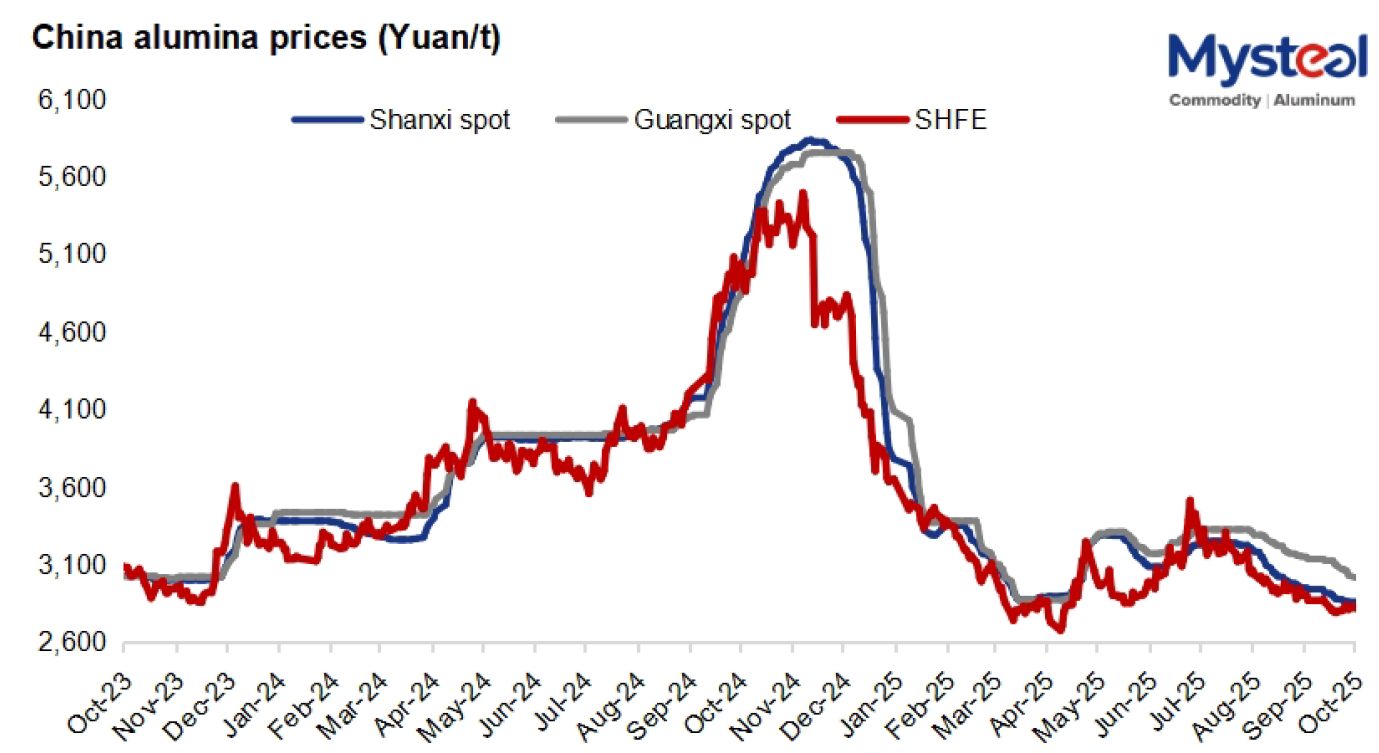
Mysteel: China alumina prices continue downward trend amid oversupply
On Oct 28, Mysteel daily assessments for Shanxi spot alumina were RMB 2,830-2,880 per tonne, EXW and including VAT, down RMB10 per tonne from a week ago, and assessments for Guangxi spot cargo were RMB 2,990-3,040 per tonne, down RMB 50 per tonne on week. SHFE most-traded contract closed at RMB 2,817 per tonne, up RMB 7 per tonne on week. The price decline in China's alumina market slowed down last week. However, the pessimistic sentiment remains unchanged. We observed high alumina supply and elevated alumina stocks in China, which remained major drivers for the downward trend. On the supply side, China's alumina operating capacity stood above 97 MTPA last week. Despite shrinking margins in the alumina sector, most refineries still maintained high and stable run rates. This, combined with...

African entity plans to boycott externals & empower local processing for aluminium value-chain
During the swearing-in ceremony of the new President of the African Export-Import Bank (Afreximbank), George Elombi set the tone for what could be Africa’s next industrial revolution. “No more Nigerian bauxite, or Gabonese manganese, or Cameroonian bauxite, or South African bauxite, raw. We are not interested,” Elombi declared, adding, “We will focus on domestic processing. This has numerous benefits.” Image source: https://www.indiamart.com/ Numbers talk truth and so you should follow them from our exclusive industry report ' A Comprehensive Analysis of Bauxite Residue - Red Mud ' to stay ahead! Africa has long faced a familiar paradox in its metals and mining complex — abundant raw-material endowment, yet limited downstream value capture. With Afreximbank launching a dedicated financing...
China's natural gas demand gains seasonal momentum as imports rebalance and domestic supply expands
China's natural gas market is entering the fourth quarter with firmer consumption fundamentals. October demand is projected to stay elevated amid heating preparation, resilient transport fuel use, and steady industrial recovery, while import dynamics show a gradual shift toward pipeline gas. Steady demand recovery: Industrial and residential consumption are firming as northern heating needs pick up and factory activity improves. Gas-fired power plants are maintaining high operating rates, offsetting lower hydropower output. Domestic output expansion: New upstream projects and efficiency gains in major producing regions supporting output stability in the near term. Import structure shift: Pipeline inflows are strengthening, while LNG arrivals have eased amid softer international prices and...

