A year’s gap and the performance of Century Aluminum, the US-based leading primary aluminium producer, has gone opposite ways. Though the aluminium manufacturer is still in the safe zone in terms of financials, the shipments and sales figures tell an altogether different tale.
Image source: https://centuryaluminum.com/
Explore- Most accurate data to drive business decisions with 50+ reports across the value chain
The year has been defined by energy volatility and thin inventory conditions across the aluminium chain, and now Century Aluminum has entered the final quarter of 2025 with a relatively clearer air and a stronger footing. The company’s third-quarter number state steady plant performance where it matters, responsive cost management, and a market that is finally giving US smelters some room to breathe.
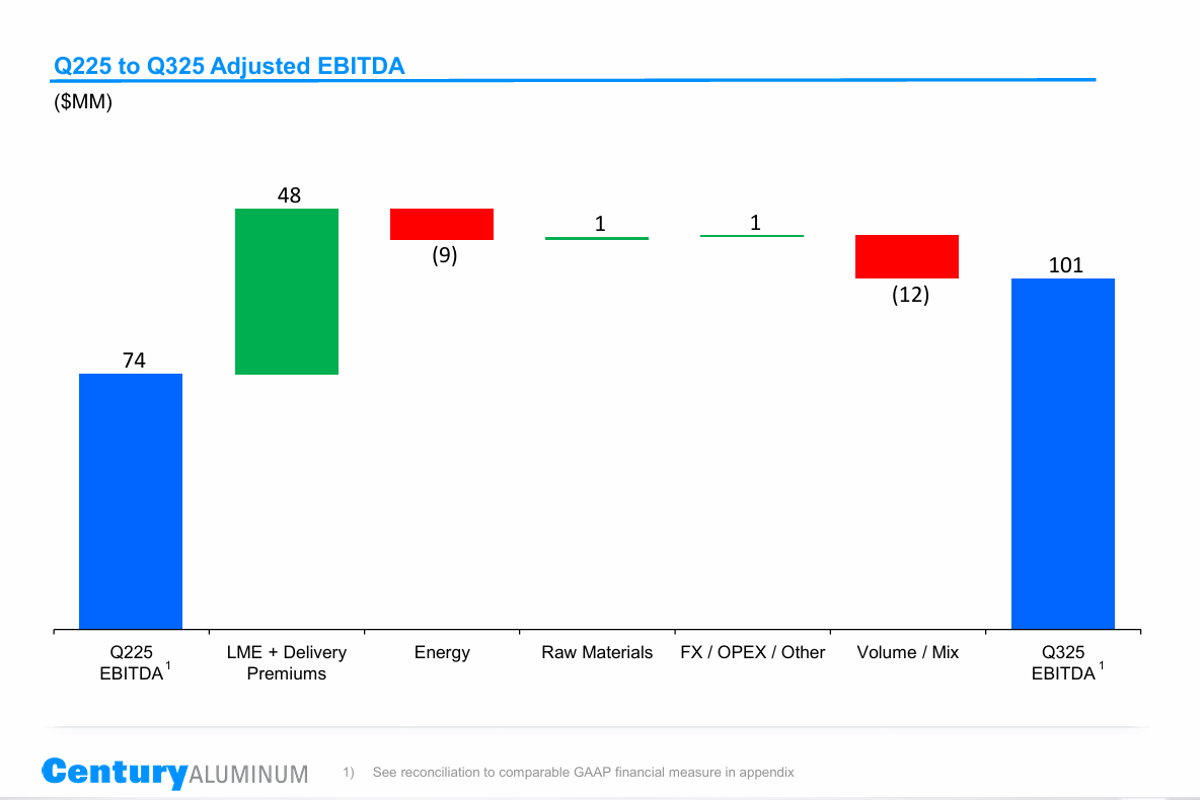
The headline result was an Adjusted EBITDA of USD 101 million in Q3, up from USD 74 million in Q2, a clean reflection of price and premium momentum more than any one-off accounting gain. Au contraire, the company posted a 203 per cent (USD 103.7 million) jump in Adjusted EBITDA for Q3 2024, only driven by rising aluminium shipments and LME prices, which was definitely not the case this time.
Shipments totalled 162,442 tonnes, down from 175,741 tonnes in Q2 and even down Year-on-Year from Q3 2024 shipments of 168,755 tonnes. At the same time, net sales increased to USD 632 million from USD 628 million, a direct pricing and premium play. Net sales for the third quarter of 2024 were USD 539.1 million, reflecting a 34.07 per cent Y-o-Y increase.
Simultaneously, an increase in Net income swung to USD 15 million, from a USD 5 million loss in the prior quarter.
Adjusted net income doubled to USD 58 million, while liquidity rose sharply to USD 488 million, up from USD 363 million at the end of June.
The liquidity improvement was not incidental. Century completed a bond refinancing that pushed cash balances to USD 151 million, up from USD 41 million, and subsequently repaid the Iceland casthouse facility in October. Just as importantly, the company received the 45X production tax credit refund of USD 75 million in October, a meaningful cushion in a sector where cash flow can shift violently with price swings.
Notably, net debt increased to USD 475 million. But management’s capital stance remains unchanged, with a liquidity target of USD 250-300 million, a net debt target of approximately USD 300 million, and growth capex activated only once those baselines are secure.
Don't miss out- Buyers are looking for your products on our B2B platform
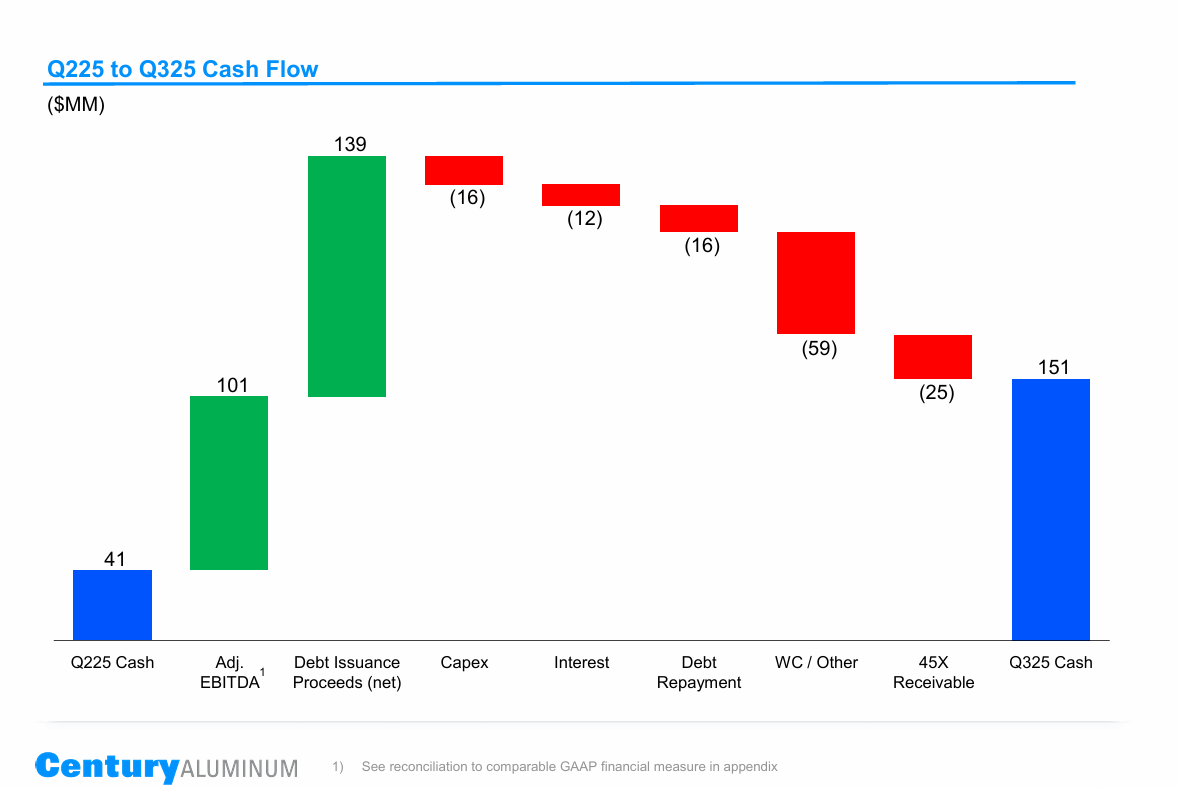
Image source: https://centuryaluminum.com/
This quarter unfolded in the context of an aluminium market that continues to defy gravity. LME aluminium prices pushed to their highest level since 2022, while the US Midwest Premium held around USD 1,450 per tonne on average, a level that had once seemed a pandemic-era anomaly. Inventories, meanwhile, remain historically thin at just 47 days of global consumption.
The billet market, ever a forward indicator of downstream softness or recovery, is sending its own signal. Century expects FY2026 US billet upcharges to be higher by roughly USD 110 per tonne, implying either confidence or fear, depending on whether one sits upstream or downstream. The message is that the US value-added market is tightening, and the reshoring conversation is no longer theoretical.
On the production and operational front
Despite the broader operational stability, Century’s production footprint continues to reflect the structural realities of the US smelting landscape. Hawesville remains fully curtailed, with its 250,000-tonne capacity still offline, putting forth the long-running energy economics challenge in US primary metal.
Across the system, Century is currently operating at roughly 70 per cent of its total 1.02 million tonnes of smelting capacity, even as Grundartangi and Sebree run at full output and Mt. Holly holds at about 75 per cent, ahead of a planned restart of idle lines.
Upstream, the company’s Vlissingen carbon anode plant in the Netherlands is running at full capacity, supplying consistent feedstock stability, while Jamalco’s alumina refinery in Jamaica continues at around 80 per cent of its 1.4 million tonne capacity following the hurricane-managed restart.
The company’s Kentucky asset base has re-established its reliability. Sebree is operating near multi-year production highs, providing a stable tonnage platform that has been anything but guaranteed for domestic smelting in recent years.
At Mt Holly, instability earlier in the quarter briefly slowed shipments, yet the production issue has been resolved, and the restart of idle potlines remains on schedule for Q2 2026 — a timeframe closely watched across the industry for what it signals about US power contracting and smelter competitiveness.
The US is short roughly 4.2 million tonnes of primary aluminium annually, a structural deficit underwritten by decades of offshoring. Today, the country operates only four primary smelters, despite being the second-largest consumer market in the world. To address this gap, Century has secured up to USD 500 million in funding from the U.S. Department of Energy to develop the first new US primary smelter in 50 years, an asset intended to run predominantly on carbon-free power.
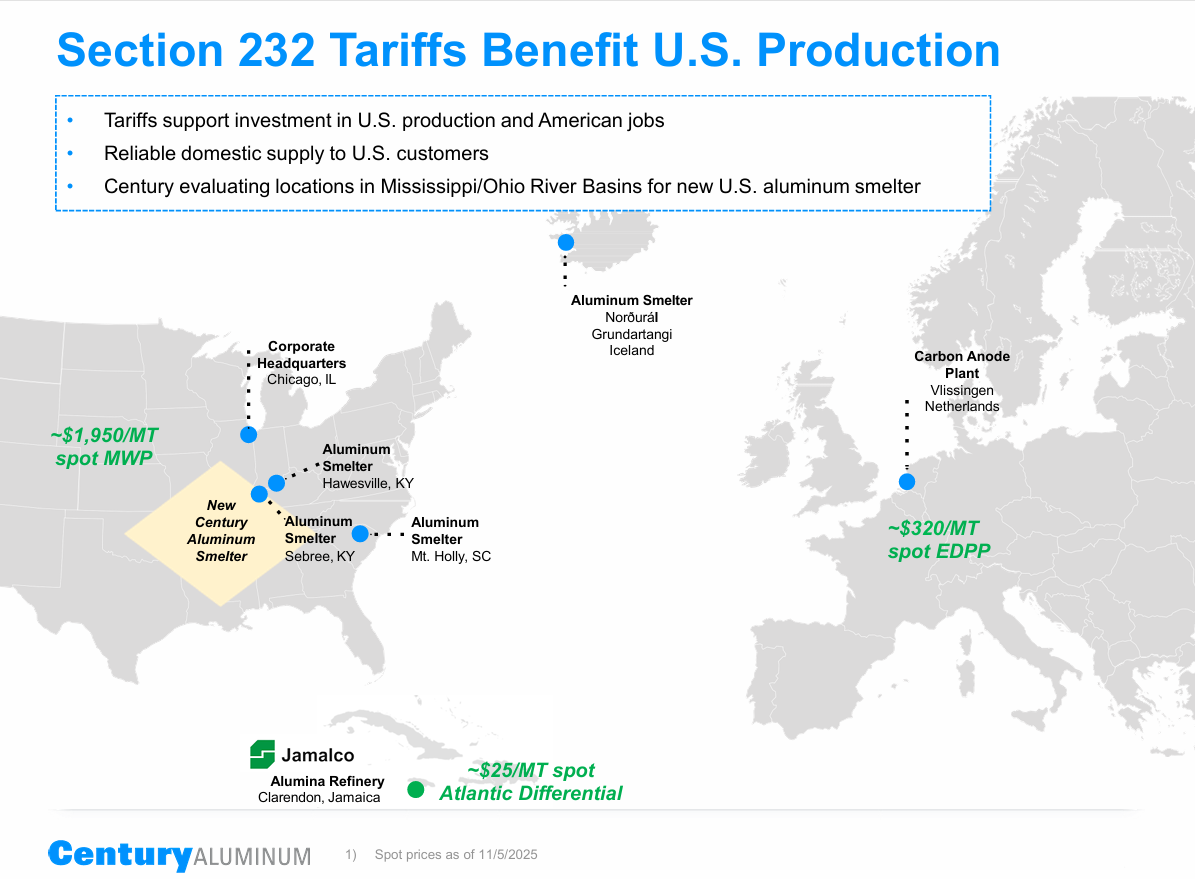
Image source: https://centuryaluminum.com/
This is not an incremental expansion
While site selection and energy sourcing are still in process, the vision is clear for reshoring for strategic autonomy, strengthening defence-linked metals supply chains, and restoring a domestic industry that once defined American industrial competitiveness.
The timing is not accidental. The Section 232 tariff framework remains intact, downstream buyers are rebalancing risk post-pandemic, and the geopolitical recalibration of metals sourcing is accelerating.
Looking into Q4, the company is not hedging the narrative. At the currently realised pricing, Adjusted EBITDA is expected to land between USD 170 million and USD 180 million. The biggest driver is pricing uplift, with limited expected pressure from energy or raw material inflation. In contrast to the volatility of recent quarters, this is the closest the sector has come to a stable forward view.
Must read: Key industry individuals share their thoughts on the hottest topics