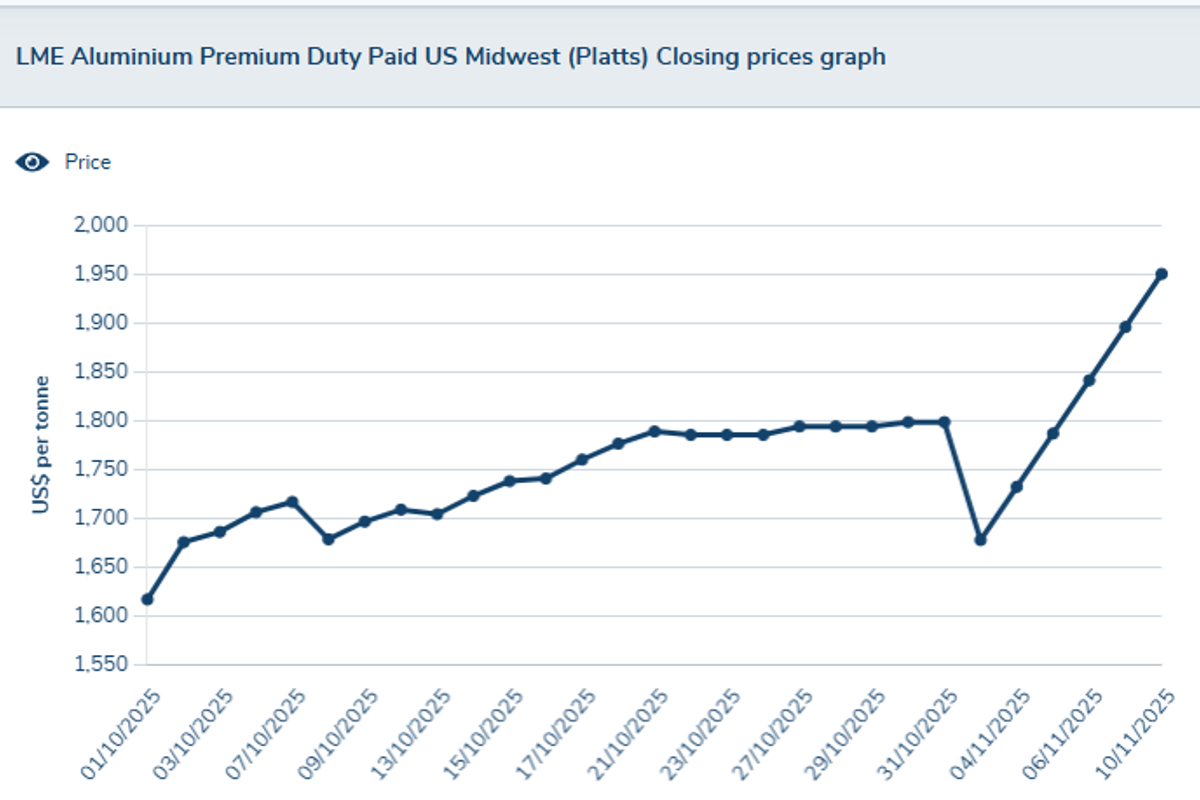
On the evening of November 10, 2025, Aluminium buyers in the US physical market witnessed history unfold as the Midwest Premium surged to an all-time high of USD 1,950.15 per tonne, striking a sharp growth of 2.87 per cent overnight from USD 1,895.72 per tonne.
The Midwest Premium, a surcharge on top of the London Metal Exchange (LME) price that reflects local delivery costs, logistics, and regional supply-demand dynamics, has become a direct casualty of US protectionist measures. Analysts attribute the latest spike to the combined effects of steep tariffs and mounting supply chain distortions, which have tightened domestic availability of the metal.
Surges over several months
However, this hike is not an overnight affair. The rally has been building steadily since the beginning of 2025. Although through January, the premiums remained range-bound, averaging USD 518.95 per tonne to USD 528.56 per tonne as of January 30, it started surging exponentially from February, attributed to the wave of uncertainty prior to tariff implementation. Over the succeeding two months, the premiums surged to USD 827.23 per tonne by the end of March 31, reflecting a surge of 59.4 per cent.
It was in the middle of March, when Donald Trump announced a 25 per cent tariff on aluminium imports. As an impact, input costs for firms using imported aluminium rose. Businesses faced pressure to either source more domestic aluminium or absorb higher imported material costs. As a result, imports into the United States, especially of primary aluminium, took a back seat at the end March 2025 from some of the suppliers. According to the US Geological Survey, the United States primary aluminium imports from Canada decreased Y-o-Y, standing at 707,000 tonnes versus 721,000 tonnes.
At the end of June 30, the premiums closed at USD 1,256.41 per tonne, recording an increase of 52 per cent. By the end of September 30, the price clocked at 1,616.93 per tonne, growing by 29 per cent. In June, the United States tariff on aluminium was raised by an additional 25 per cent, bringing it to 50 per cent.
Trade shifts reshape premiums structure
In tandem with the premium hike and steep tariffs, the US imports from Canada plunged further in Q2 2025, reaching 483,000 tonnes. That brought the consolidated import volume in six months to 1.17 million tonnes, down by 16.43 per cent from 1.4 million tonnes a year ago. Overall, the United States primary aluminium imports dropped at the end of H1 2025, amounting to 1.81 million tonnes versus 1.85 million tonnes during H1 2024.
Consultancy Harbor Aluminum reasoned that this downtrend in aluminium imports into the US, leading to weakening domestic stocks, triggered the hike in premiums, besides a strong conviction that tariffs would be permanent, especially after Canada and Trump called off trade negotiations in October.
US consumers are facing intense competition in sourcing aluminium also due to China's 45 million tonnes production cap.
Panmure Liberum analyst Tom Price expects an aluminium market deficit of 1.8 million tonnes this year, in line with a significant decline of 900,000 tonnes in China’s net exports of refined metal and semi-fabricated products to 1.9 million tonnes a year. While the production of aluminium outside China fell 1.1 million tonnes a year. Together, that’s a two million ton decline in aluminium availability outside China."
To know current market insights and price trends, download our in-depth reports here.
The question now is who ultimately pays for record-high premiums. The answer, as history shows, is shared across the value chain, but with varying pain points.
Industries with high aluminium intensity, such as automotive, beverage packaging, and building materials, are feeling the heat first. Ford Motor Company estimates an additional cost of USD 40 to 60 per tonne in vehicle production due to increased premiums, while companies like Ball Corporation and Crown Holdings have reported margin compression. At the onset of the US tariffs, analysts had assessed that steep duties would approximately raise the retail price by 2 per cent. Building materials incorporating aluminium have also seen a hike of 15 to 25 per cent since the tariffs took effect.
For consumers, the impact is unfolding in waves. Products with short cost cycles like beverage cans tend to reflect price increases within two to three months. Durable goods manufacturers, including automakers, may initially absorb the rise but eventually pass it through in later product cycles. Historically, 70 - 85 per cent of premium-related cost increases have been passed on to consumers, according to research from the 2018 tariff period.
To explore market opinion from industry leaders, read our curated e-Magazines.













_md.webp)








