Have the speculations of India’s staggering loss worth USD 4.56 billion from metal exports to the US post-tariffs come true? Statistics strongly disagree. In the January-March quarter (Q1) of 2026, India’s export value of primary aluminium to the United States surged by 43.64 per cent year-on-year to USD 154.66 million from USD 107.67 million. Is this upward streak likely to continue? Outlook strongly agrees.
A striking improvement can be noticed in the cumulative export value of India’s primary aluminium shipments to the US, which climbed to USD 387 million in 2025 from USD 173.22 million recorded in 2024, marking a 123.6 per cent hike.
Has the upward trend of 2025 been reflected in 2026?
As the US imports of primary aluminium from India surged by 17.2 per cent Y-o-Y to 146,000 tonnes (approx.) in 2025 from 124,600 tonnes (approx.) in 2024, Q1 2026 saw the upward streak in stronger terms.
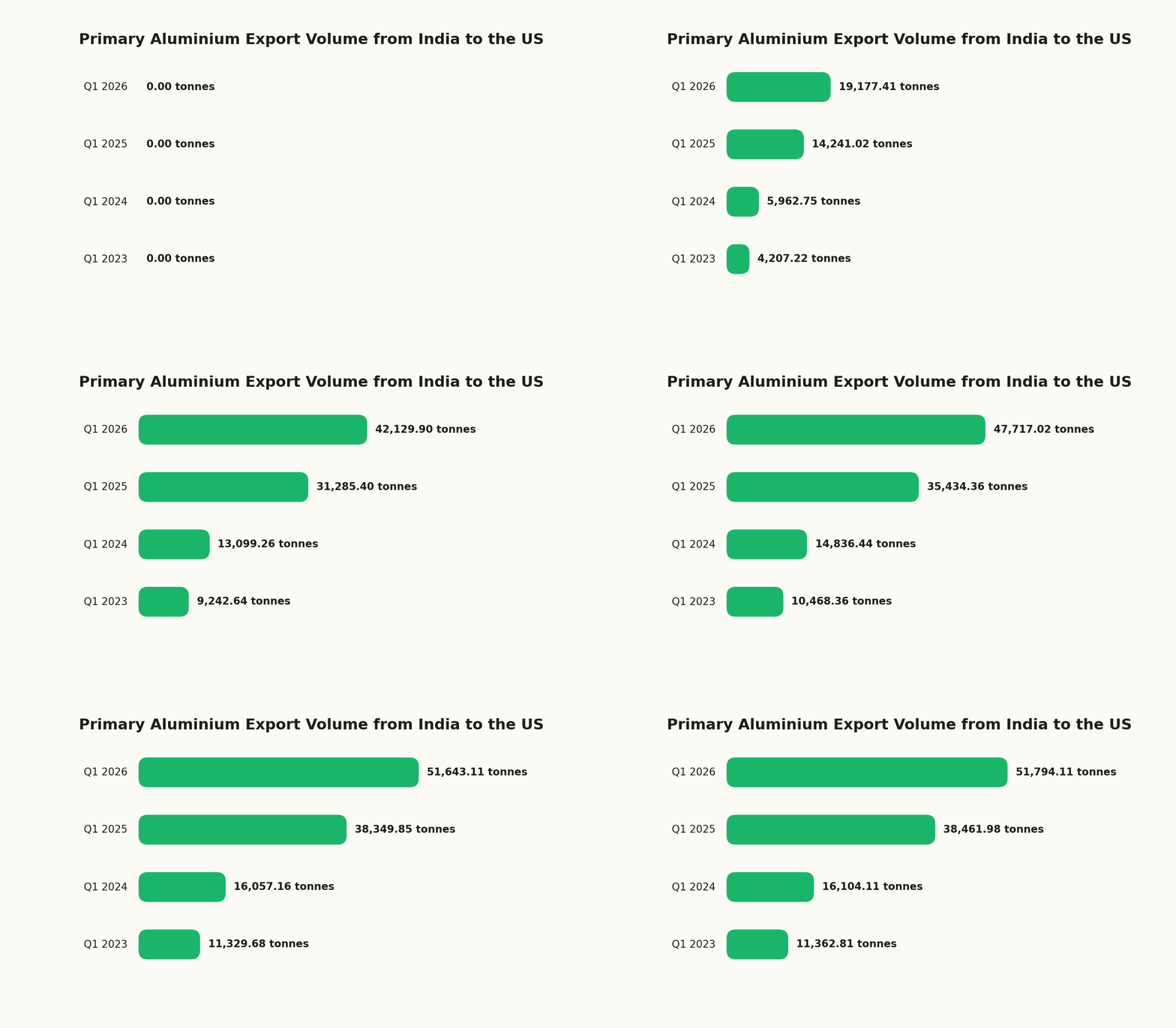
Looking closely, the quarterly figures of India’s exports to the US have steadily surged since 2024:
Q1 2026: 51,794.11 tonnes, up 34.66 per cent from Q1 2025
Q1 2025: 38,461.98 tonnes, up 138.83 per cent from Q1 2024
Q1 2024: 16,104.11 tonnes, up 41.73 per cent from 11,362.81 tonnes in Q1 2023
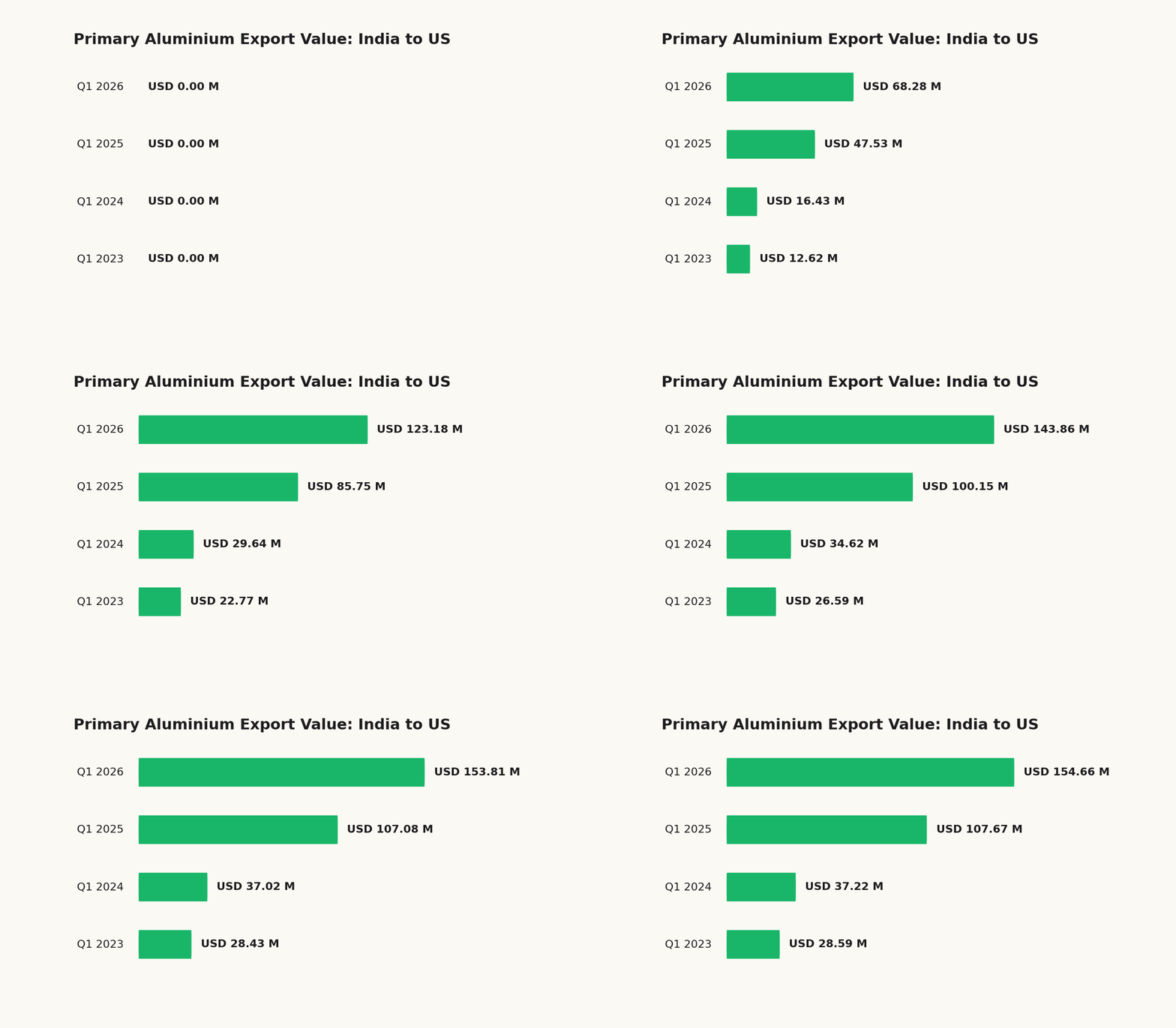
Interestingly, the spike has been starker in the value segment:
Q1 2026: USD 154.66 million, up 43.64 per cent from Q1 2025
Q1 2025: USD 107.67 million, up 189.28 per cent from Q1 2024
Q1 2024: USD 37.22 million, up 30.19 per cent from USD 28.59 million in Q1 2023
If the export graph has seen a consistent surge throughout the years, with the Q1 reporting Y-o-Y gains, have the US tariffs on imported aluminium under Section 232 of the Trade Expansion Act of 1962 left India free from danger in 2026?
The US continues to face a structural supply deficit in primary aluminium. Domestic smelting capacity has declined significantly over the years, leaving the country dependent on imports. Hence, even with higher import costs, US buyers still require substantial volumes of aluminium to support manufacturing activity.
Another factor is the limited ability of traditional suppliers to fully satisfy US demand. While Canada remains the largest source of primary aluminium for the US market, its production alone cannot always meet growing consumption requirements. This creates opportunities for alternative suppliers, including India, to increase shipments and capture additional market share.
Moreover, Canada’s exports to the US have continued to decline over time. While the export quantity in Q1 2025 stood at 707,602.22 tonnes, it fell to 488,448.81 tonnes in Q1 2026, reflecting a Y-o-Y decline of 30.97 per cent.
Supply diversification has also become a priority for many US buyers. In an effort to reduce dependence on a limited number of sourcing regions, manufacturers and traders have increasingly turned to reliable suppliers such as India. The country's expanding aluminium industry, stable trade relations and growing export capabilities have strengthened its position as an alternative source of primary metal.
Additionally, Indian aluminium producers also benefit from competitive production economics backed by integrated operations spanning bauxite mining, alumina refining and aluminium smelting. This cost advantage can help offset the impact of tariffs, allowing Indian metal to remain commercially attractive compared to some competing sources. The low-cost and high-quality products shipped from India may have also attracted the US buyers. Thus, Commerce Secretary Rajesh Agrawal stated, “Despite tariffs, we have been able to hold our exports” in 2025.
At the same time, elevated Midwest premiums in the US market have improved returns for exporters, partially compensating for the additional tariff burden and maintaining the attractiveness of the American market.
The three-month average of the US Midwest average aluminium pricing stood at around USD 2.49 in Q1 2026, up 63.82 per cent from the average of USD 1.52 in Q1 2025. Delving deeper, the Y-o-Y surge from Q1 2024 to Q1 2025 can also be noted as the figure spiked 28.8 per cent from USD 1.18. Consequently, the percentage boost in prices has been more accentuated than that in the volumes, thereby raising the export edge for India.
Delve deeper: How the American aluminium industry navigates through trade shifts, sustainability pressures, and rapid advances in manufacturing in the American Aluminium Industry: The Path Forward
Surging trend mirrors the 2019 scenario
The uptick in Indian aluminium exports to the US in 2025 and its continuity in 2026 have mirrored the original phase of the 10 per cent duty imposed by Donald Trump on Indian aluminium imports during his first term.
The volume rose by 1.24 per cent Y-o-Y from 180,684.02 tonnes in 2018 to 182,928.57 tonnes in 2019, although the nation sustained the tariffs at a much smaller scale.
The increase in India's primary aluminium exports to the US highlights a combination of strong American demand, constrained domestic supply, favourable market premiums, competitive Indian production costs and the need for diversified sourcing, all of which have outweighed the impact of tariffs.
Does 2026 look better for India?
The US tariff burden has been reduced from 25 per cent to 15 per cent in early February 2026. Therefore, with considerable relief of about 35 per cent from the 50 per cent levy introduced in August 2025, India is likely to benefit from the eased trade conditions.
Moreover, the Middle East conflict and the ensuing scenario offer India another window for export ramp-up. The 22 per cent of the US’ total imports from the Gulf Cooperation Council (GCC) nations have decreased in Q1 2026, having settled around 199,637.33 tonnes, down per cent Y-o-Y from 214,136.95 tonnes in Q1 2025.
As any development on the situation is going at a very slow pace, India currently stands at a vantage point to boost its primary aluminium exports and fill the Gulf deficit of 6.77 per cent, or 14,499.62 tonnes.
Note: This is exclusive coverage by AL Circle and may not be reproduced, republished or shared without prior permission.












_md.webp)
_md.webp)
_md.webp)







