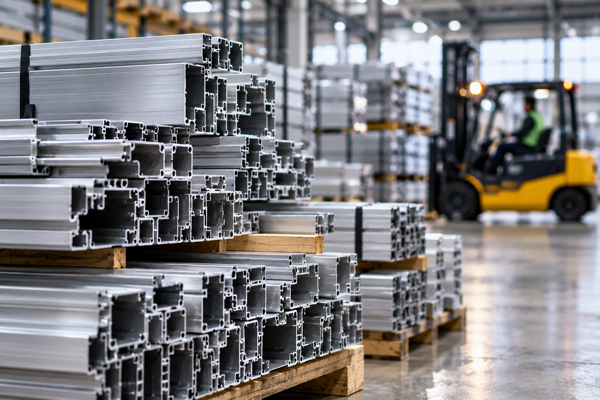
Profilgruppen reported a 14 per cent increase in third-quarter revenue to SEK 567.6 million (USD57.12 million), but the rise was driven mainly by higher metal prices rather than stronger demand. The Swedish aluminium profile producer delivered 6,850 metric tonnes of aluminium profiles during Q3 2026, down 6.8 per cent from 7,350 tonnes in the same period last year. Despite the higher revenue, operating profit under International Financial Reporting Standards (IFRS) edged down 1.7 per cent to SEK 28.6 million (USD 2.88 million) from SEK 29.1 million (USD 2.93 million) a year earlier. Under the company’s alternative accounting method, RAN, operating profit fell 37.5 per cent to SEK 3 million (USD 301,970), compared with SEK 4.8 million (USD 483,153) in Q3 2025. Net income under IFRS...
Aluminium’s downstream and end-user world is having one of those fortnights where a beer can, a luxury sports car, a German construction site and an Indian furnace all end up in the same conversation. The metal may begin its life far upstream, but its real fuss is playing out in cans, cars, extrusions, buildings and factories, where tariffs, trade policy, energy costs and demand cycles decide who wins. This fortnight highlights that aluminium demand is moving towards electric vehicles, lightweight transport and long-life infrastructure, even as packaging and construction feel the pinch of cost and weak activity. Meanwhile, producers from Vietnam to New Zealand are arguing over the oldest question in the business of how much protection, taxation or openness does a downstream industry need...
Grow with
AL Circle

In the current global downstream and recycled aluminium, every company is making crucial steps towards sustainability, circularity and better operational efficiency. With new regulations coming into play, smart investments being made and improvements in recycling and manufacturing practices, companies are stepping up to meet decarbonisation goals while also bolstering their supply chains and making the most of their resources. All these trends together are paving the way for a more organised and sustainability-focused future in the aluminium ecosystem. Ball Corporation, in its financial results for the year 2025 have represented impressive results in relation to maintaining and upholding sustainability. The firm has enhanced the use of renewable electricity by 84 per cent , representing a...

Glencore secured a 45 per cent stake in an aluminium recycling and remelting plant near Charleston, South Carolina, raising its position in the US aluminium market. The move is due to global supply chains facing pressure because of the conflict in the Middle East, which has affected availability and pushed up aluminium prices. The metal is widely used in sectors such as transport, construction, and packaging, making a stable supply important for the industry. For the global aluminium value-chain 2026 outlook, book our exclusive report “ Global ALuminium Industry Outlook 2026 " Glencore already holds a 30 per cent stake in Century Aluminum and had earlier provided funding for the Charleston-area facility in return for marketing rights. With this new investment, the company is increasing...

Over the past two weeks, the aluminium value chain has unfolded in fragments rather than a single, linear move. What starts as policy shifts and price pressure in bauxite moves through a well-supplied alumina market, before ending in a sudden supply shock in primary aluminium. Each layer is reacting to a different trigger-but together, they are reshaping the balance across the system. Bauxite: export controls, price signals and new capacity plans At the upstream end, supply discipline and expansion are moving side by side. Nigeria has stepped forward with plans to build a 1 million tonne alumina refinery, backed by USD 1.3 billion in financing, with expectations of producing 19 million tonnes over 20 years and contributing USD 1.2 billion annually to GDP. The full story is here . At the...

中文翻译附于新闻末尾,敬请继续阅读。 Canada’s economy has handled a year of US tariffs better than expected, but the impact has not been equal across sectors and regions, according to a report by Royal Bank of Canada (RBC). Industries such as steel, aluminium, copper, auto parts, softwood lumber, and some consumer goods have been the most affected. In 2025, steel product exports dropped by 30 per cent, hurting company revenues and hiring plans. Firms are cutting new hires, cutting overtime, and delaying training programs. Some are also shifting toward automation and changing how they run their operations. For the global aluminium value-chain 2026 outlook, book our exclusive report “ Global ALuminium Industry Outlook 2026 " According to RBC, supply chains between Canada and the US are closely linked. But...

Alcoa has pushed back against concerns over rising mercury emissions at its Wagerup alumina refinery in Western Australia, even as environmental groups move to challenge its operating licence. The refinery is located about 120 km south of Perth in the Jarrah forest region and it has come under scrutiny after recent data showed a steady increase in mercury emissions in recent years. Emissions reached around 400 kilograms in 2025, nearly double the levels which were recorded in 2022. The Conservation Council of Western Australia has formally opposed the state’s decision to approve a revised licence for the facility, arguing that the environmental and public health risks linked to the increase have not been fully addressed. CCWA executive director Matt Roberts said, “It seems Alcoa has seen...

Hind Aluminium Industries Limited has reported to the BSE that fluctuations in its share price are due to overall market trends rather than significant developments at the Company itself. For the global aluminium value-chain 2026 outlook, book our exclusive report “Global ALuminium Industry Outlook 2026" On April 8, 2026, the BSE asked a question about stock price volatility. On April 9, the Company responded that the fluctuations in stock prices were due to external forces in their markets. Hind Aluminium also confirmed compliance with Regulation 30 of the SEBI (Listing Obligations and Disclosure Requirements) Regulations, 2015, adding that all price-sensitive information has been disclosed in a timely manner. The company said that there is no material undisclosed information that could...

Did you know? Around 7 per cent of black dross is generated from the total volume of recycled aluminium worldwide, and Europe reflects a similar ratio of black dross generation at around 6.83 per cent. Aluminium dross occurs in two forms: black and white. White dross is generated mainly in primary aluminium smelters and during the melting of clean or pre-treated scrap in foundries. It forms when molten aluminium reacts with oxygen during smelting, refining, or casting, creating a residue with relatively high aluminium content. Black dross, by contrast, forms during recycling, particularly where mixed or contaminated scrap is melted. Coatings, oils, and other impurities increase oxidation and slag formation, producing a darker residue with lower aluminium content. On a global scale, dross...

Runaya Metsource, an Indian sustainable manufacturing company that specialises in resource recovery and green aluminium production, which is by Vedanta, on Thursday announced its achievement in developing green, spherical gas-atomised aluminium powder at its facility in Jharsuguda, Odisha. The project has been initiated in collaboration with Eckart, a firm that develops, produces and distributes metallic effects and pearlescent pigments in powder. Currently, the facility is deemed to produce aluminium powder with the focus of fostering a sustainable and integrated value chain. With this project, the firm aims to cut down on imports and then further boost different industrial sectors like aerospace, solar energy, catalysts and effect pigments. The first announcement Tracing back to January...

The London Metal Exchange (LME) aluminium prices continued to edge downwards on April 9. As cash prices and near-term contracts eased, the longer-dated contracts improved considerably. Stocks kept sliding down, indicating a continued high demand and supply pressure. Explore- Most accurate data to drive business decisions with Global ALuminium Industry Outlook 2026 across the value chain On April 9, LME aluminium cash bid price stood at USD 3494 per tonne, reflecting a 0.71 per cent decline from USD 3519 per tonne on April 8 . The cash offer price settled at USD 3494.5 per tonne, down 0.72 per cent from USD 3520 per tonne on the previous close. The LME aluminium 3-month bid as well as offer prices marked a decline of 0.23 per cent. The bid dropped from USD 3,463 per tonne on April 8 to USD...

A significant reduction in the shareholder payout has brought Xingfa Aluminium’s current position into sharper focus. The company lowered its annual dividend from HKD 0.64 to HKD 0.50 ( USD 0.082 to USD 0.064) after reporting a 23.5 per cent decline in 2025 profit, which fell to RMB 632 million ( USD 88 million). This reduction reflects a deeper operational strain driven by rising input costs, even as aluminium markets worldwide tighten. Explore- Most accurate data to drive business decisions with Global ALuminium Industry Outlook 2026 across the value chain Globally, the metal is entering a period defined less by cycles and more by constrained supply. Physical availability has thinned considerably, with London Metal Exchange (LME) inventories dropping to 418,675 tonnes as of March 27,...

Colombia-headquartered Tecnoglass Incorporated, manufacturer of architectural glass, windows and associated aluminium products, has revised its full-year 2026 profit outlook downward, citing the impact of newly implemented US tariffs on aluminium window imports. Explore- Most accurate data to drive business decisions with Global ALuminium Industry Outlook 2026 across the value chain Reduced from USD 259 million recorded over the last twelve months through Q4 2025, the extruded aluminium products manufacturer now expects its adjusted EBITDA to reach around 225 million to USD 245 million, with a midpoint of USD 235 million. Tariff impact drives earnings revision The updated guidance reflects a USD 50 million net impact compared to the company’s earlier forecast. The adjustment has come...

India is increasing its focus on renewable energy further, owing to the rising tensions in the Middle East, which create concerns about fuel supply. The country depends on imports for about 80 per cent of its oil and gas, now exposed to global risks. It also relies heavily on imports of key minerals required for clean energy technologies. India aims for 500 GW in renewables, including solar, wind, and hydro, by 2030. It is also scaling up battery storage and electric vehicles. The current climate goal of the nation aims for 60 per cent of power capacity from non-fossil sources by 2035, which will further increase demand for minerals. For the global aluminium value-chain 2026 outlook, book our exclusive report “ Global ALuminium Industry Outlook 2026 " While India produces some materials...

In FY2025-26, India hit its record wind power addition of 6.05 GW. This represents a 46 per cent increase compared to the previous year and exceeds the earlier peak recorded in FY2016-17. With this, the country’s total installed wind capacity reached over 56 GW. For the global aluminium value-chain 2026 outlook, book our exclusive report “ Global ALuminium Industry Outlook 2026 " India’s wind capacity growth aids its drive for non-fossil fuels. The 2030 goal is 500 GW, with wind joining solar and other renewables. The government is supporting the wind sector through several measures. It lowered customs duties on turbine parts and raw materials. It offered phased waivers on inter-state transmission charges (ISTS) until June 2028. There is a usage of competitive bidding for project...

India’s aluminium extrusion sector is seeing a steep slowdown, with production levels falling sharply due to ongoing disruptions linked to the West Asia crisis. Industry body Aluminium Extrusion Manufacturers Association of India said monthly output has nearly halved, dropping from around 100,000 tonnes to roughly 50,000-60,000 tonnes. On an annual basis, the sector had been operating at about 1.2-1.3 million tonnes, indicating a significant pullback in activity. According to ALEMAI Secretary Ankur Aggarwal, production cuts are directly linked to supply bottlenecks and fuel shortages. A large share of raw materials, close to 50 per cent, typically sourced from West Asia is currently stuck, as container unloading at ports in the region has come to a standstill, he said. For the global...

Shares of RITES Limited moved higher after the company received a revised contract from National Aluminium Company Limited, linked to coal mine infrastructure in Odisha. The stock rose 6.7 per cent to INR 213.90 (USD 2.31), up from the previous close of INR 200.41 (USD 2.17). Despite the jump, the stock remains down 4.6 per cent over the past year, with a current market capitalisation of around INR 98.65 billion. The updated contract relates to a railway siding project at Sankerjang, part of Phase I of NALCO’s Utkal-D coal mines. RITES is providing detailed engineering and project management consultancy (PMC) services under a deposit work, cost-plus turnkey model. For the global aluminium value-chain 2026 outlook, book our exclusive report “Global ALuminium Industry Outlook 2026" The key...

The South Korean government is planning to make solar panels mandatory on the rooftops of new factories, part of a wider push to speed up its renewable energy transition and reduce reliance on external fuel sources. The proposal, presented by the Ministry of Climate, Energy and Environment, comes as President Lee Jae Myung framed the ongoing Middle East crisis as a turning point for the country’s energy strategy. He said the pace of grid transformation will be critical for long-term energy security. At the centre of the plan is a sharp scale-up in renewable capacity. The government is targeting 100 gigawatts of installed capacity, well ahead of its 2030 goal. Current capacity stands at about 37 gigawatts, so this would mean nearly tripling output within four years. Solar is expected to do...

The Can Manufacturers Institute (CMI) and other industry groups have criticised recent tariff decisions by Donald Trump, saying they give an advantage to imported canned goods over products made in the United States. CMI President Scott Breen said tariffs on aluminium and steel used by US manufacturers remain high, increasing the cost of producing metal cans domestically. In contrast, imported canned foods and beverages are not subject to the same level of tariffs, making them cheaper in the US market. He said this creates an uneven situation for American can makers, farmers, and food producers. For the global aluminium value-chain 2026 outlook, book our exclusive report “ Global ALuminium Industry Outlook 2026 " In his words, “The Trump Administration’s recent aluminium and steel tariff...

Novelis Inc. has moved to standardise its global operations, with 10 of its manufacturing plants achieving the first level of certification under the Novelis Operating System (NOS) by the end of fiscal year 2026. The milestone marks the first tier in a four-level certification framework designed to embed uniformity across the company’s aluminium rolling and recycling footprint. The NOS, built on established manufacturing operating system principles, has been tailored specifically for the operational complexities of aluminium processing, signalling a shift from decentralised improvement practices to a standardised global model. For the global aluminium value-chain 2026 outlook, book our exclusive report “ Global ALuminium Industry Outlook 2026 " "Having world-class operations is...