What 2025 revealed about aluminium’s real pressure points
In 2025, the global aluminium landscape seized moments with factors like scrap availability, recycling efforts and sustainability goals increasingly influencing trade patterns, pricing trends and strategies in the industry. The industry witnessed changes in scrap trade dynamics, a robust secondary aluminium market and the automotive sector's growing dependence on low-carbon materials. Additionally, challenges from solar waste and gaps in the circular economy are emerging, highlighting a complex relationship between decarbonisation objectives and material security. With new investments in recycling and community-led sustainability projects, these shifts indicate that the aluminium value chain is in the midst of profound changes, setting the stage for increased volatility, strategic adjustments, and new opportunities in the coming year.
Weekly Recap Recycled AL + Sustainability by AL Circle Pvt Ltd
Focus: ALuminium scrap trading in 2025
At the close of 2025, China’s aluminium scrap market witnessed a rise in demand, especially for the secondary aluminium feedstock, mainly due to a tightening supply of raw materials and stockpiling efforts by secondary producers. Factors like this keep the cost of secondary aluminium stable, where the price of primary aluminium is seen to be falling slightly. As per SMM, A00 aluminium prices dipped slightly, whereas ADC12 secondary alloy saw a steady price movement, mainly because of the traders’ determination to uphold price levels and limited supply caused by environmental production restrictions. However, the demand for the downstream aluminium products weakened, which led to slower trade. A combination of scarce scrap supply and production limits provided a solid price floor, with ADC12 expected to stay high in the near future.
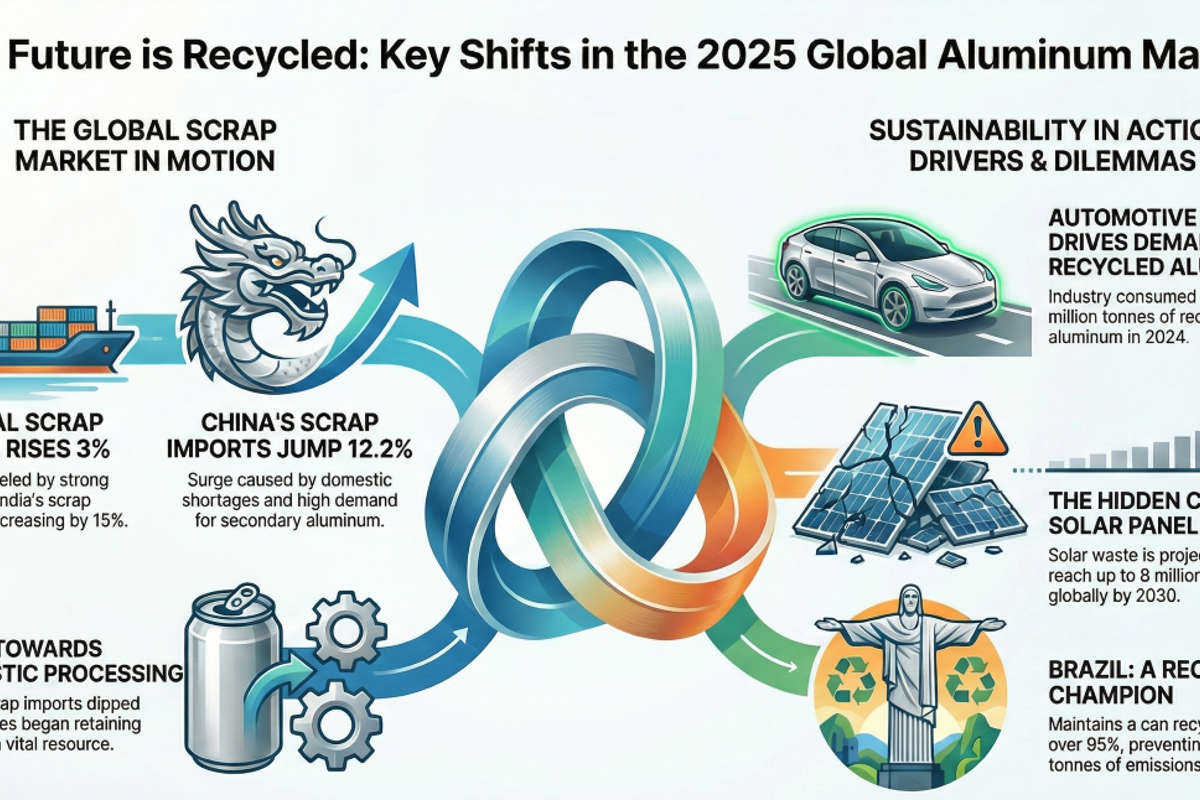
From January to October 2025, the aluminium scrap global trade rose by 3 per cent in comparison to the previous year due to strong demand, especially from India. The country, as per the preliminary data, ramped up its aluminium scrap imports by 15 per cent from major suppliers like the European Union (EU), the United Kingdom (UK) and the Middle East. In this time frame, the global aluminium scrap trade reached 9.95 million tonnes, presenting a steady flow of scrap, whilst the primary aluminium production saw a modest growth, with China’s total output reaching 2 per cent. There are certain concerns regarding the supply constraints, mainly for the limited primary capacity and regulatory challenges. Amongst all, the US is deemed to be the top exporter of aluminium scrap and in contrast, Germany and intra-EU shipments had mixed results. Looking forward to 2026, the industry is expected to fall under increased volatility, influenced by changing trade policies, tariffs, regulatory changes and shifting sourcing patterns directly impacting price and supply dynamics in various regions.
As reported by the General Administration of Customs (GACC), the aluminium scrap imports by China recorded a jump of 12.2 per cent year-on-year, reaching 1.8 million tonnes in the first eleven months of 2025. The growth is owed to a shortage of domestic scrap and a strong demand for secondary aluminium. November alone saw a rise in imports by 17.7 per cent in comparison to the previous year, bringing the total to nearly 162,756 tonnes. The leading supplier of aluminium scrap is Thailand; however, the UK reached a seven-month high in terms of shipments. The influx of aluminium scraps shows that the secondary aluminium producers are in line with their production level, irrespective of the fact that China showed a slowed market during the winter.
The global aluminium recycling market, in 2025, recorded recycling of about 41.9 million tonnes, which mainly surged due to improved domestic recovery and processing capabilities. The volume of global aluminium scrap imports dipped to around 11.92 million tonnes, a decrease from the peak last seen in 2022. This highlights a change towards retaining more scrap domestically and reducing the dependency on trade. According to material-flow modelling, the flow of scrap, which includes both domestic recycling and international trade, saw a good growth over the past decade. Nonetheless, the international scrap exports fell sharply as countries began to view scrap as a vital industrial resource. Thailand and Italy have emerged as the top destinations for the remaining internationally traded scrap, while the shrinking scope of scrap trade reflects the changing dynamics of the supply chain in the secondary aluminium sector.
Automotive sector & recycled AL grow hand-in-hand
The global aluminium industry, in 2025, met at a juncture where carbon intensity and sustainability metrics became just as important as cost and quality. The shift rose by the automotive sector's rising demand for low-carbon and recycled aluminium, as well as the shifting pricing standards and regulatory signals like the EU’s Carbon Border Adjustment Mechanism (CBAM). With this, low-carbon aluminium rose as a unique and increasingly valuable market segment. In 2024, the global automotive industry, which includes passenger cars, commercial vehicles and motorcycles, recorded a total recycled or secondary aluminium usage between 12.2 million tonnes and 12.5 million tonnes, which is nearly 44 per cent of overall aluminium consumption (both primary and secondary) of 27.52 million tonnes for the overall transportation sector, including railways, aerospace, marine and other, during the same period. This volume is, however, likely to increase to 28.63 million tonnes by 2025.
Solar waste: The hidden cost of green energy
Globally, the growth of solar photovoltaic capacity is deemed to be rising, with China hitting around 1,100 GW, the US at 260 GW, India at 132 GW and the EU at 406 GW of installed solar power. However, the rise in solar power installation can pose certain challenges, especially in the waste management of the old OV modules, which have already started to pile up. It has been warned by the International Renewable Energy Agency (IRENA) that the solar waste may reach between 1.7 million tonnes and 8 million tonnes by 2030 and by 2050, the waste volume may soar to 60 million tonnes to 78 million tonnes. This is a rising concern across the industry because it can pose serious environmental and resource-efficiency concerns in key markets. Overcoming these challenges may not be possible without developing effective circular economy strategies and recycling systems for handling the waste sustainably while continuing to expand renewable energy sources.
Recycling projects and initiatives in 2025
In 2025, the global aluminium industry initiated its efforts towards decarbonisation and sustainability by kicking off a series of aluminium recycling projects and initiatives designed to bolster low-carbon supply chains and create closed-loop material flows. This shift shows how producers and recyclers are embracing circular economy models. As the year wrapped up, these initiatives, like launching advanced recycling facilities and revitalising existing plants has highlighted how the sector is tapping into material recovery and secondary aluminium production. This not only helps cut emissions but also boosts resource efficiency and guides strategic business decisions for the upcoming year.
Charity and sustainability starts at home
EGA Spectro Alloys, a processor of post-consumer aluminium scrap, donated USD 100 thousand during the holiday season to 30 nonprofit and charitable organisations through its annual “Giving Together” program. In this structure, employees helped choose the beneficiaries, which shows a strong local focus. In addition to this donation, the firm introduced the EGA Spectro Alloys Scholarship at Dakota County Technical College. Through this scholarship, USD 25 thousand has been committed over five years to support annual awards for students pursuing careers in construction and manufacturing. These initiatives help align the firm with rising talents in the industry. The recipient organisations cover areas including social services, education, sports, and cultural groups. This highlights the company’s commitment to supporting various community sectors.
Aluminium cans turned into a climate asset
Brazil, the rising champion in aluminium can recycling, for more than 15 years, has maintained a recycling rate of more than 95 per cent. The achievement is mainly owed to environmental benefits, which aided in restricting the greenhouse gas emissions by around 18 million tonnes. This has been made possible by the region for its continuous circular approach towards the benevolence packaging. The rooted success can be achieved by forging long-term partnerships, industry organisations and a strong public awareness campaign, with the production and consumption of cans rising alongside the country’s economy. It highlights the strategic climate benefits of aluminium’s endless recyclability, making it a powerful sustainability asset in packaging supply chains.
_0_0.png)
National subsidy policy funds disbursed, inventory buildup reality limits upside potential for aluminium prices
Next articleMacro positive signals continue to be released, and aluminium prices hover at highs
Grow with
AL Circle