Brazil’s aluminium can industry is deeply interwined with the country’s economy and lifestyle, and this is not any recent development but the outcome of consistent, decades-long journey that began in 1989 with Latasa’s first factory in Pouso Alegre, Minas Gerais. Since then, there is no looking back! Through innovation, collaboration, and awareness, the South American country becomes a global leader in aluminium cans. And at the core of this lies sustainability. More specifically, Brazil’s ability to leverage aluminium’s defining advantage – infinite recyclability. As awareness of this attribute grew, aluminium cans gained wide acceptance as a preferred beverage packaging solution. In a decade, by 1999, the production of cans hit 10 billion units, and by 2009, it doubled to 20 billion outputs, fueled by rising disposable incomes and increasing environmental awareness. Over time, growing production and consumption were matched by a parallel rise in recycling performance, with Brazil sustaining recycling rates above 95 per cent for more than 15 years.
Economic growth and aluminium can demand move in tandem
Brazil’s aluminium can market closely tracks the country’s economic trajectory. According to the World Bank, Brazil’s real GDP per capita grew from USSD 10,377.59 in 2023 to USD 10,616 in 2024. During the same period, aluminium can sales increased from 32.3 billion units to 34.8 billion units, with a production rate of 32.6 billion cans annually. Till mid-year 2024, Brazil’s per capita aluminium cans consumption was 165 12-can packages per year.
In 2022, when Brazil’s GDP per capita was USD 9,281, the country’s aluminium can sales were around 31 billion units. So, over the three years, Brazil’s aluminium can sales grew in tandem with the country’s economy.
Mr Cátilo Cândido, Executive President of the Brazilian Association of Aluminum Can Manufacturers (Abralatas), said: “Brazil’s robust and dynamic economy—particularly the rising purchasing power of its people—fuels the demand for soft drinks and, in turn, aluminium cans.”
Sustainability awareness – a driving force
Brazil’s leadership in aluminium can recycling is anchored in long-standing sustainability awareness. For more than 15 years, the country has consistently maintained a recycling rate above 95 per cent. Although in 2024, it slightly eased from 99.7 per cent in 2023 to 97.3 per cent, yet maintained a rate above 95 per cent. In 2022, the recycling rate had even touched 100 per cent, achieving zero waste to landfill.
Cátilo Cândido once said, "We are a true success story around the world when we talk about recycling. We are ahead of European countries, which have an average rate of around 73%, and the United States with 56%, for example. This makes us proud and shows the world that we work and collaborate intensely towards the transition to a low-carbon economy."
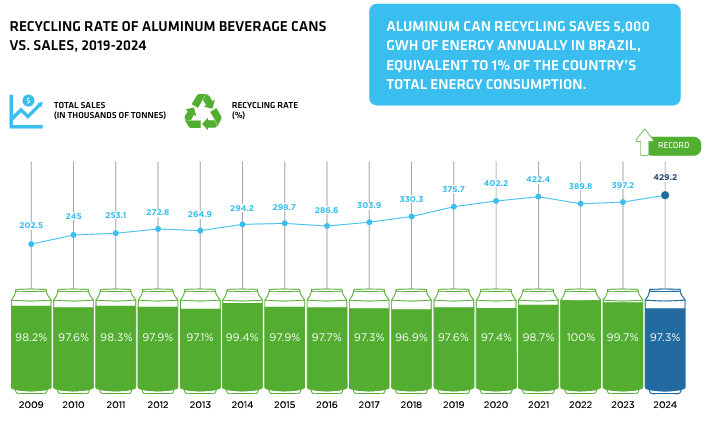
Image source: ABRALATAS ESG Report 2025
The above graph shows that despite minor fluctuations in recycling rates, aluminium can sales have continued to climb. In 2024, sales reached a record 429.2 thousand tonnes—up 8.1 per cent from 397.2 thousand tonnes in 2023. Compared with 2009 levels of 202.5 thousand tonnes, sales volumes have increased by 112 per cent.
A nationwide recycling ecosystem
Brazil’s recycling performance is supported by a well-established, decentralised infrastructure. There are 39 collection centres in 20 states, 49 recyclers in 10 states, 25 plants in 13 states, and 42 co-op partners in 10 states. In 2024 alone, 3 new collection centres were commissioned.
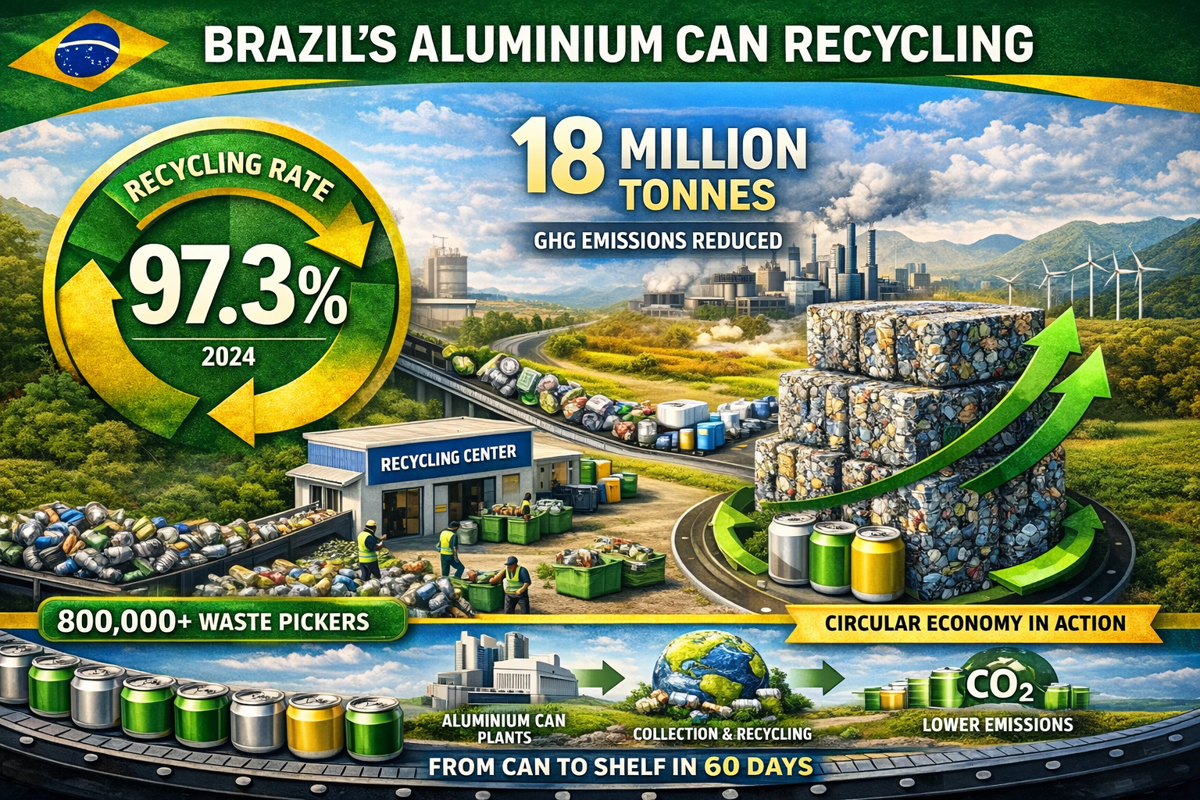
Human capital remains central to this system. More than 800,000 waste pickers—working individually or through cooperatives—form the backbone of Brazil’s aluminium can collection and sorting network, ensuring high recovery rates and material flow back into the recycling loop.
On the production side, Ardagh, Ball Corporation, CANPACK, and Crown Holdings dominate the market, collectively operating 17 facilities. While Ardagh and CANPACK individually operate three facilities, Ball Corporation has eleven plants with nearly 3,000 employees.
To know about the future aluminium can market, prebook our report: Global Aluminium Industry Outlook 2026
Recycling gains turn into climate benefits
Over the past decade, Brazil’s significant rate of aluminium beverage can recycling has led to an estimated 18 million tonnes of reduced greenhouse gas (GHG) emissions. Recycling also has a direct positive impact on waste management as it prevents improper disposal of aluminiun cans. Moreover, the recycling cycle is short and thus, cans are back to shelves within 60 days of disposal. ABRALATAS, the Brazilian Association of Aluminum Can Manufacturers, plays a key role in aluminium cans waste management, sending less than 1 per cent of all waste generate to landfills.
Aluminium cans recycling has also become a viable avenue to achieve the country’s ambitious climate transition. As part of this ambition, ABRALATAS in 2024 launched its Sectoral Decarbonization Project, which has since become the Brazilian Aluminum Can Transition Pathway (BACTway), the climate transition plan for Brazil’s aluminum can industry. This agenda places the sector at the core of the global fight against climate change and positions Brazilian industry to act proactively within the evolving regulatory landscape of the carbon markets. And as an integral part of these initiatives, the circularity of the aluminium cans, which has maintained over 95 per cent recycling rate for more than the last 15 years play a crucial role.
Policy support and quality standards strengthen aluminium can chain
Policy interventions have further reinforced Brazil’s aluminium can ecosystem. Selective Tax and Recycling Incentive Law introduced in 2024 reshaped the aluminium cans production and sustainability practices. Selective Tax is a fiscal measure designed by ABRALATAS in partnership with sectoral representative groups, to advocate the transition to a low-carbon economy. Under Selective Tax, products with potential environmental harm are subject to higher taxation so that Brazilian consumers consciously choose more sustainable products that represent a virtuous cycle promoting sustainable production and consumption.
In July 2024, Federal Decree No. 12,106/2024 was published, regulating the tax incentive for the recycling production chain. That same month the Brazilian Securities and Exchange Commission (CVM) issued Resolution No. 206/2024, which established the rules for Investment Funds for Recycling Projects, known as “ProRecicle.” In December, the Ministry of the Environment and Climate Change issued Ordinance No. 1,250/2024, establishing rules for the submission, review, approval, monitoring, accountability, and evaluation of project results.
ABRALATAS also developed the world’s first technical quality standard for aluminium cans in Brazil, in partnership with the Brazilian Association of Technical Standards (ABNT), resulting in the creation of NBR 17194. After two years of thorough research, NBR 17194 was formalized as the industry’s best practice, aiming to enhance the quality, safety, and performance of aluminum beverage cans. It outlines a structured framework of requirements, procedures, and guidelines covering the production and filling stages of the can, such as setting dimensional, visual, and functional parameters, as well as specifications for transportation, handling, and filling to ensure greater safety for producers, retailers, and consumers.
Don't miss out- Buyers are looking for your products on our B2B platform
Education and awareness: sustaining the loop
The first and foremost step towards ensuring proper waste management begins with the dissemination of knowledge on the subject. ABRALATAS thus, carried out four such major awareness campaigns last year, as part of the Recicla Latas programme to Brazilian society. The programme continuously creates and distributes public educational content which addresses topics like waste collection, proper waste disposal, and the environment impact of individual choices.
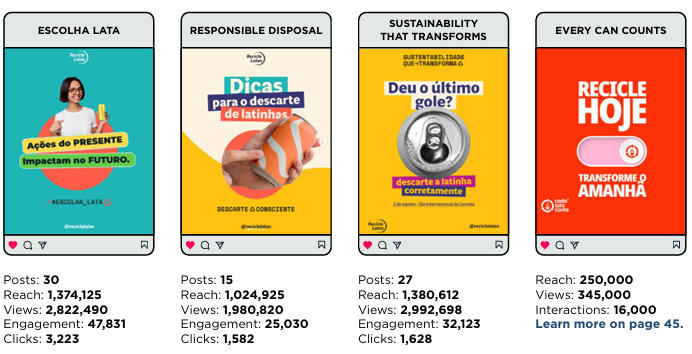
Image source: ABRALATAS ESG Report 2025
Brazil’s aluminium can industry demonstrates how circularity can move beyond aspiration to become a measurable climate solution. By sustaining a recycling rate above 95 per cent for more than fifteen years, the country has transformed a high-volume consumer product like aluminium beverage cans into a strategic environmental asset by avoiding an estimated 18 million tonnes of greenhouse gas emissions while supporting economic growth, job creation, and efficient waste management.
What sets Brazil apart is the alignment of multiple forces: consumer awareness, a vast and inclusive recycling network, proactive industry leadership through ABRALATAS, and a policy framework that rewards sustainable choices. Together, these elements have created a resilient ecosystem in which aluminium cans circulate rapidly back into the economy, reinforcing both material security and climate goals.













_md.webp)
_md.webp)