In the first quarter of 2025, the global electric vehicle (EV) battery market experienced a considerable surge, with total installed capacity reaching 221.8 GWh, which is a 38.8 per cent increase compared to the same period in 2024. Today, we delve into the leading brands and their performance in 2025, which has aided in the surge against all odds. Country-wise, China has shoved South Korea and Japan in the sustainable battery race.
China’s battery manufacturers lead the charge
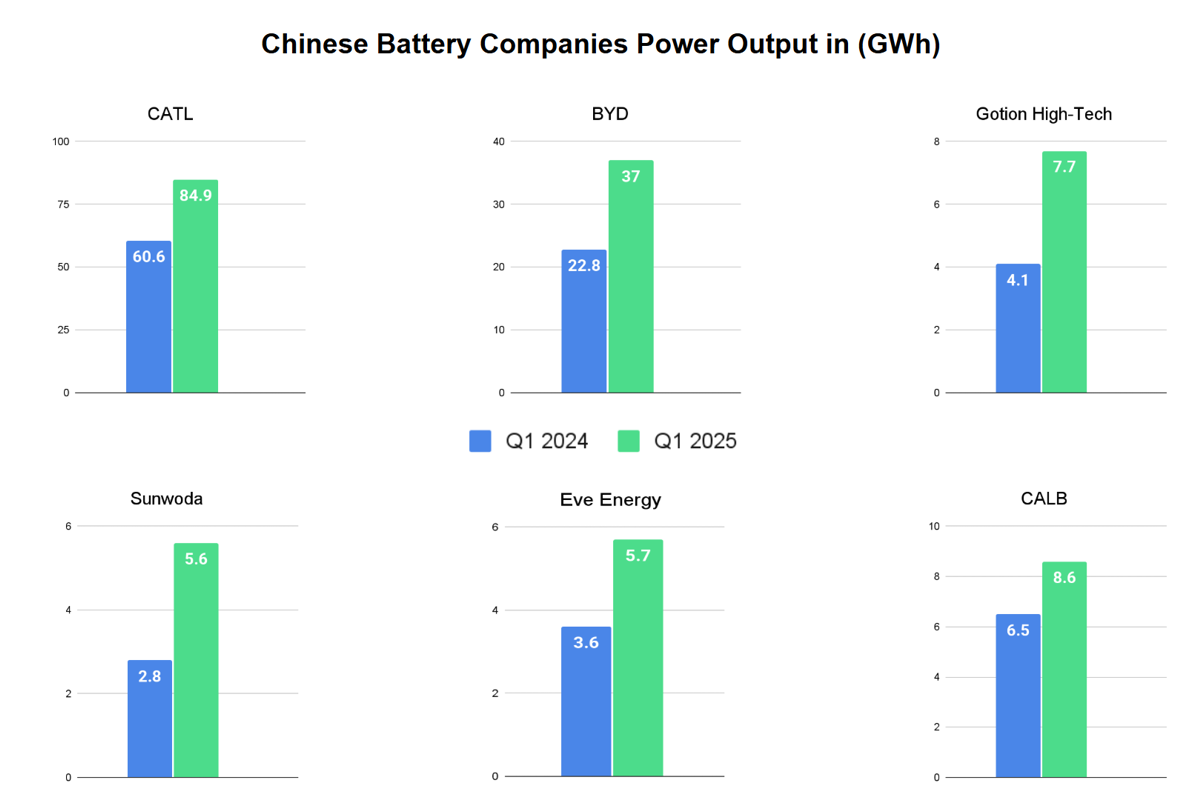
Chinese battery manufacturers have solidified their dominance in the global EV battery market:
- CATL (Contemporary Amperex Technology Co. Limited): Maintained its position as the world’s leading EV battery supplier, with an installed capacity of 84.9 GWh, marking a 40.2 per cent year-over-year increase. CATL’s batteries are utilised by major automakers, including Tesla, BMW, Mercedes-Benz, and Volkswagen.
- BYD: Recorded a 62 per cent year-over-year growth, reaching 37 GWh in battery installations. As both a battery and EV manufacturer, BYD’s competitive pricing and popular models have propelled its expansion in Asia and Europe.
- CALB (China Aviation Lithium Battery): 8.6 GWh (+31.5 per cent Y-o-Y)
- Gotion High-Tech: 7.7 GWh (+86.6 per cent Y-o-Y)
- EVE Energy: 5.7 GWh (+59.6 per cent Y-o-Y)
- SVOLT Energy: 5.6 GWh (+100.2 per cent Y-o-Y), the highest growth rate among the top ten suppliers
Collectively, these six Chinese companies accounted for 67.5 per cent of the global EV battery market in Q1 2025, highlighting China’s strategic investments and advancements in battery technology.
Korean battery makers face market share decline
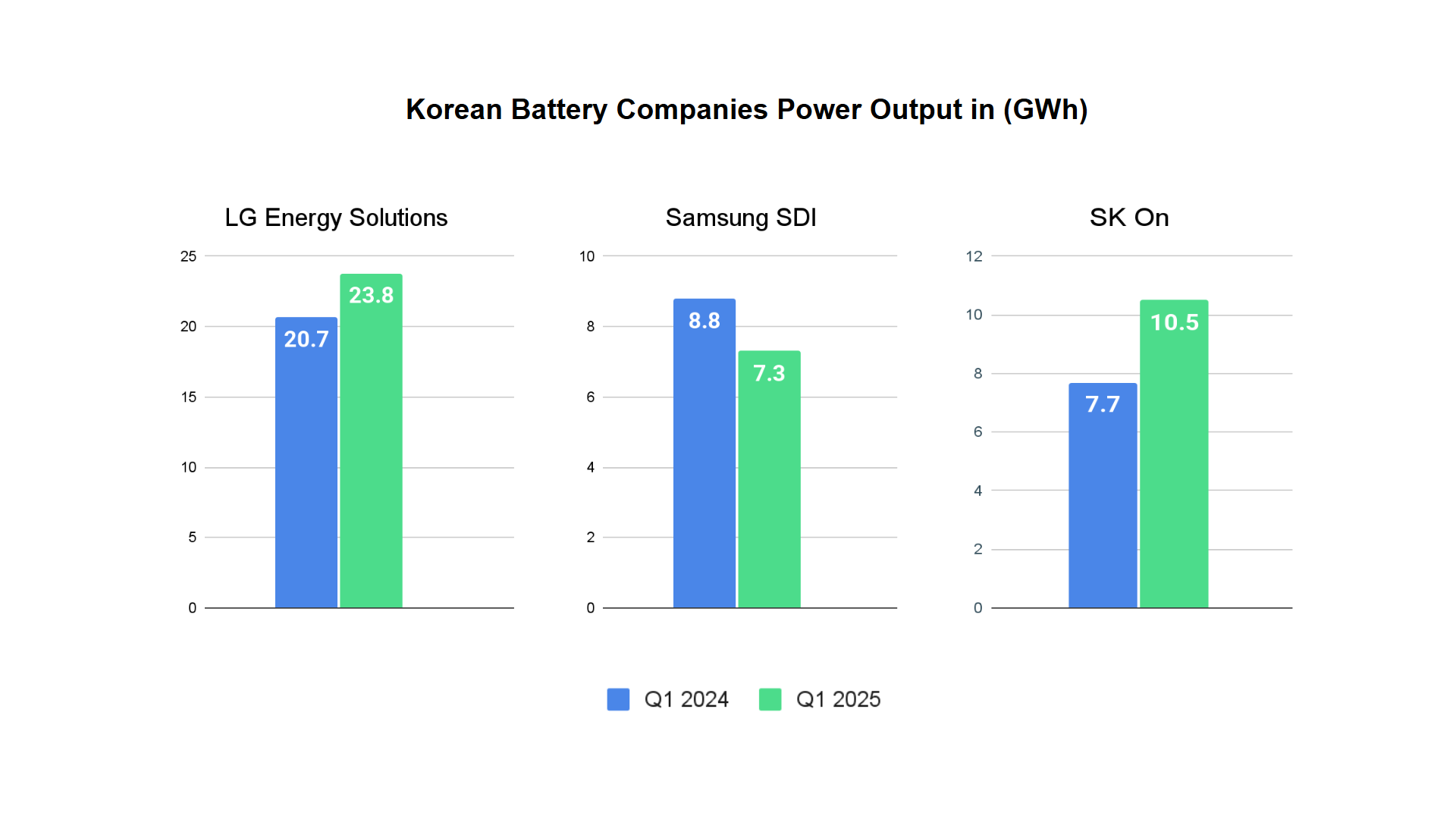
South Korea’s top three battery manufacturers, LG Energy Solution, SK On, and Samsung SDI, experienced a combined market share drop to 18.7 per cent in Q1 2025, down from 23.2 per cent the previous year:
- LG Energy Solution: Despite a 15.1 per cent year-over-year increase to 23.8 GWh, LG’s growth was tempered by a 17.3 per cent decline in battery installations for Tesla vehicles. However, strong performances from Volkswagen’s ID series and Kia’s EV3 contributed positively.
- SK On: Achieved a 35.6 per cent year-on-year growth, reaching 10.5 GWh, supported by stable sales of Hyundai’s IONIQ 5 and EV6, as well as Mercedes-Benz’s EQA and EQB models.
- Samsung SDI: Faced a 17.2 per cent decline to 7.3 GWh, attributed to reduced demand from partners like Rivian and Audi.
The decreasing market share of Korean manufacturers underscores the intensifying competition and the need for strategic adaptations in the evolving EV landscape.
Panasonic feels the Tesla tremor but eyes a North American comeback
Among the top ten EV battery manufacturers in Q1 2025, Panasonic stands out for the wrong reasons. The Japanese company, Tesla’s long-standing battery partner, was one of only two top-ranked firms to record a year-on-year drop in battery installations, alongside Samsung SDI. Panasonic’s installed capacity dipped 6.3 per cent to 7.2 GWh, pushing it down to eighth place globally.
The slump reflects a wider trend: Tesla’s Q1 sales softened, primarily due to cooling demand for its Model 3 and Model Y, two models heavily reliant on Panasonic’s battery supply. With its battery business still largely tethered to Tesla, Panasonic took a direct hit.
Yet, there’s a strategic rebound in motion. Panasonic is upgrading its 2170 cells and scaling up its next-generation 4680 batteries, which are set to become pivotal in Tesla’s future US production strategy. Given the localised demand incentives under the Inflation Reduction Act, Panasonic’s capacity in the North American market is expected to bounce back quickly, provided Tesla’s pipeline of refreshed models and new platforms finds market traction.
China widens the gap with South Korea in global battery market share
Between 2017 and 2024, global EV battery installations surged at a staggering compound annual growth rate (CAGR) of 47.5 per cent, pointing at the sheer momentum of the electrification decade. In Q1 2025, this trajectory was reinforced, with Chinese battery giants CATL and BYD commanding a combined 55 per cent share of the global EV battery market, an increase driven by their dominance in the world’s largest EV market.
What’s more telling is the rise of China’s second-tier battery players. Companies like Gotion High-Tech and Sunwoda (Honeycomb Energy) recorded breakout growth in Q1 2025. Collectively, four mid-tier Chinese battery manufacturers now hold an additional 12.5 per cent of the global market, pushing China’s total battery market share to a commanding 67.5 per cent.
In stark contrast, South Korea’s ‘Big Three’, namely LG Energy Solution, SK On, and Samsung SDI, have seen their combined global market share shrink from 23.2 per cent in Q1 2024 to just 18.7 per cent this year. Meanwhile, Japan’s Panasonic, once a pioneer in EV batteries, has slipped to a modest 3.3 per cent market share. The China-Korea battery gap is not only real, it’s widening.
This divergence arrives at a time of geopolitical tremors. Following Donald Trump’s re-election as US President, Washington has enacted aggressive tariffs on Chinese-made EV batteries and upstream raw materials, exacerbating friction in the already fragile global battery supply chain.
Korean battery majors are responding with urgency. Joint ventures with North American automakers, localisation of US production, and supply chain hedging are now top-line strategies. These firms are aggressively fortifying their footprint in the US to secure Inflation Reduction Act (IRA) incentives and avoid tariff exposure.
But there’s a deeper structural risk wherein Korea’s battery industry remains heavily reliant on Chinese raw materials, especially lithium, cobalt, and graphite. Diversifying this dependence is now a survival imperative. In an era of rising US protectionism, tighter EU environmental norms, and price compression in China, Korean battery makers face a triple challenge and must chart bold new growth trajectories to regain their footing.
Near-term anticipation for global EV battery market
The global (predominantly Asian) EV battery market promises continued growth, steered forward by increasing EV adoption and technological advancements. However, manufacturers must navigate challenges such as geopolitical uncertainties, supply chain disruptions, and intensifying competition. Strategic investments in innovation, localisation, and diversification will be crucial for companies aiming to secure and expand their market positions in this dynamic industry.













_md.webp)
_md.webp)







