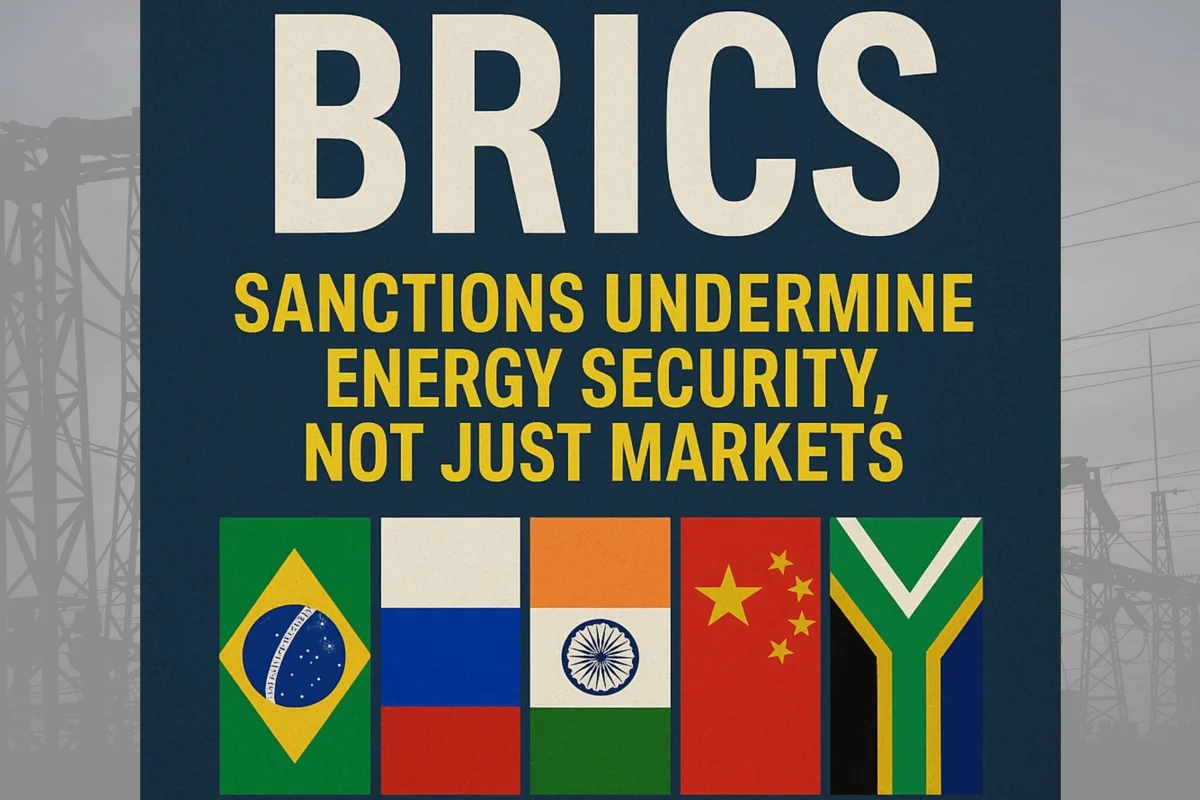
In a sharply worded communique, the BRICS bloc — Brazil, Russia, India, China, and South Africa — has fired a warning shot at the West’s growing reliance on sanctions as an instrument of energy policy. At the latest BRICS Energy Ministers’ Meeting held under Russia’s presidency, the five-nation grouping condemned what they call “unilateral sanctions” and “arbitrary restrictions,” signalling an urgent geopolitical realignment that is beginning to redraw the contours of the global energy map.
“We express concern about unilateral sanctions and arbitrary restrictions on energy trade and investment in the energy sector that disregard international law... and pose a threat to the security of the critical energy infrastructure,” the BRICS group said in a joint statement.
This declaration comes against a combustible global backdrop: one where sanctions have increasingly targeted major fossil fuel producers, supply chains are splintering, and energy is no longer just a commodity — it’s a weapon.
While the BRICS rhetoric may read like diplomatic boilerplate, the subtext reveals a coordinated counteroffensive to Western economic coercion. Since 2022, owing to Russia’s full-blown invasion of Ukraine, more than 13,000 sanctions have been imposed on Russia, according to Castellum.AI, with a considerable portion targeting oil, gas, and metals. However, the contentious move has led to a secondary spillover that has impacted Chinese tech firms, Indian refiners, and even Brazilian biofuel exporters caught in the dollar-denominated crossfire.
For BRICS, this isn’t just about defending sovereignty but reclaiming market agency.
“We highlight the need to enhance energy security by ensuring market stability and maintaining undisrupted flows of energy from diverse sources, strengthening value chains, ensuring resilience and protection of critical energy infrastructure.”
Russia: From isolation to energy pivot
Cut off from European markets, Russia is now shipping nearly 80 per cent of its crude exports to Asia, with China and India accounting for a combined 60 per cent. It has also expedited the Power of Siberia 2 pipeline to further entrench energy relations with Beijing, bypassing EU-linked infrastructure entirely.
Yet, this realignment isn’t just opportunistic; it’s strategic. As Moscow argues, the politicisation of energy flows risks dismantling a global energy order built over decades.
China: Sanctions as climate sabotage?
China, now the world’s largest energy consumer, frames the sanctions as a dual threat not just to energy security but to the very architecture of global climate cooperation. Beijing is increasingly vocal about how export controls and tech restrictions, particularly on solar wafers, EV batteries, and green hydrogen, are stunting its clean energy ambitions.
“Sanctions impede collaborative efforts to combat climate change and promote sustainable development,” Chinese representatives argue, pointing to the US Inflation Reduction Act and the EU’s CBAM (Carbon Border Adjustment Mechanism) as indirect sanctions by design.
The BRICS line here is clear: You can’t build a green future with red tape.
India & Brazil: Friends of all, allies of none
India walks a tightrope, balancing its QUAD partnership with the US while refusing to condemn Russia or restrict its energy trade. In 2024 alone, Indian refiners processed over 1.6 million barrels/day of Russian crude, up from just 100,000 pre-Ukraine war. Brazil, meanwhile, has flagged concerns over agri-energy tariffs, especially EU restrictions on biofuels tied to deforestation metrics.
Neither country wants an ideological showdown, but both reject a sanctions-first world order.
The bigger bet: BRICS is building firewall economics
Beyond political posturing, BRICS is laying the structural groundwork to insulate its energy systems:
- BRICS pay and bilateral currency deals (e.g., India-Russia rupee-ruble settlements) challenge the petrodollar’s supremacy.
- Energy corridors, including China’s BRI-linked pipelines and Brazil’s Transoceanic Interconnection plans, aim to delink critical flows from US-aligned chokepoints.
- Intra-bloc energy trade is up 18 per cent year-on-year, led by solar panels, refined fuels, and uranium swaps.
In other words, this isn’t a tantrum. It’s a build-out.
“We share the view that improved energy efficiency... including renewable energy, bioenergy, fossil fuels, nuclear energy and hydrogen... are crucial for a just transition towards more flexible, resilient and sustainable energy systems.”
What this means for aluminium and resource supply chains
For energy-intensive industries like aluminium smelting, this geopolitical tug-of-war introduces new uncertainties as well as new opportunities. Western sanctions have already disrupted alumina flows from Russia and nickel exports from Indonesia. Meanwhile, BRICS is investing in joint exploration, refinery setups, and critical mineral cooperation (notably, Brazil and South Africa’s rare earth reserves).
The group’s energy doctrine now dovetails with its metals diplomacy — securing supply chains via south-south partnerships, alternative logistics routes, and shared infrastructure platforms.
Critics argue that BRICS’ moral posturing hides self-preservationism. But that critique misses the bigger shift, i.e., the energy world is no longer flat. From OPEC+ policy moves to the China-GCC axis, the global grid is being rewired. Moreover, BRICS wants to be on the command line.
And in this multipolar energy economy, infrastructure is power, and sanctions are sparks. The question is, who controls the circuit?













_md.webp)
_md.webp)







