Germany’s Fraunhofer and University of Stuttgart develop aluminium anode technology for lithium-ion batteries
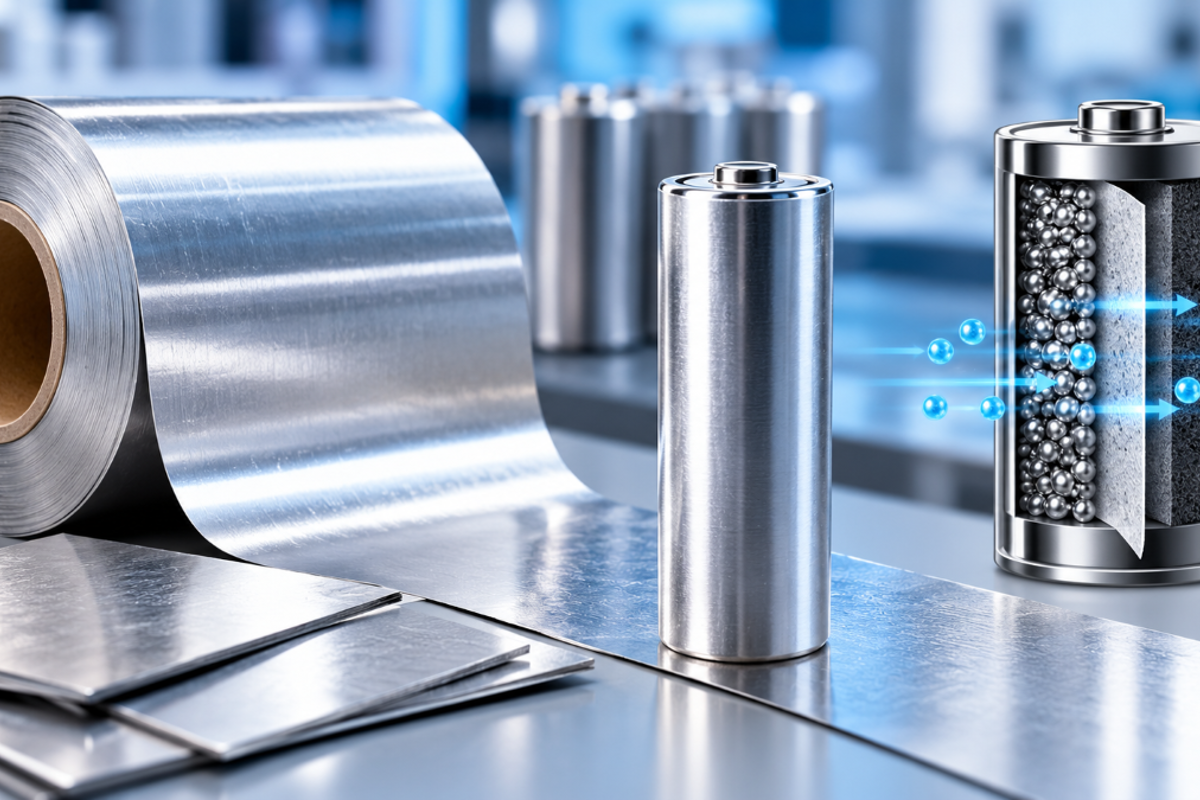
The image used in this article is generated with an AI tool and does not depict any real-time moment
Germany-based Fraunhofer Institute for Manufacturing Engineering and Automation (Fraunhofer IPA), headquartered in Stuttgart, has developed a new aluminium anode technology for lithium-ion batteries in collaboration with the University of Stuttgart, addressing a key challenge that has limited the material’s practical use.
The patented cell and electrode design manages the volume changes that occur during charging and discharging, helping prevent electrode damage and maintain electrical contact over repeated cycles. The technology also eliminates graphite and silicon from the anode, replaces conventional copper foil with aluminium foil and removes a separate electrode coating process.
Aluminium anode technology targets electrode degradation
Aluminium has long attracted interest as an alternative to graphite and silicon in lithium-ion batteries because it is relatively inexpensive, widely available and offers high capacities. However, repeated charging and discharging cause aluminium to change in volume, placing mechanical stress on the electrode. Over time, this can lead to cracks, pores and eventually pulverisation of the electrode material, resulting in capacity loss and a shorter battery lifespan.
Fraunhofer IPA, in collaboration with the Institute for Photovoltaics at the University of Stuttgart, has developed and patented a cell and electrode technology to address these ageing processes. The approach is designed to stabilise the materials during operation and preserve electrical contact within the electrode over many charge and discharge cycles.
“We are making a battery technology that has been known for a long time but has been difficult to control practically usable,” said Kai Peter Birke, Scientific Director for Battery and Hydrogen Systems and Storage at Fraunhofer IPA, in a German-language press release.
To know the aluminium casting demand forecast in the construction sector, explore our report "Global Aluminium Casting Market 2026-2032: Plant Economics, Alloy Segmentation, Pricing Intelligence, Supply Chain Analysis & Strategic Recommendations"
Aluminium foil replaces graphite, silicon and copper
The new technology completely eliminates graphite and silicon from the anode. This reduces reliance on graphite, which is considered a critical raw material for the European battery industry, and avoids the significant volume changes associated with highly silicon-based anodes.
The electrode design uses commercially available alloyed aluminium foil as both the active material and the current collector. This removes the need for the copper foil typically used in conventional anodes.
The technology also eliminates the separate coating process used to apply active material to a current collector. This is expected to reduce electrode manufacturing costs and energy consumption.
For the cathode, the researchers identify lithium manganese oxide (LMO) as a possible material. Combined with the aluminium anode, it can offer a competitive energy density. The resulting cell chemistry would be phosphate-free, providing a potential cost-effective alternative to lithium iron phosphate batteries.
Aluminium-based battery design addresses safety concerns
The aluminium anode can also be combined with electrolyte solvents that have a high flash point. When paired with a fluorine-free LMO cathode, the technology enables the possibility of a completely fluorine-free and, consequently, PFAS-free cell structure.
This design would also avoid the risk of hydrogen fluoride formation in the event of a battery fire.
Fraunhofer identifies applications such as air freight, tracking systems for transport containers and specialised medical devices as initial areas of interest. These applications place particular importance on safety, robustness and compact installation space.
The technology also offers a potential manufacturing advantage. According to the institute, the cell chemistry can be produced using existing production facilities, eliminating the need for a complete rebuild of manufacturing infrastructure.
Find trade opportunities for aluminium battery foils on the AL Biz platform.
Fraunhofer tests aluminium anode prototypes
Several prototypes have already been built and are undergoing testing at the Fraunhofer IPA Centre for Digitalised Battery Cell Production. However, the institute has not yet disclosed specific cycle-life figures or gravimetric and volumetric energy-density values in its current announcement.
Alongside its aluminium-anode research, Fraunhofer is investigating other ways to improve battery performance through changes in materials and cell architecture.
In September, the Fraunhofer Institute for Solar Energy Systems ISE (Fraunhofer ISE) presented a cell architecture featuring significantly thicker electrodes. By reducing the proportion of current collectors, the design can increase energy density by 10 to 15 per cent, depending on the battery type and design.
The thicker-electrode approach remains at the research stage and must demonstrate its industrial scalability. Meanwhile, ongoing prototype testing will establish the performance and practical suitability of the new aluminium-anode technology.
Showcase your brand, aluminium recycling initiatives and sustainability vision in our upcoming magazine: "Sustainability & Recycling: Aluminium’s Commitment 2026".
Grow with
AL Circle