How a Pittsburgh plumber’s aluminium dome helped shape observatory design
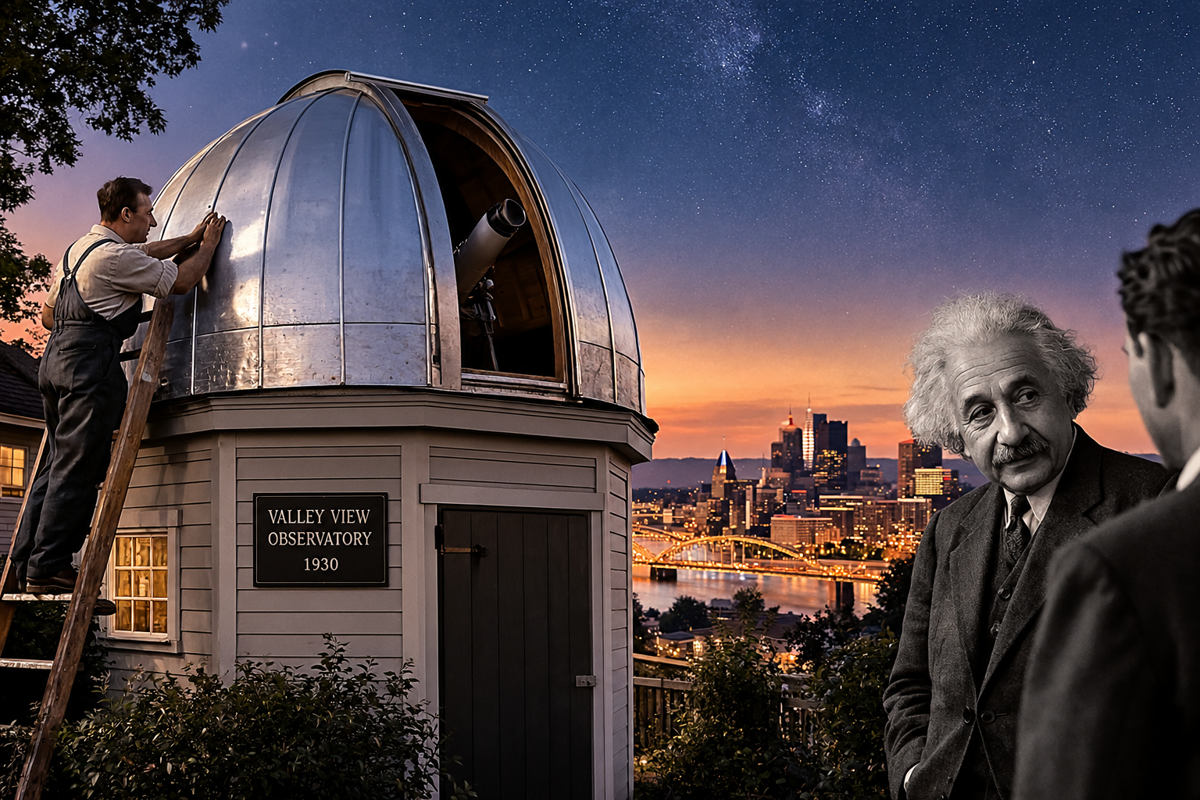
The image used in this article is generated with an AI tool and does not depict any real-time moment.
In 1930, Pittsburgh plumber Leo Scanlon built a backyard observatory using a material rarely employed in construction at the time: sheet aluminium. His lightweight, rotating dome protected a homemade telescope and became a model for later small observatories, helping establish his reputation in the amateur astronomy community before he met Albert Einstein four years later.
Known as the Valley View Observatory, the structure stood in the Summer Hill neighbourhood on Pittsburgh’s North Side. Scanlon’s solution to a practical engineering problem demonstrated how aluminium could offer an alternative to heavier materials such as wood and steel in observatory construction.
Aluminium offers a lighter solution
Scanlon began documenting his backyard project in September 1930, according to historical records preserved in the Stellafane convention archives. Working with a friend, Bud, he designed a rotating dome that did not require an internal support frame.
Rather than relying on heavy iron supports, Scanlon joined curved sheets of aluminium using specially folded external seams. The resulting structure was light enough to rotate smoothly on rollers installed above a simple, eight-sided wooden building.
Scanlon even tested the completed dome’s strength by sitting on top of it after installing the final metal panels. The observatory cost USD 250 to build, of which USD 178 went towards the aluminium dome itself.
The Valley View Observatory officially opened on October 4, 1930. Its rotating dome shielded Scanlon’s reflecting telescope while allowing him to observe the night sky over Pittsburgh. The design was described as the world’s first all-aluminium observatory dome.
To know the aluminium casting demand forecast in the construction sector, explore our report "Global Aluminium Casting Market 2026-2032: Plant Economics, Alloy Segmentation, Pricing Intelligence, Supply Chain Analysis & Strategic Recommendations"
A backyard observatory attracts wider interest
Scanlon’s project helped establish him as a recognised figure in the US amateur astronomy community. He had co-founded the Amateur Astronomers’ Association of Pittsburgh (AAAP) in 1929 to support independent astronomy enthusiasts and people who built their own telescopes.
The Valley View Observatory soon became a gathering place for amateur astronomers, optical equipment specialists and professional astronomers visiting western Pennsylvania, according to historical records published by the AAAP.
The aluminium dome also drew interest from telescope makers across the country. Its light weight, resistance to rust and corrosion, relatively low maintenance requirements and ease of rotation made the design attractive for smaller observatories.
These characteristics helped aluminium gain wider acceptance as a material for observatory domes, demonstrating how a solution developed for a personal backyard project could influence designs beyond its original setting.
From aluminium innovation to a meeting with Einstein
Scanlon’s involvement in amateur astronomy eventually brought him into contact with Albert Einstein. In December 1934, Einstein visited Pittsburgh to deliver a lecture on his theory of relativity at the Carnegie Institute of Technology, now Carnegie Mellon University.
Historical accounts published by Carnegie Mellon University News describe how local organisers arranged meetings between Einstein and people interested in scientific research, including amateur researchers and working people pursuing science outside their professions.
As an AAAP co-founder, Scanlon was invited to meet the physicist and personally invited him to view the association’s astronomy exhibits and instruments. Accounts preserved in Carnegie Mellon’s archives indicate that Einstein valued the enthusiasm of amateur scientists who pursued research out of genuine interest.
The meeting marked a notable moment in Scanlon’s journey from a plumber with a homemade telescope to a recognised participant in the amateur astronomy movement.
Preserving the dome’s legacy
The Valley View Observatory remained in Pittsburgh for nearly seven decades before it was dismantled in August 1997. Preservationists and AAAP members saved its historic aluminium dome, seeking to protect the structure’s place in the history of amateur astronomy.
Scanlon’s contribution was also commemorated beyond the observatory itself. Main-belt asteroid 8131, discovered in 1976, was later officially named Scanlon in his honour.
His achievement lay in applying practical skills to an unusual engineering challenge. By using aluminium to create a lightweight, rotating observatory dome, Scanlon produced a design that attracted attention among astronomy enthusiasts and helped demonstrate the metal’s value in a specialised application.
Find the right unwrought aluminium for your business. Browse a comprehensive list of primary aluminium products on AL Biz.
Grow with
AL Circle