Europe holds 10% of global aluminium extrusion demand, supported by Germany’s Constellium, France’s Hydro Extrusions & Italy’s Metra
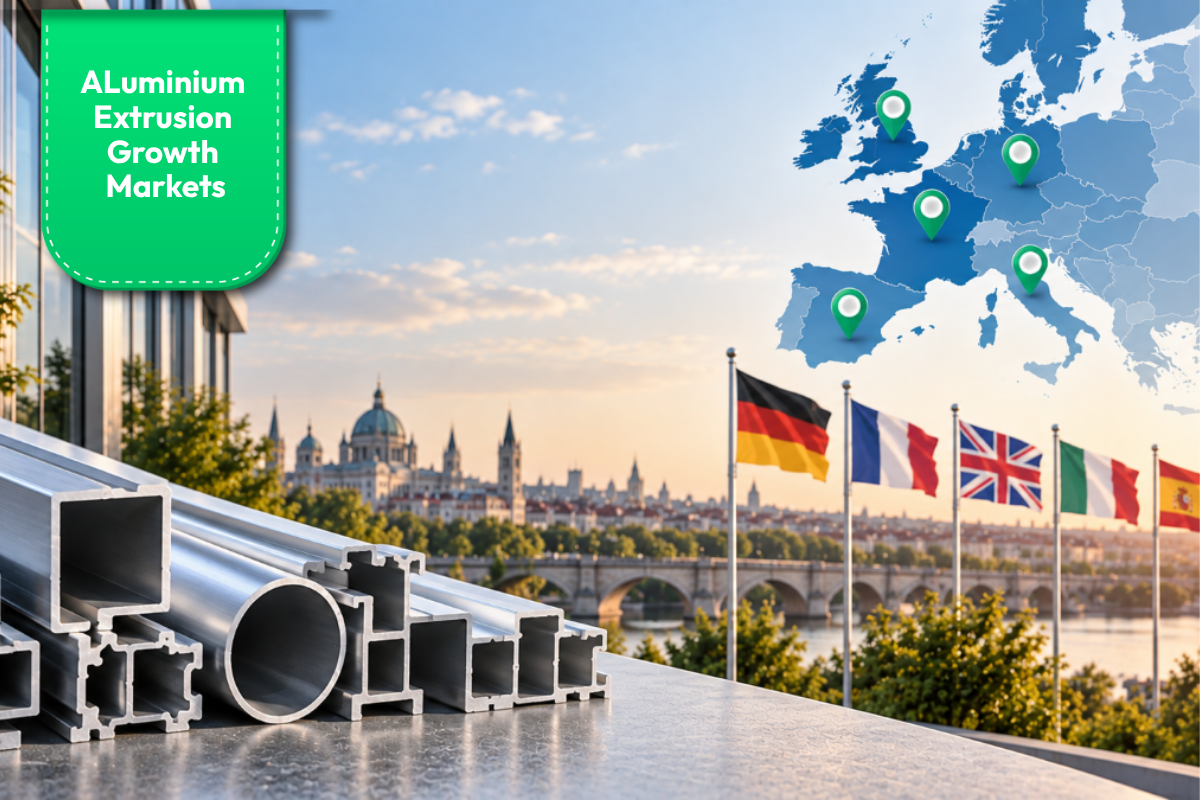
The image used in this article is generated with an AI tool and does not depict any real-time moment
Across Europe, aluminium extrusion has become closely woven into some of the region’s biggest industrial and construction markets. From automotive and transport to buildings and industrial applications, extruded profiles are finding demand across a wide range of sectors. This is reflected in Europe’s position in the global market: the region accounted for 12 per cent of global aluminium extrusion capacity, making it the second-largest regional contributor after China.
At the same time, Europe represented 10 per cent of global aluminium extrusion usage, out of total global usage of 35.35 million tonnes. With production capacity and usage shares relatively close, Europe’s extrusion capacity and consumption are broadly at par.
If we break down Europe’s 10 per cent share of global aluminium extrusion usage, the picture becomes clearer. Usage is projected to rise from 3.46 million tonnes in 2025 to 3.55 million tonnes in 2026, before reaching 3.82 million tonnes by 2032. From 2032 to 2035, usage is expected to grow by another 5 per cent CAGR, as per AL Circle market analysis. For the exact figures and detailed sector-wise outlook, read our updated aluminium extrusion report - The World of Aluminium Extrusions to 2035 - Demand Forecast | Price Benchmarking | Plant Economics | Strategic Growth Sectors.
So, which European markets are driving this demand, and which companies are meeting it with their production networks?
Germany leads Europe’s aluminium extrusion market
Germany stands at the centre of Europe’s aluminium extrusion demand, backed by its strong automotive, construction and machinery industries. The country’s aluminium extrusion market was valued at USD 3,787.5 million in 2025 and is expected to grow at a 5.8 per cent CAGR by 2030, as per various industry sources.
A major part of this demand comes from the automotive sector, where the shift towards lighter and more fuel- and energy-efficient vehicles is increasing the use of aluminium extrusions in EV components, chassis parts and structural assemblies. At the same time, building renovation and infrastructure programmes are supporting demand for profiles used in thermally efficient windows and façades.
Germany’s role in the European extrusion market is also reflected in its trade flows. The country is a net importer of extrusions, with imports roughly twice its export volume, highlighting its position as a major downstream fabrication and automotive-OEM hub.
The companies serving Germany
Constellium SE has a significant presence through its Singen plant, a roughly 100-year-old facility employing 1,300-1,500 people. The plant operates five extrusion presses, including a 100 MN press, which the company describes as the largest in Western Europe. Its production is mainly used for crash-management systems, side-impact beams and rail and metro components. Constellium has also added a dedicated extrusion press and an 8,000 sq m hall at Singen. Its Dahenfeld site in Neckarsulm converts extrusions into structural assemblies for premium and performance-car body structures.
Hydro Extrusions, As the world’s largest extrusion producer, with roughly 1.4 million tonnes of annual extrusion capacity and sales volumes of 1.0 million tonnes in 2025, Hydro operates a network of German plants, including Bellenberg through its Hydro Building Systems Extrusion unit, serving both industrial and construction-systems demand.
Exlabesa operates a production centre in Minden, forming part of its wider pan-European network. Across the group, extrusion capacity is roughly 220,000–238,000 tonnes per year across 29 presses, with operations spanning Spain, Portugal, France, Poland, the UK, Morocco and the US.
Connect with verified aluminium extrusion buyers and suppliers through the AL Biz marketplace.
France brings aerospace, automotive and construction demand
France adds another important layer to Europe’s extrusion market. Demand comes from aerospace, automotive and architectural aluminium systems, with the Airbus supply chain, EV programmes and building activity supporting consumption.
The French extrusion market was valued at USD 2,120.2 million in 2025 and is expected to grow at a CAGR of 6.3 per cent by 2030.
Who is supplying France?
Hydro Extrusions operates four extrusion plants in France - Lucé, Albi, Châteauroux and Puget-sur-Argens. Its Lucé plant has been producing custom and standard profiles since 1959 and operates two extrusion presses and an anodising line. Hydro invested around NOK 67 million, or about EUR 6 million, in 2023 to upgrade the plant’s electrical, mechanical and hydraulic extrusion-line equipment.
Hydro’s French building-systems business also owns Technal, the Toulouse-founded aluminium glazing-systems brand. It directly employs around 700 people in France and works with more than 230 partner fabricators nationwide. Its network has installed an estimated 2 million windows, more than 70,000 conservatories and 330,000 sq m of façades over more than 30 years.
Exlabesa strengthened its French presence by acquiring Flandria Aluminium, a more than 50-year-old extruder near Warneton. The site has two extrusion presses across more than 35,000 sq m of facilities and an in-house recycling furnace, employing around 170 people.
Cortizo also operates in France through its Chemillé facility, where it added a second 1,800-tonne extrusion press as part of an EUR 87.4 million multi-country capacity-expansion plan.
UK: a major market powered by international players
The UK’s extrusion market is largely shaped by international companies operating local production bases. The market was valued at USD 2.26 billion in 2025 and is projected to reach USD 3.11 billion by 2030, representing a 6.5 per cent CAGR, as per various industry sources.
Hydro has the largest presence, with more than 1,300 employees in Britain. Its six extrusion presses are located at Birtley, Cheltenham and Tibshelf, with press forces ranging from 1,600 to 3,300 metric tonnes. Its wider British network includes fabrication and component plants, an extrusion-die operation and building-systems offices.
Aluminium Shapes, based in Corby, Northamptonshire, is one of only two UK-owned aluminium extrusion companies. It operates two extrusion presses with in-house machining and fabrication and serves customers across Europe.
Exlabesa also has a production site in Doncaster, supplying British construction, transport and industrial customers alongside its exports.
Italy keeps domestic manufacturers in the mix
Italy’s aluminium extrusion market was valued at USD 1.13 billion in 2025 and is expected to rise at a CAGR of 5.9 per cent as per industry sources.
Metra is one of the country’s key extrusion companies. Headquartered in Rodengo Saiano, it operates three extrusion sites in Italy - Rodengo Saiano, Serravalle and Ragusa. Metra has an estimated 10 per cent share of the Italian extrusion market and a little over 1.5 per cent of the European market. Its total extrusion capacity is around 145,000-190,000 tonnes per year across nine plants in Italy, the US and Canada.
Other established names include All.co S.p.A., founded in 1973 and specialising in aluminium profiles for industry and architecture, and Trafilerie Alluminio Alexia S.p.A., based in Gordona, one of the longest-established names in Italian aluminium extrusion, producing a wide range of profile sizes and volumes for industrial customers.
Spain: the home of two expanding European extrusion groups
Spain’s market was valued at USD 1.15 billion in 2025 and is projected to reach USD 1.51 billion by 2030, representing a 5.5 per cent CAGR, as per various industry sources. But Spain’s importance goes beyond domestic demand: it is also the home base of Cortizo and Exlabesa, two groups with increasingly broad European footprints.
Cortizo, headquartered in Padrón, is a leading manufacturer of aluminium (and PVC) profiles for architecture and industry. Around 70 per cent of its sales go to exports, led by Germany, France and the UK.
Exlabesa, also headquartered in Galicia, has developed a network spanning Spain, Portugal, France, Germany, Poland, the UK, Morocco and the US. Its extrusion capacity is in the 200,000-plus tonne range, serving construction, automotive, transport, infrastructure and renewable-energy customers across 40 countries. Its recent acquisitions (Flandria Aluminium in France) and greenfield builds (a new EUR 25 million plant in Soure, Portugal, adding 16,000 tonnes per year) illustrate an aggressive, acquisition-led growth model out of its Spanish base.
The group has continued to expand through acquisitions and new facilities. Its moves include the acquisition of Flandria Aluminium in France and a EUR 25 million plant in Soure, Portugal, initially adding 16,000 tonnes per year and now being expanded to 45,000 tonnes per year under the Exlabesa Coimbra 2030 programme.
Europe’s aluminium extrusion market is therefore being shaped by two connected forces: demand from its major industrial economies and the companies building capacity to serve them. Germany, France, the UK, Italy and Spain remain key markets, while producers such as Hydro, Constellium, Exlabesa, Cortizo and Metra continue to strengthen their positions across Europe.
Note: This is an exclusive coverage by AL Circle and may not be reproduced, republished or shared without prior permission.
Uno Minda plans INR 14.15bn capex as aluminium casting capacity jumps 162%
Next articleTaber Extrusions launches North America’s largest aluminum press in $70m expansion
Grow with
AL Circle