Germany aluminium extrusion imports from Italy fall 41.83% in 4 years, with automotive & construction playing a major role - know why
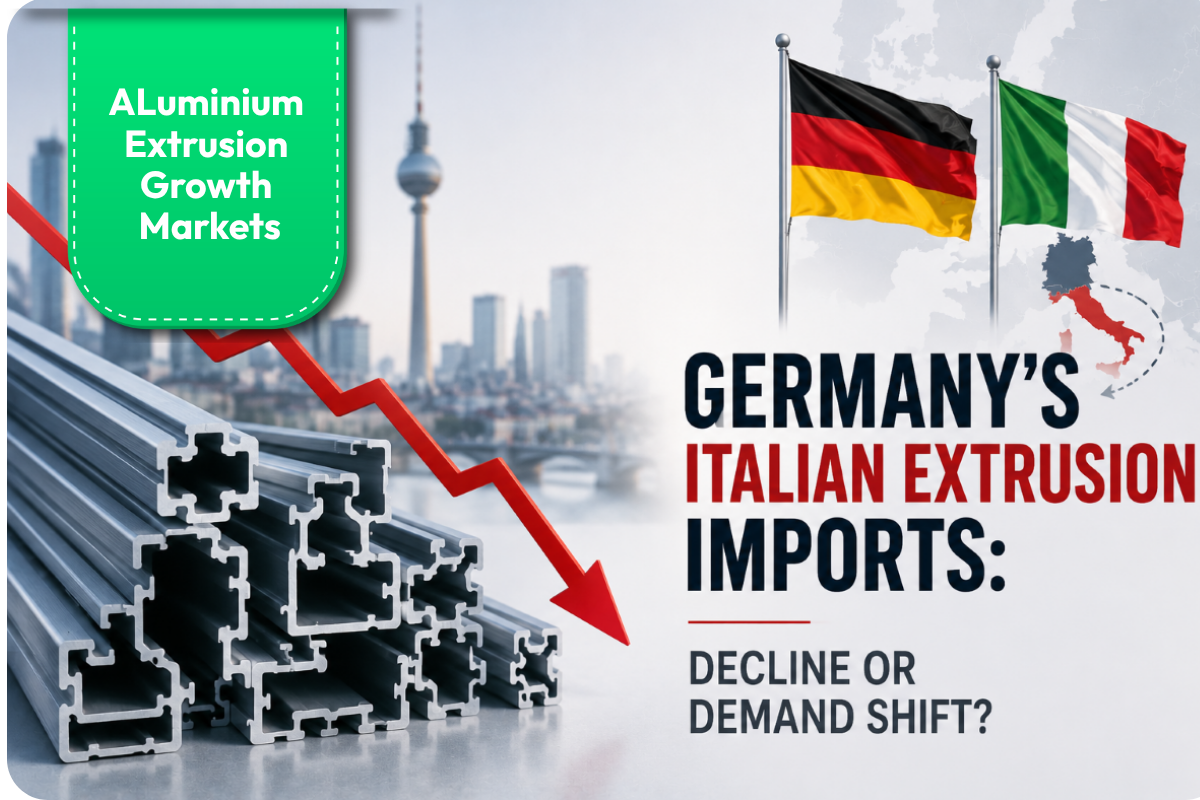
The image used in this article is generated with an AI tool and does not depict any real-time moment
Germany and Italy have long been closely linked in Europe’s aluminium extrusion trade. Italy remains a significant source of extruded aluminium for the German market, but the flow has changed considerably over the past few years. The latest numbers raise an interesting question: is Germany simply buying fewer Italian extrusions, or is the country’s demand for the product itself going through a broader transformation?
German aluminium extrusion imports from Italy stood at 43,496.98 tonnes in January-May (YTD) 2022. By YTD 2023, that had fallen to 35,197.76 tonnes, down 19.08 per cent year on year. Imports declined again in YTD 2024 to 30,420.46 tonnes, a further 13.57 per cent decrease.
Then the fall appeared to pause. Imports in YTD 2025 were almost unchanged at 30,397.72 tonnes, declining just 0.07 per cent. But in YTD 2026, volumes fell again to 25,303.24 tonnes, down 16.76 per cent. Across the four-year period, imports from Italy have therefore fallen 41.83 per cent.
The full year trade picture
Germany imported 100,215.8 tonnes of aluminium extrusions from Italy in 2021. The volume slipped 4.43 per cent to 95,780.8 tonnes in 2022, before falling more sharply by 25.90 per cent to 70,975 tonnes in 2023.
Imports fell another 7.23 per cent in 2024 to 65,844.2 tonnes. Then the direction changed. In 2025, German imports from Italy recovered 7.21 per cent to 70,589.6 tonnes.
However, Italy’s share of Germany’s total aluminium extrusion imports has remained relatively resilient despite the decline in shipment volumes.
Italy accounted for 12.36 per cent of Germany's total aluminium extrusion imports in YTD 2022. Its share declined to 11.26 per cent in YTD 2023, before edging up to 11.46 per cent in YTD 2025. In YTD 2026, the share rose again to 11.87 per cent. For the exact figures and detailed sector-wise outlook, read our updated aluminium extrusion report - The World of Aluminium Extrusions to 2035 - Demand Forecast | Price Benchmarking | Plant Economics | Strategic Growth Sectors.
To understand why volumes have changed, the focus has to move from trade to demand.
The first warning came from costs - then demand weakened
The change became particularly visible after 2022, when Europe's aluminium industry was hit by sharply higher energy costs following the Russia-Ukraine conflict.
German aluminium billet premiums averaged USD 1,528 per tonne in May 2022, compared with USD 935 per tonne in May 2021.
At the same time, demand was beginning to lose momentum. By mid-2022, European aluminium market participants were already reporting weaker demand, with the softness continuing into 2023.
Construction was one of the areas feeling the pressure. Germany's construction sector contracted 4.4 per cent in real terms in 2023.
The extrusion market faced additional changes in 2024. The German government's cancellation of EV purchase subsidies in December 2023 added pressure, while German extruders also faced growing competition from third-country suppliers, particularly Turkey.
Connect with verified aluminium extrusion buyers and suppliers through the AL Biz marketplace.
How the automotive industry fits into the equation
Automotive is an important end-use market for aluminium extrusion. Extruded profiles are used in EV battery enclosures, crash-management systems, chassis and structural components, body structures and thermal-management systems.
Their lightweight and high-strength properties make aluminium extrusions particularly relevant as automakers increase the use of lightweight materials and EV-specific components.
German automotive production has taken several turns since 2021. As global semiconductor shortages eased, production grew 11 per cent year on year in 2022, followed by an 18 per cent increase in 2023, taking output to 4.11 million vehicles, as per various industry sources.
To know the global production, demand and consumption forecasts of aluminium extrusions, explore our report "The World of Aluminium Extrusions to 2035"
The rebound included 2.67 million vehicles built at Volkswagen's German plants, alongside 1.18 million from BMW and 1.02 million from Mercedes-Benz.
The momentum then faded. German automotive production fell back below 4 million units in 2024, continuing a longer-term decline from 5.6 million vehicles in 2017. Across the EU, automotive production was projected to fall around 6.5 per cent that year.
By 2025, production volumes were roughly stable, but profitability came under pressure. Mercedes-Benz profit fell 56 per cent, Porsche operating profit dropped 91 per cent, and BMW profit declined by a third, largely amid weaker sales in China.
Passenger-car registrations, meanwhile, have followed a more mixed path. They fell 10.1 per cent to 2.62 million in 2021, before increasing 1.1 per cent to 2.65 million in 2022 and 7.3 per cent to 2.84 million in 2023. Registrations then declined 1 per cent to 2.82 million in 2024, before rising 1.4 per cent to 2.86 million in 2025, as per various industry sources.
For aluminium extruders, that shift matters because the opportunity is increasingly linked not just to the number of vehicles produced, but to the changing mix of components used in those vehicles.
AL Circle is coming up with a new Magazine "ALuminium’s Frontline: OEM Edition 2026." Feature your brand and opinion in the edition
Construction remains the other piece of the puzzle
Automotive is only one side of Germany's extrusion demand. Construction remains equally important, particularly for architectural and structural applications.
Aluminium extrusion is widely used for window and door frames, curtain walls, façades, roofing systems, railings, partitions, structural frames and other architectural applications.
The material's low weight, high strength and corrosion resistance make it suitable for a wide range of applications, while extrusion allows manufacturers to create complex shapes for both structural and decorative uses.
The German construction market, however, has been under sustained pressure.
Output contracted across all subsectors in 2022, while the residential building cost index increased 13.4 per cent that year. The market shrank another 4.4 per cent in real terms in 2023. In 2024, growth was marginal at best. Building permits fell 11.5 per cent, while insolvency filings rose 23.6 per cent year on year.
The decline continued into 2025, when construction output fell 1.8 per cent in real terms - the fifth consecutive year of contraction. Building permits were down 43 per cent cumulatively since 2021. Even in Q1 2026, construction value-add remained under pressure, falling 4.4 per cent year on year, as per various industry sources.
Still, there are signs that the picture could begin to change.
H2 2026: Outlook
The direction of Germany's aluminium extrusion market in the second half of 2026 could depend heavily on what happens in automotive and construction.
In January-July 2026, German passenger-car registrations reached 1.75 million, up 5.1 per cent year on year, while passenger-car production stood at 2.43 million units, down 3 per cent y-o-y. The shift towards EVs is even more notable, with electric vehicles accounting for 41 per cent of new registrations in July and EV registrations rising 44 per cent y-o-y.
This could support extrusion demand as automotive lightweighting remains a key structural driver. The VDA expects German battery-electric vehicle production to rise 30 per cent to 693,000 units in 2026, even as overall domestic passenger-car production edges down around 1 per cent and vehicle exports slip slightly to 3.2 million units.
AL Circle's report also identifies automotive and EV structural components, including battery trays, crash-management structures and busbars, as among Europe's strongest extrusion growth niches through 2035.
Construction could provide another source of support. Germany's construction investment is projected to grow around 1.7 per cent in real terms in 2026, backed by the “Sondervermögen Infrastruktur und Klimaneutralität” infrastructure fund.
The numbers therefore point to a market that is not simply getting smaller - it is changing.
Note: This is an exclusive coverage by AL Circle and may not be reproduced, republished or shared without prior permission.
Lumino Industries debuts at ₹109, 32.93% above issue price, with 40kt aluminium capacity
Next articleCanada-US trade talks: Carney seeks deal as aluminium and auto tariff pressure mounts
Grow with
AL Circle