Aluminium extrusion usage in building and construction to grow 1.24% CAGR through 2035, with Americas at 1.15%, Europe at 1.30% & MEA at 2.47%
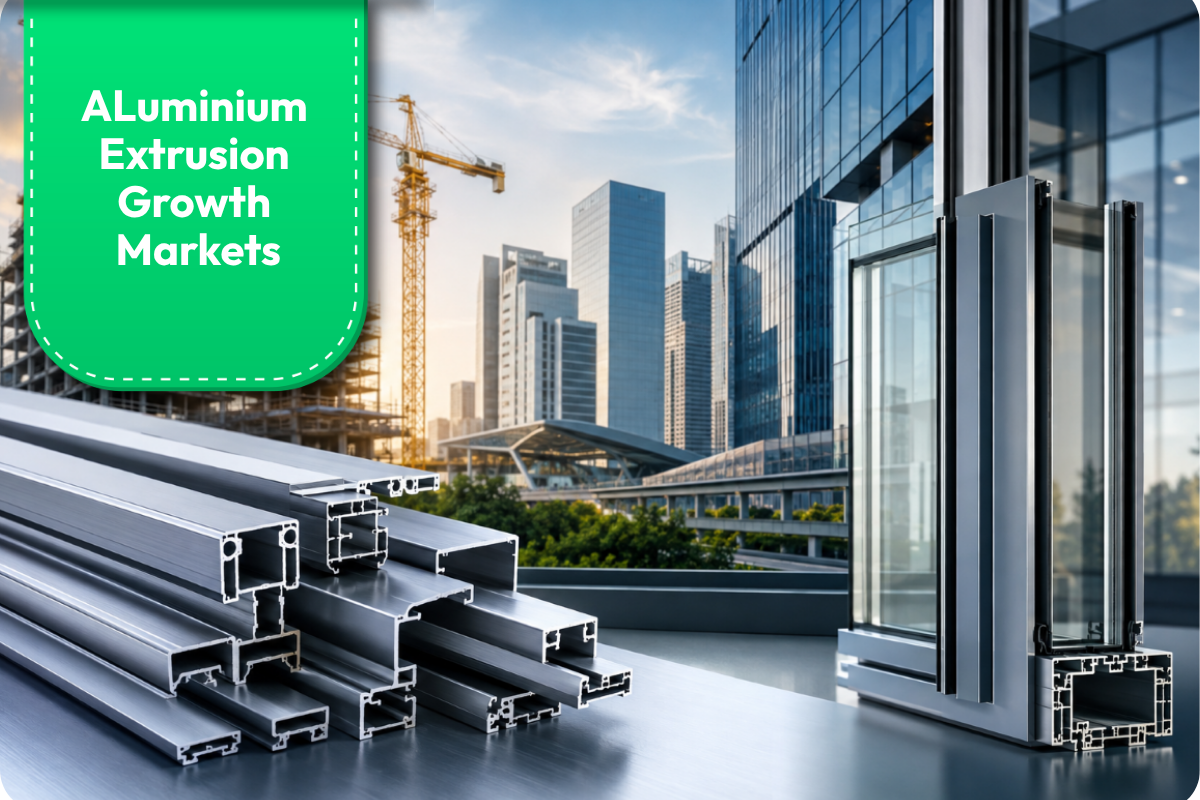
The image used in this article is generated with an AI tool and does not depict any real-time moment
What does the building and construction market mean for aluminium extrusion industry? The answer may depend less on how much the world builds and more on where it builds and what those buildings require. As construction activity picks up across regions, aluminium extrusion is set to follow - but with the strongest opportunities emerging in different ways across markets.
The global construction market was valued at about USD 11.4 trillion in 2024 and is estimated at USD 12.1 trillion in 2025. It is forecast to expand to around USD 16–17 trillion by 2030, representing a 5-6 per cent CAGR over the next five years, according to various industry sources.
This expansion matters for aluminium extrusion because building and construction is already the largest end-use sector for extruded aluminium. In 2025, it accounted for 19.31 million tonnes, or approximately 54.8 per cent of total global extrusion usage. Usage is forecast at 19.30 million tonnes in 2026, with the sector expected to register a 1.12 per cent CAGR through 2030 and a 1.24 per cent CAGR through 2035. For the exact figures and detailed sector-wise outlook, read our updated aluminium extrusion report - The World of Aluminium Extrusions to 2035 - Demand Forecast | Price Benchmarking | Plant Economics | Strategic Growth Sectors.
However, its 1.24 per cent CAGR is significantly below the 2.29 per cent CAGR of the global market. Consequently, its share is expected to decline from 54.8 per cent in 2025 to 49.4 per cent by 2035.
So, as the construction market moves into its next cycle, where will the biggest extrusion opportunities emerge?
The growth map is moving east - and south
The answer begins with Rest of Asia & Oceania (ROA), where building and construction extrusion usage is expected to rise from 1.79 million tonnes in 2025 to 1.83 million tonnes in 2026. The sector is projected to grow at a 3.58 per cent CAGR through 2032, accelerating to a 3.80 per cent CAGR through 2035.
Close behind is the Middle East & Africa, where usage is expected to increase from 1.52 million tonnes in 2025 to 1.56 million tonnes in 2026. The sector is projected to grow at a 2.45 per cent CAGR through 2032 and a 2.47 per cent CAGR through 2035.
That puts ROA and the Middle East & Africa ahead of other regions in terms of building and construction extrusion growth through 2035. But what is driving this stronger performance?
Two regions, two different growth stories
In ROA, rapid urbanisation is translating into new housing, commercial space and infrastructure across South and Southeast Asia. South Asia is projected to grow 6.0 per cent in 2026, while South-East Asia is expected to expand 5.0 per cent, well above the broader Asia-Pacific growth of 0.5 per cent, which is being weighed down by China's slower pace.
Manufacturing and industrial activity is adding another layer of construction demand, while strong imports indicate that local supply is still catching up with regional requirements.
The Middle East & Africa, meanwhile, is following a more investment-led path. Saudi Vision 2030, UAE giga-projects and broader economic diversification plans are driving infrastructure, construction, renewable-energy and industrial projects, particularly across the GCC.
Regional conflicts and disruptions to logistics and energy supplies have raised input costs and increased supply-chain uncertainty for aluminium producers and downstream processors. But, at the same time, localisation efforts in Saudi Arabia and the UAE are encouraging investment in extrusion capacity and downstream aluminium manufacturing.
To know the global production, demand and consumption forecasts of aluminium extrusions, explore our report "The World of Aluminium Extrusions to 2035 - Demand Forecast | Price Benchmarking | Plant Economics | Strategic Growth Sectors"
what about the markets already using aluminium at scale?
The picture changes as the focus moves to mature markets.
In North America, building and construction extrusion usage is forecast to decline from 0.96 million tonnes in 2025 to 0.94 million tonnes in 2026. It is then projected to grow at a 0.87 per cent CAGR through 2032 and a 1 per cent CAGR through 2035 from 2025.
Future extrusion demand in North America is likely to shift increasingly from conventional building activity towards industrial, digital and energy infrastructure projects.
Europe is following a similar path. Building and construction extrusion usage is forecast to decline slightly from 1.52 million tonnes in 2025 to 1.50 million tonnes in 2026, before growing at a 0.28 per cent CAGR through 2032 and a 1.30 per cent CAGR through 2035 from 2025.
There are already signs of improvement. European aluminium extrusion demand improved in H1 2026, with Q2 demand increasing 0.4 per cent year on year after a weaker first quarter. Read - Europe’s aluminium extrusion demand set to grow at 2.42% CAGR through 2035 - Which end-use sectors will drive it?
But the opportunity in Europe extends beyond new construction. An ageing building stock is creating a growing renovation market, while new commercial developments and the EU Green Deal are supporting demand for aluminium façades, window frames and structural glazing.
Connect with verified aluminium extrusion buyers and suppliers through the AL Biz marketplace.
Building and construction already accounts for more than 40 per cent of European extrusion consumption, while more than 30 per cent of new EU construction projects specify aluminium extrusions for window and door systems.
South America, meanwhile, offers a more gradual growth path. Building and construction extrusion usage is forecast to remain at 0.53 million tonnes in 2025 and 2026, before growing at a 1.54 per cent CAGR through 2032 and a 1.42 per cent CAGR through 2035 from 2025.
Economic volatility, currency swings and uneven construction financing, particularly in Brazil and Argentina, are keeping near-term growth measured. Still, continued urbanisation, infrastructure investment and rising aluminium use in commercial and residential buildings are creating a steady foundation for expansion.

China remains the volume story
Then there is China, which continues to set the scale of the global market.
Building and construction extrusion usage is forecast at 12.98 million tonnes in 2025, easing slightly to 12.95 million tonnes in 2026. It is then projected to reach 13.62 million tonnes by 2032, representing a 0.69 per cent CAGR.
The near-term weakness reflects the prolonged property downturn. Fewer housing starts, weaker transactions and financial pressure on developers are reducing demand for doors, windows and curtain-wall profiles.
Yet other areas are providing support, including industrial parks, factories, government buildings, renovation and home-decoration activity. At the same time, China's extrusion industry is increasingly shifting capacity towards new energy, power infrastructure, EV and heat-dissipation applications.
That leaves construction as a large but relatively stable, low-growth base, rather than the industry's main growth engine.
What will the next building and construction boom actually use?
The regional numbers tell only part of the story. The other part is happening inside the buildings themselves.
Aluminium's lightweight properties, corrosion resistance, design flexibility, durability and recyclability make it a natural fit for construction. Extruded profiles are widely used in windows and doors, curtain walls, facades, roofing systems, railings, balustrades, partitions, skylights, canopies and other architectural applications.
Window and door systems remain a major application, with extrusions used for frames, sliding systems, casement windows and entrance structures. Growing focus on building energy efficiency is driving wider adoption of thermal-break and multi-chamber profiles, particularly in Europe.
In commercial and high-rise construction, curtain walls and façades remain important applications, supporting complex designs while keeping structures lightweight. Demand is also expanding in solar shading, canopies, skylights and roof systems, where integrated fastening and reinforcement features can enable faster installation.
Inside buildings, aluminium profiles are used across partitions, ceiling grids, wall framing, modular offices, decorative trims and architectural fittings. Growing modular and prefabricated construction is further supporting demand for precision extrusions.
AL Circle is coming up with a new Magazine "ALuminium’s Frontline: OEM Edition 2026." Feature your brand and opinion in the edition
What does this mean for aluminium extrusion?
The construction market is entering a period of expansion, but the aluminium extrusion opportunity is becoming more targeted. While global construction is projected to grow at a 5-6 per cent CAGR from 2025 to 2030, building and construction extrusion usage is expected to grow at 1.12 per cent through 2030 and 1.24 per cent through 2035.
The regional picture adds more context. ROA and the Middle East & Africa are emerging as the fastest-growing extrusion markets, supported by new construction, urbanisation and infrastructure investment. At the same time, Europe and North America are seeing demand evolve towards renovation, infrastructure and specialised applications, while China continues to provide the industry's largest volume base.
The takeaway is clear: construction growth is creating opportunities across markets, but the nature of that opportunity is changing - from new-build volume in emerging regions to renovation, infrastructure and higher-value applications in mature markets.
Note: This is exclusive coverage by AL Circle and may not be reproduced, republished or shared without prior permission.
DCM Shriram starts aluminium extrusion operations at Kota as ₹1.5b project progresses
Next articleLumino Industries debuts at ₹109, 32.93% above issue price, with 40kt aluminium capacity
Grow with
AL Circle





















