How investment priorities and changing production requirements are reshaping aluminium coil and strip processing
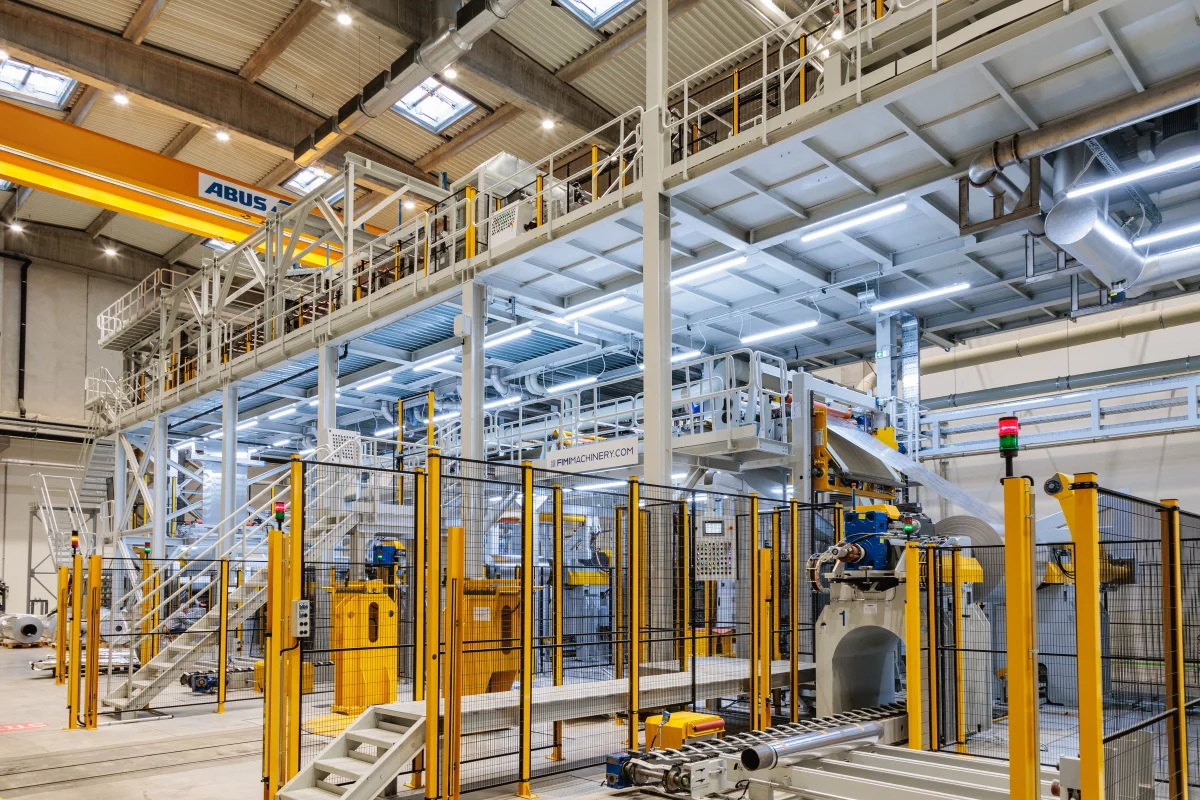
Provided by FIMI Group in an interview
Changing production requirements, selective capital expenditure and the need for greater operational flexibility are influencing investment decisions across aluminium coil and strip processing. In its OEM 2026 edition, ALuminium’s Frontline: OEM Edition 2026, AL Circle spoke with Mario Colombo, Sales Director at FIMI Group, to understand the investment trends, equipment upgrades, automation challenges and production priorities shaping the industry.
Investment trends: Where companies are investing and why
AL Circle wanted to understand how FIMI assesses the current investment appetite among aluminium rolling companies, service centres and downstream processors, as well as the markets where it is seeing investment activity.
According to Colombo, investment activity remains present, but companies are becoming more selective about where they allocate capital. Decisions are increasingly linked to clear operational requirements, such as expanding capacity, improving surface quality, reducing scrap, lowering costs or replacing production bottlenecks.
While larger rolling companies are looking at long-term efficiency, quality and product mix, service centres and downstream processors are prioritising flexibility, faster changeovers and the ability to handle different materials and order sizes. Energy costs, financing conditions, trade measures and raw material volatility continue to influence investment decisions.
“The investment appetite is present, but it is more selective than it was a few years ago,” says Colombo. He adds, “The market is cautious, not inactive.”
On the regional front, India and the Middle East stand out as particularly dynamic markets. India's industrial growth, infrastructure development, consumption and manufacturing activity are supporting investment interest. In the Middle East, aluminium availability and the focus on diversification and downstream processing are creating opportunities. Turkey is also active, while investment in Europe is more focused on modernisation, efficiency and extending the life of existing assets. Asia continues to offer opportunities alongside competition.
FIMI's positioning in these markets draws on its specialised know-how, international references, machinery, automation and digital tools, supported by its service capabilities.
Another important consideration in investment decisions is whether to install a new production line or revamp existing equipment. Colombo explains that both approaches remain relevant. In mature markets, revamping and targeted upgrades are receiving greater attention, particularly where existing plants have a sound mechanical base but outdated automation, electrical systems, drives, safety features or process sections.
Upgrades can help restore reliability and performance while extending asset life, often with a lower investment and shorter implementation period. New lines, meanwhile, become relevant when companies need additional capacity, want to manufacture new products or require higher speeds and tighter tolerances that their existing equipment cannot support.
However, revamping may no longer be sensible when equipment has widespread wear, an unsuitable layout, insufficient structural capacity, significant safety gaps or a lack of spare parts. It can also become difficult to justify when the required product range differs substantially from the line's original design.
There is also a risk that upgrading automation and drives will not deliver the expected performance if the mechanical sections continue to limit speed, quality or flexibility. Repeated upgrades and shutdowns can add complexity, with the overall cost and production impact approaching that of installing a new line.
The decision, therefore, depends on the condition of existing assets, future product mix, available space, shutdown windows and expected returns. As Colombo emphasises, “A proper technical assessment should define which parts still have value and which would remain a bottleneck after the upgrade.”
He also explains FIMI’s role in evaluating these decisions: “Our role is to give the customer a realistic lifecycle assessment, including expected performance, remaining risks, implementation time and future maintainability.”
Changing production requirements: Flexibility, productivity and plant bottlenecks
AL Circle also explored how changing order sizes and product requirements are influencing the design and performance expectations of aluminium processing lines.
Colombo points to a broader range of alloys, tempers, gauges, widths and surface requirements, alongside smaller orders and tighter delivery expectations. In this environment, productivity is not determined by line speed alone. Changeover times, recipe management, automatic settings, transition scrap and repeatability between batches are also important considerations.
Processing lines therefore need to offer flexibility across a wider process window. Automation, material handling, logistics and traceability also form part of the requirements for managing this variety of production demands.
These changing requirements also make it important to identify bottlenecks across the complete production process. Colombo explains that there is no single bottleneck common to every plant. In many cases, the challenges emerge at the interfaces between different processes.
These can include coil handling, inspection, data exchange and finished-product logistics. Protecting delicate surfaces and materials, maintaining levelling and slitting accuracy without marks, and preparing surfaces before coating are also important considerations. Integrated quality inspection and manual handling or packaging operations can further affect productivity and safety.
For FIMI, addressing these challenges requires looking beyond individual machines and considering the movement of material across the complete plant.
The digital shift: Industry 4.0 and connected production lines
With digitalisation becoming part of production environments, AL Circle explored the practical challenges of implementing Industry 4.0 technologies and integrating modern automation with existing machinery.
Colombo notes that the technology itself generally performs well. The difficulties are more often associated with data quality and consistency, connectivity, cybersecurity, access rights and the adoption of digital systems by operators and maintenance teams.
Digital platforms can improve visibility, support the early detection of abnormal behaviour and enable remote assistance. However, their usefulness depends on reliable data, meaningful alarms and the ability of users to interpret the information. Excessive alerts, poorly defined thresholds and incomplete machine histories can reduce confidence in these systems.
FIMI's approach involves validating data during commissioning, fine-tuning systems and providing training, while implementing digital tools progressively around useful indicators.
As Colombo explains, “A digital platform creates value only when the data is reliable, the alarms are meaningful and people know how to interpret the information.”
Integrating modern automation with existing machinery is another challenge, particularly where older equipment uses proprietary controls or obsolete communication protocols. Colombo considers interoperability manageable when it is addressed early. However, older systems may have undocumented signals or outdated protocols that make it difficult to exchange production orders, recipes, quality information and maintenance data.
A proper assessment of controls, drives, sensors, networks, documentation and equipment condition helps determine the most suitable approach. Depending on the situation, this may involve gateways, upgraded control layers or phased replacement.
Colombo cautions against attempting to connect systems without first establishing how the data should be structured and exchanged.
A lifecycle approach to equipment investment
Across these investment and technology decisions, FIMI's perspective centres on assessing the complete production line, its existing condition and its future requirements.
A revamp can be highly effective when the existing line has a sound mechanical base and clearly identifiable weak points. However, when obsolescence affects the complete production concept, replacement may be the more sustainable long-term decision.
This conversation with Mario Colombo, Sales Director at FIMI Group, is part of AL Circle's ALuminium’s Frontline: OEM Edition 2026. Read the full interview.
Grow with
AL Circle












_md.webp)
_md.webp)
_md.webp)