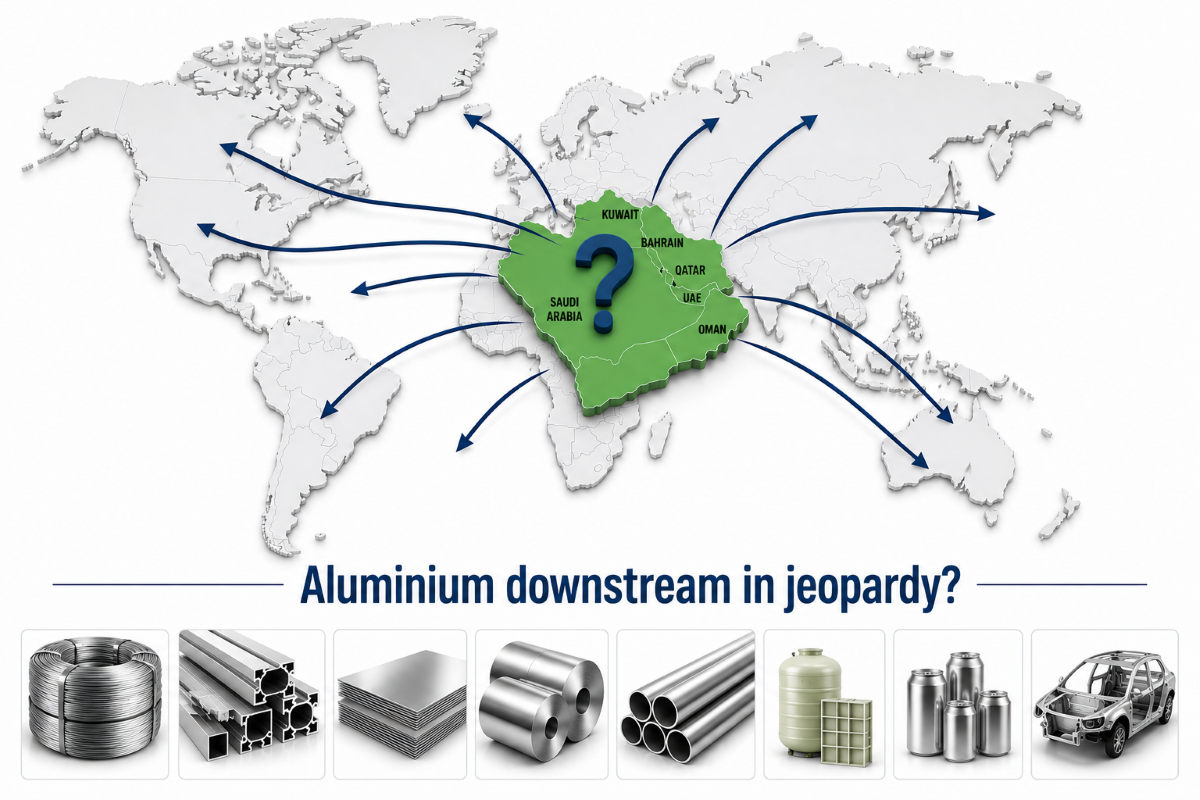
Over the years, the Middle East has been a notable contributor to the global primary aluminium production and trade. Out of the 6-6.5 million tonnes produced in the region, 5-5.5 million tonnes are exported, underlining the lion’s share of the production being shipped overseas. This share accounts for about 9 per cent of the total primary aluminium trade volume in the global market. However, it is interesting to note that the Middle Eastern region, particularly the Gulf Cooperation Council, also contributes to the trade and export of aluminium downstream products.
Discover: The Gulf aluminium market risks, China impact, and logistics disruptions shaping pricing and trade in the Gulf Disruption Roadmap
Uday Patel, Principal Analyst at Wood Mackenzie, noted, “What this disruption highlights are how concentrated and fragile aluminium supply chains have become.”
Ever since the onset of geopolitical tensions stemming from the Middle East conflict among Iran, Israel and the United States, followed by the closure of the Strait of Hormuz trade corridor, the point made abundantly clear is the world’s dependence on the region for a balanced market for primary aluminium. “With so much production and export infrastructure tied to a single trade route, even short-term disruptions can have outsized and immediate global consequences,” Patel mentioned.
However, apart from the primary aluminium production gaps, another worrying situation arises in the supply chain, as the Middle East also ships a considerable volume of aluminium downstream products to the global market. As import routes for sourcing raw material remain blocked, the downstream sector faces grave jeopardy.
The GCC chart of aluminium downstream production and export
As of 2025, the GCC countries, barring Kuwait, have exported about 767,044.83 tonnes of aluminium downstream products overseas. The top buyers with the approximate purchase volumes of GCC-produced aluminium downstream products are:
- The United States – Sourced 2,15,840.72 tonnes or 12.05 per cent of the total import volume of 17,91,282.60 tonnes.
- Canada – Sourced 49,610.12 tonnes or 8.18 per cent of the total import volume of 6,06,195.20 tonnes.
- Turkey – Sourced 30,349.42 tonnes or 8 per cent of the total import volume of 3,78,645.23 tonnes.
- Egypt – Sourced 80145.34 tonnes or 96 per cent of the total import volume of 82,628.59 tonnes.
- Iraq – Sourced 42852.2 tonnes or 68.6 per cent of the total import volume of 62,457 tonnes.
Being almost completely dependent on the GCC bloc, Egypt and Iraq are faced with grave challenges in running the downstream sectors. Turkey may source a greater amount from China, but it is doubtful whether China can fill all the GCC supply gaps. The US may face difficulty in mitigating the sudden halt in imports as it trades downstream products with Canada, its top sourcing country and vice versa. The situation is compounded as Bahrain is among its top five sources. Canada, too, faces blocked intake routes, as apart from the US, Saudi Arabia and Bahrain are two of its top sources.
What is the intra-GCC trade scenario?
Since the Gulf nations export about 85 per cent of their primary aluminium to the foreign market, intra-GCC trade becomes essential for sustaining their national downstream industries. The 2025 estimated data sheds light on the interdependent nature of the GCC countries to support their downstream sector:
- Bahrain – Sourced 4899.08 tonnes or 54.23 per cent of the total import volume of 9034.5 tonnes.
- Oman – Sourced 16104.99 tonnes or 54.35 per cent of the total import volume of 29630.13 tonnes.
- Qatar – Sourced 6184.61 tonnes or 29.35 per cent of the total import volume of 21075.03 tonnes.
- Saudi Arabia – Sourced 81896.21 tonnes or 35.2 per cent of the total import volume of 232578.39 tonnes.
- The United Arab Emirates – Sourced 56,234.58 tonnes or 16.54 per cent of the total import volume of 340095.1 tonnes.
As global aluminium prices maintain consistency on the rising graph, with the Middle East conflict pushing the limit as high as USD 4,000 per tonne, a ripple effect falls upon the downstream sector, as the lack of raw material would affect downstream production. Strained fuel supply is affecting the aluminium extrusion industry, as well as putting an indefinite pause on smelting and downstream production, leaving a question mark hanging over how the supply gaps might be filled and the deficit made up for.
Who leads the GCC symbiosis and why is it a concern?
Amongst the Gulf nations, Bahrain stands out as the greatest contributor of downstream products to the other countries. In 2025, Bahrain alone shipped 90,926.7 tonnes (approx.) to Oman, Qatar, Saudi Arabia and the UAE.
Apart from being a leading producer of primary aluminium with an average production capacity of around 1.6 million tonnes per year, Aluminium Bahrain (Alba) is also a major supplier to the downstream industries.
Alongside its export operations, 50 per cent of Alba’s primary production is channelised into the downstream sector of the country to support the nation’s industrial development.
Due to the Middle East conflict, smelters in the region have been operating at a reduced capacity, including the controlled shutdown of Alba’s potlines 1, 2, and 3. Compounded by geopolitical tensions such as Iranian attacks on the facilities of Alba and Emirates Global Aluminium (EGA), there is no indication of restarting full-capacity operations for the time being.
These disruptions in the supply chain were followed by the Q1 2026 results of Alba, which recorded a major drop in sales by 17 per cent. Compared to Q4 2025, the company’s profit slipped about 30.7 per cent quarter-on-quarter, from BHD 108.7 million (USD 289.2 million) to BHD 75.3 million (USD 200.3 million).
To look for buying or selling leads of aluminium industrial extrusion products, visit our B2B marketplace.
Aluminium downstream steps into an uncertain 2026
The geopolitical tensions have left long-term effects on the aluminium industry, owing to the damaged smelters and the rapidly widening supply gap, thereby turning it into a chokepoint for the entire global market.
The year-to-date March 2025 export volume from the UAE to the world was about 32,215.6 tonnes. Comparing year-on-year, the volume dropped by a staggering 61.84 per cent to 12,293.27 tonnes. While the monthly average in the first three months of 2025 stands around 10,738.5 tonnes, it has fallen to 4,097.76 tonnes in Q1 of 2026.
Therefore, the rest of the three quarters of 2025 stand at a cumulative of around 96,646.5 tonnes. The cumulative projection of Q2, Q3 and Q4 2026 output based on the average drawn from Q1 2026 figures comes to an estimate of 36,879.84 tonnes, indicating the gaping deficit of 59,766.66 tonnes. This indicates a Y-o-Y decline compounded by the alarming effects and imminent after-effects of the geopolitical conflict, specifically the Iranian attacks at the Al Taweelah smelter, compelling EGA to shut down 60 per cent of primary production. It might take a considerable period of recovery unless the steady production momentum is restored, which, as per EGA’s official statement, “could take up to 12 months.”
On the other hand, to mitigate the immediate consequences of the blocked Strait of Hormuz trade corridor, EGA has been rerouting shipments through the Sohar port. Moreover, according to sources, EGA has been in talks with competing producer Sohar Aluminium of Oman, which has a production capacity of about 395,000 tonnes per year. EGA reportedly plans to take over TAQA's stake in the company, which is about 40 per cent, i.e., acquiring about 158,000 tonnes annually, or 13,166 tonnes every month. This indicates an attempt to reduce the deficit, which would cover only 9.87 per cent of Al Taweelah’s annual production of 1.6 million tonnes (approx.) and about 133,333 tonnes monthly.
Provided Oman is willing to give up its stake to the UAE, the deficit would still continue to prevail until the Al Taweelah facility is operational within a year, and the added stake from Sohar acts as a boost to fill up the present gaps and pick up pace on primary export as well as feed the downstream industries.
While this is only one case study, Alba’s potline shutdown and the damaged smelter of IRALCO in Iran remain the chokepoints in the Middle Eastern primary aluminium trade, indirectly affecting the downstream segment. As Alba states a recovery period of 6 to 12 months and IRALCO about 3 to 6 months, the heat of supply deficit spreads across the global aluminium supply chain from primary production through downstream to end use sectors. The Gulf nations face a graver challenge of restoring order on the production and export front while mitigating the obstacles in the domestic aluminium downstream industries.
Must read: Key industry individuals share their thoughts on the ALuminium LeaderSpeak 2026












_md.webp)
_md.webp)
_md.webp)







