Can a giant heat battery change how alumina is refined? Rio Tinto puts it to the test with their 360 MWh heat battery project at Yarwun alumina refinery
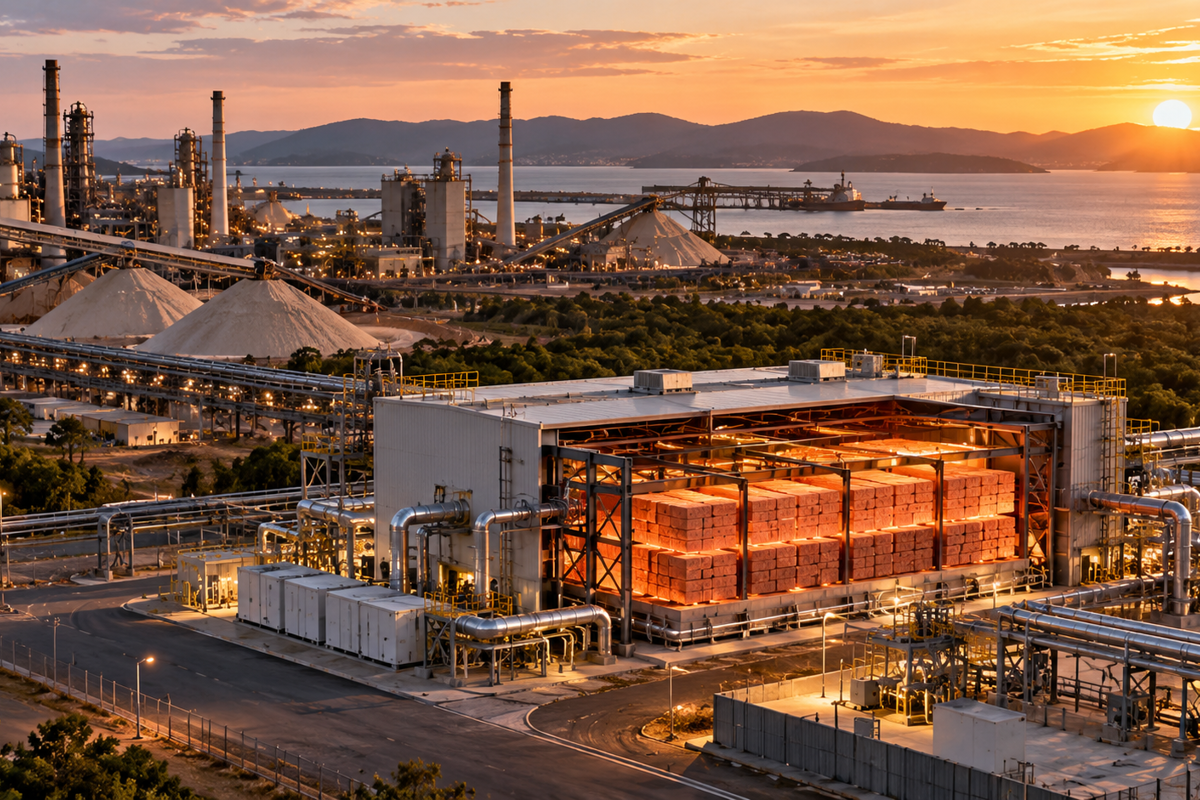
The image used in this article is generated with an AI tool and does not depict any real-time moment.
Rio Tinto and Rondo Energy have commenced front-end engineering and design for a 30 MW/360 MWh thermal energy storage project at the Yarwun alumina refinery near Gladstone, Queensland, marking a potential milestone in the use of heat batteries to reduce emissions from alumina refining.
The Rondo Heat Battery will store energy as high-temperature heat in refractory bricks and supply continuous process heat to support Rio Tinto’s alumina refining operations. If progressed, the project would be one of the first large-scale demonstrations of thermal energy storage for industrial process heat globally and a world-first for the alumina industry.
Heat batteries target round-the-clock industrial demand
Australia regularly experiences four to six hours of surplus solar-generated renewable electricity around the middle of the day. However, industrial facilities require heat continuously, including during periods when solar power is unavailable.
Rondo’s heat battery is designed to address this mismatch by charging when electricity is abundant and inexpensive, then discharging stored energy to provide continuous heat. The approach could enable industrial facilities to use periods of low-cost renewable electricity while maintaining the round-the-clock heat supply required for their operations.
To learn about the market potential of aluminium dross, explore "ALuminium Dross Processing: Generation, Recovery & Strategic Roadmap"
ARENA funding to support project development
The project will receive staged support from the Australian Renewable Energy Agency (ARENA), beginning with an initial grant of AUD 3.6 million (USD 2.53 million) to complete front-end engineering and design.
Following successful completion of a demonstration study, ARENA will provide up to AUD 38 million (USD 26.71 million) towards deployment. The agency has also approved up to AUD 33.3 million (USD 23.41 million) in conditional contingency support, if required.
Focus on industrial competitiveness and emissions
Rondo’s Australian head, Dr Kira Rundel, said the project demonstrates how Australia’s abundant energy resources could become a competitive advantage for industry.
“Heat batteries allow manufacturers to use low-cost electricity to produce the reliable, round-the-clock heat their operations need. Australia’s largest heat battery will show how factories can cut emissions without increasing energy costs, helping Australian industry to increase global competitiveness and supporting local manufacturing jobs," she stated.
Rio Tinto Pacific operations managing director Armando Torres said reducing emissions from alumina refining was complex, particularly when it came to generating the high-pressure steam required by its operations.
The project will test the potential for thermal energy storage to help meet these industrial heat requirements while supporting efforts to reduce emissions from alumina production.
To keep your aluminium operations running efficiently, explore essential consumables and connect with global suppliers on AL Biz.
Grow with
AL Circle