Brazil’s alumina ambition leaves a 13Mt red mud challenge: How effective is residue handling? The story behind one of aluminium's largest residues
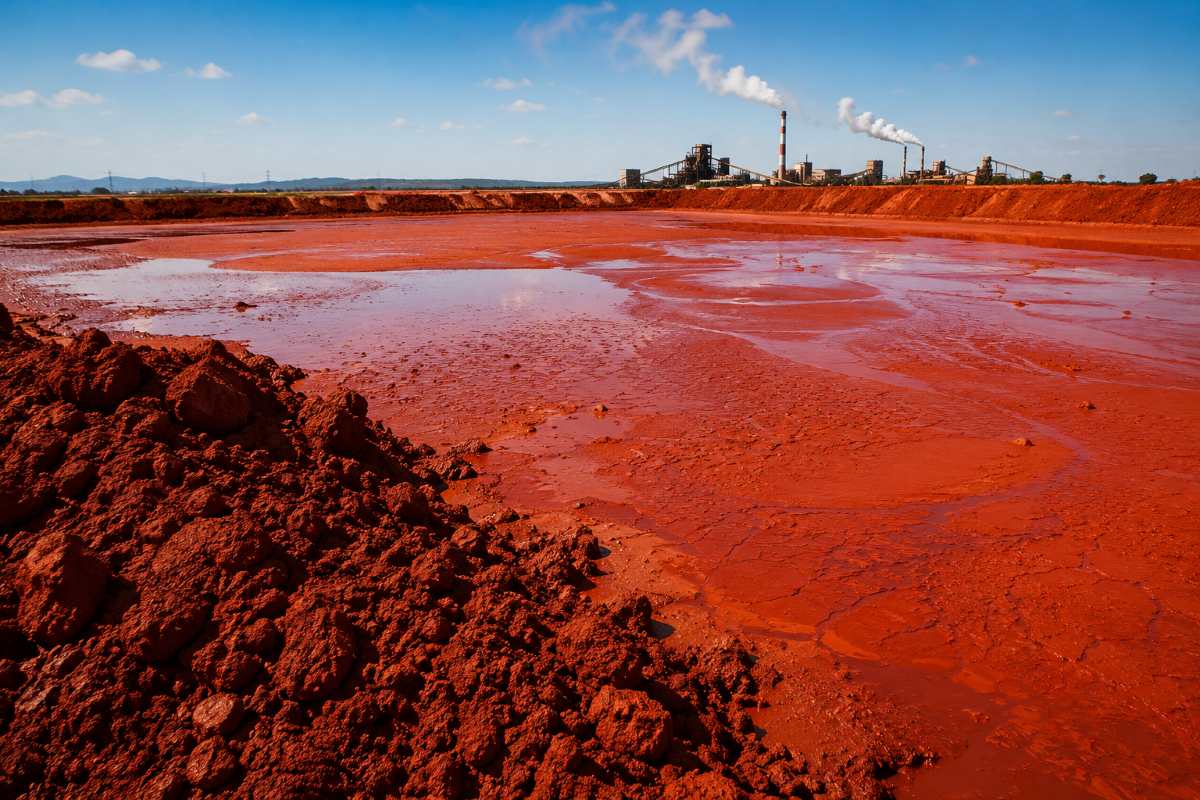
The image used in this article is generated with an AI tool and does not depict any real-time moment
Every year, Brazil produces more than 13 million tonnes of red mud, making it one of the world's largest generators of the aluminium industry's biggest industrial residue. Created during alumina refining, red mud is unavoidable-but the amount produced is never determined by the residue itself. It depends on everything that happens much earlier, from the quality of bauxite entering a refinery to how efficiently alumina is extracted.
In 2025, Brazil mined 33 million tonnes of bauxite. Around 27 million tonnes of that ore was refined domestically, producing 10.86 million tonnes of alumina and ultimately generating around 13.5 million tonnes of red mud.
The numbers appear straightforward, showing stable red mud generation alongside rising bauxite production. The explanation begins long before red mud reaches a storage facility.
The link between alumina and red mud
Red mud is produced only during the Bayer process, where alumina is extracted from bauxite. This means mining alone does not determine how much residue is created. Instead, red mud production closely follows alumina output, while alumina production depends on both bauxite quality and refinery efficiency.
Across the aluminium industry, producing one tonne of alumina generally requires 2.2-2.8 tonnes of bauxite, while every tonne of alumina leaves behind around 1-1.23 tonnes of red mud.
Brazil operates at the more efficient end of this range.
Its bauxite-to-alumina conversion ratio in 2025 stood at approximately 2.5:1, meaning around 2.5 tonnes of bauxite were required to produce one tonne of alumina. Around 40.2 per cent of the bauxite refined domestically was converted into alumina, compared with 42.5 per cent in 2022, showing that refinery performance has remained consistently high.
To know the futuristic market and value proposition of red mud, explore the report "A Comprehensive Analysis of Bauxite Residue (Red Mud): Sustainability, Resource Recovery and Strategic Recommendations"
High-quality bauxite shapes Brazil's red mud generation
Not all bauxite deposits contain the same amount of recoverable alumina. Higher-grade ore enables refineries to extract more alumina while processing less material, improving efficiency throughout the Bayer process and ultimately influencing how much red mud is produced.
Brazil possesses 1.7 billion tonnes of bauxite reserves, accounting for around 6 per cent of global reserves. In 2025, the country produced 33 million tonnes, representing about 7 per cent of global output.
Its bauxite is predominantly gibbsite-rich, containing 52.4 per cent Al₂O₃, while its alumina yield reaches 92.77 per cent. As a result, Brazilian refineries generally require only 2.2-2.4 tonnes of bauxite to produce one tonne of alumina, compared with the global average of 2.2-2.8 tonnes.
Although Brazil increased bauxite production from 30 million tonnes in 2022 to 32 million tonnes in 2023, before reaching 33 million tonnes in both 2024 and 2025, that additional mining did not translate into significantly higher red mud generation because alumina production remained relatively stable.
A consistent pattern in Brazil's red mud generation
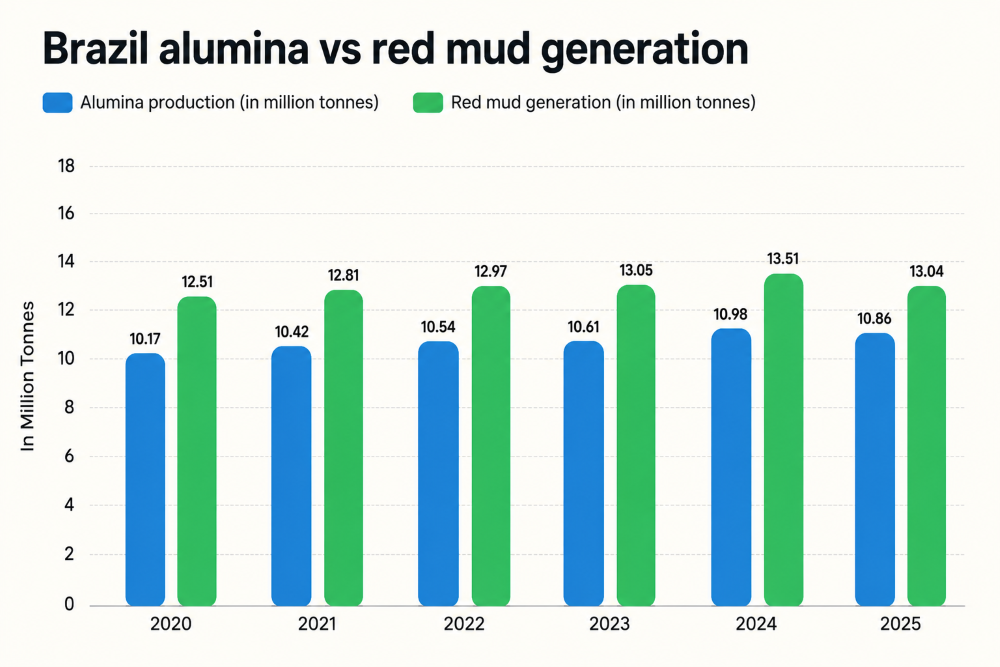
The production data clearly demonstrates the relationship.
Between 2020 and 2025, Brazil's alumina output fluctuated within a narrow range. Production stood at 10.17 million tonnes in 2020 before rising to 10.98 million tonnes in 2021. It remained virtually unchanged at 10.97 million tonnes in 2022, eased to 10.57 million tonnes in 2023, recovered to 10.71 million tonnes in 2024 and reached 10.86 million tonnes in 2025.
Red mud generation mirrored this trend almost perfectly. Output increased from 12.51 million tonnes in 2020 to 13.51 million tonnes in 2021, edged down slightly to 13.49 million tonnes in 2022, declined to 13 million tonnes in 2023 and recovered to 13.17 million tonnes in 2024 before reaching 13.35 million tonnes in 2025.
Throughout the six-year period, Brazil consistently generated around 1.2 tonnes of red mud for every tonne of alumina produced, reinforcing that residue generation depends far more on refining output than on mining volumes.
Also, Brazilian red mud is far from a uniform industrial residue. It contains 37.16 per cent iron oxide (Fe₂O₃) and 35.5 per cent alumina (Al₂O₃) by weight, together with 8.49 per cent sodium oxide (Na₂O), 6.18 per cent titanium dioxide (TiO₂), 2.34 per cent silica (SiO₂) and 1.23 per cent calcium oxide (CaO).
This mineral-rich composition has attracted increasing interest for recovering valuable metals while supporting circular economy initiatives. Explore our report - A Comprehensive Analysis of Bauxite Residue (Red Mud): Sustainability, Resource Recovery and Strategic Recommendations.
The refinery network behind Brazil's red mud
The consistency of Brazil's red mud generation is also supported by its well-established refining industry.
The country's alumina refineries have a combined installed capacity of 11.35 million tonnes per annum.
The largest is Alunorte in Barcarena, Pará, operated by Norsk Hydro and its partners, with annual capacity of 6.30 million tonnes. It is followed by the São Luís (Alumar) refinery, jointly owned by Alcoa, South32 and Rio Tinto, with 3.86 million tonnes of annual capacity.
CBA's Alumínio refinery contributes 0.80 million tonnes annually, while Alcoa's Poços de Caldas refinery adds another 0.39 million tonnes.
Together, these facilities efficiently convert Brazil's high-grade bauxite into alumina, resulting in remarkably consistent red mud generation year after year.
Explore buying & selling leads of alumina and trade opportunities on AL Biz
How Brazil manages millions of tonnes of red mud
Producing red mud may be unavoidable, but managing it safely has become a central part of alumina refining.
At Hydro Alunorte in Barcarena, Pará, red mud undergoes press filtration before being placed in dry stacks. The refinery operates eight filter presses, producing residue with around 78 per cent solids. According to Hydro, modern press filtration can reduce moisture content to roughly 22 per cent, improving storage efficiency while reducing reliance on conventional wet disposal.
The filtered residue is transferred to dedicated dry storage facilities, including DRS2, one of Hydro's most advanced residue management systems.
A similar approach is adopted at Alcoa's Poços de Caldas refinery in Minas Gerais. Press filtration removes roughly 70 per cent of the moisture from red mud, allowing recovered water to be recycled back into the Bayer process before the remaining solids are transferred to dry disposal areas.
Across Brazil's major alumina refineries, press filtration and dry stacking have increasingly replaced traditional wet ponding, improving both environmental performance and long-term residue management.
Unlock key insights from leading companies and experts across the aluminium ecosystem with our e-Magazine - Mine to Market: Aluminium Producers & Manufacturers 2026
From industrial residue to future resource
Although red mud remains one of the aluminium industry's largest waste streams, perceptions are changing rapidly.
Its highly alkaline nature still requires careful management, including neutralisation with acidic flux before disposal. However, researchers have demonstrated its potential in road construction, landfill engineering, cement, ceramics and fly ash-based geopolymers.
Its greatest opportunity may lie in mineral recovery.
Scientists at the Max Planck Institute for Sustainable Materials have developed a process that converts iron-rich red mud into CO₂-free iron using green hydrogen and an electric arc furnace. Designed for residues containing 30-40 per cent iron oxide, the technology could help prevent up to 1.5 billion tonnes of CO₂ emissions from the steel industry.

Brazil's experience illustrates that red mud is shaped long before it reaches a storage facility. Driven by high-quality bauxite, efficient alumina refineries and modern residue management practices, the country has maintained remarkably stable red mud generation despite increasing mining activity. As new technologies continue to unlock its value, red mud is steadily evolving from an environmental liability into a strategic industrial resource.
Note: This is exclusive coverage by AL Circle and may not be reproduced, republished or shared without prior permission.
Impact advances Lake Hope HPA project, reports A$2.08m cash balance in June quarter
Next articleTRUNNANO highlights advanced ceramic crucibles for aluminium and high-temperature industries
Grow with
AL Circle