As the global aluminium market braces for a new phase of industrial transition, driven by decarbonisation, electric mobility, and infrastructure growth, the mineral fuelling this surge is quietly building geopolitical weight. Bauxite, the primary ore for aluminium, is showing a reshaped reserve landscape in 2024, with fresh data from AL Circle's research highlighting strategic concentrations that could redefine global supply chains. As of 2024, five countries dominate the global bauxite landscape by reserve volume: Guinea, Australia, Vietnam, Brazil, and Indonesia. Together, they account for over 66 per cent of the world’s total reserves. However, when juxtaposed with actual production output, the picture becomes more complex.
Global snapshot: 29 billion tonnes and counting
As of 2024, the world’s total bauxite reserves stood at 29.06 billion tonnes, based on the latest compiled figures. This marks not only the vast availability of the ore but also underlines how control over these resources is becoming synonymous with geopolitical leverage in the aluminium value chain.
Three countries, Guinea, Australia, and Vietnam, command the lion’s share of global reserves. Their cumulative reserves account for nearly 48 per cent of the world’s bauxite, making these nations pivotal players in any strategic recalibration of supply routes and downstream investment decisions.
Guinea, the world’s strategic bauxite arsenal
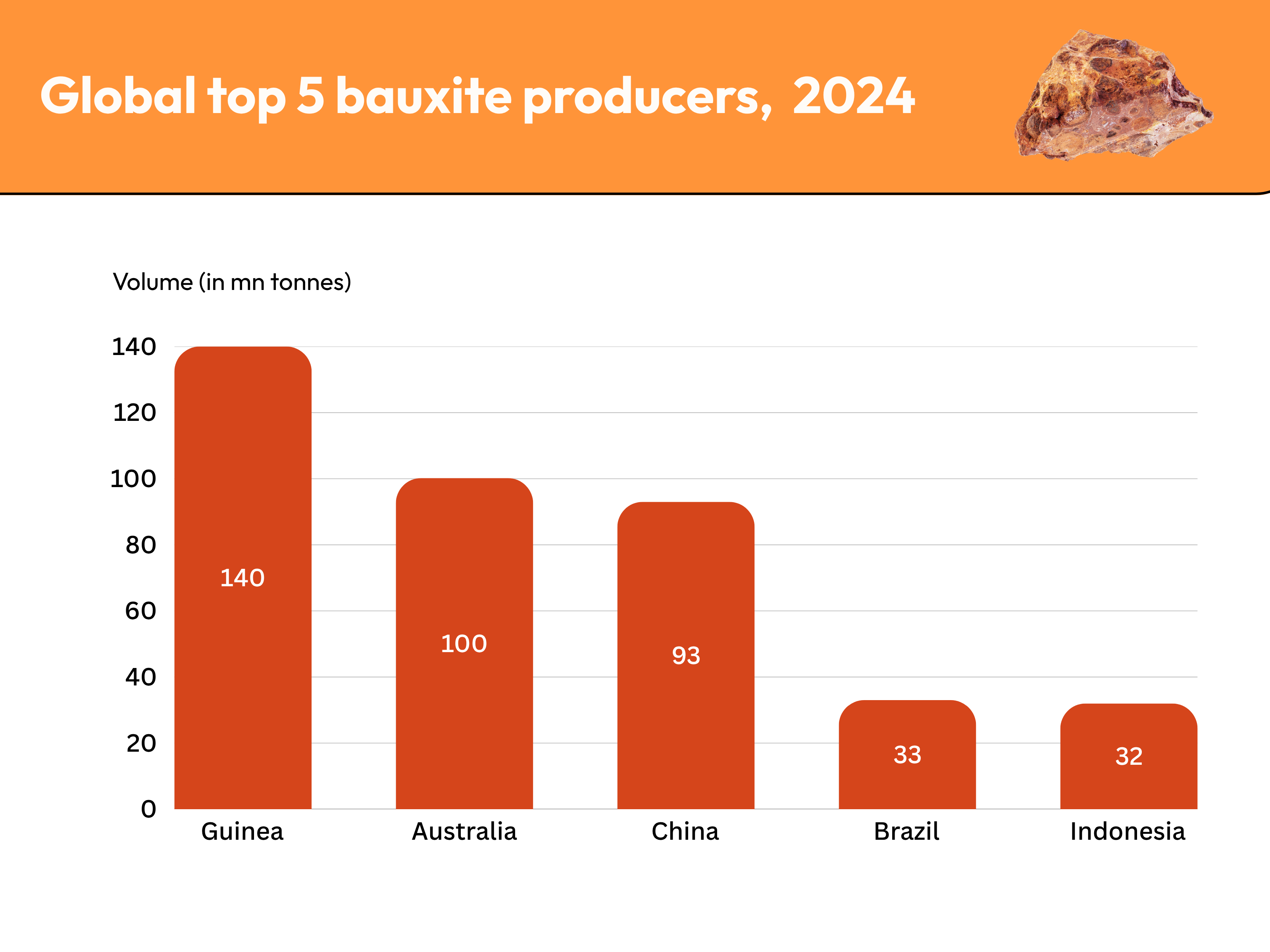
Guinea alone houses 25 per cent of the global bauxite reserves, standing at 7.4 billion tonnes, cementing its role as the global bauxite kingpin. The West African country has not only led in reserves but also surged as the top global producer in 2024, mining 140 million tonnes as per the production data (see attached visual). This dual dominance in reserves and production makes Guinea indispensable, especially for bauxite-hungry regions like China, which lacks comparable domestic reserves.
In a year where political instability often shadows African commodity markets, Guinea has attracted massive foreign investments, particularly from China. Through partnerships such as the Simandou infrastructure agreement and direct offtake contracts, China continues to secure access to Guinean ore as a hedge against both price shocks and future supply disruptions.
Australia, with 3.5 billion tonnes, remains a critical supplier with integrated mining-refining infrastructure. Though its production in 2024 (100 million tonnes) was second to Guinea’s, its strategic stability and regulatory transparency keep it an attractive investment landscape, especially for Western consumers.
Vietnam, meanwhile, emerges as a dark horse. With 3.1 billion tonnes of bauxite reserves, it now ranks third globally, edging out traditional giants like Brazil and Indonesia. While its production capacity still trails, Vietnam’s reserves are largely untapped and are being actively considered for development by local and international investors, particularly from Japan and South Korea.
Vietnam’s rising profile comes as no surprise: in the last decade, geological surveys across the Central Highlands have unearthed deposits with high alumina content, offering significant long-term strategic value.
Brazil and Indonesia are tied with 2.7 billion tonnes each, yet their trajectories differ. Brazil combines a strong reserve base with a mature mining ecosystem. However, 2024 has seen mounting ESG-related scrutiny in Brazil’s Amazonian operations, threatening to limit future output without significant environmental remediation commitments.
Data from the Geological Agency in 2023, which shows that Indonesia holds 7.4 billion tonnes of bauxite resources, with reserves of 2.7 billion tonnes. However, the country faces policy-induced bottlenecks. Following a series of ore export bans and reversals to push in-country refining, the country’s abundant reserves are underutilised. Though it produced just 32 million tonnes in 2024, its reserve potential remains promising, if the policy landscape stabilises.
Despite being among the largest aluminium consumers, China and India hold surprisingly modest bauxite reserves — 680 million tonnes and 650 million tonnes, respectively. These limited domestic reserves sharply contrast with their massive production capacities and point to an inevitable increase in import dependency.
China, which produced 93 million tonnes of bauxite in 2024, is already heavily reliant on imports, especially from Guinea, Indonesia, and Australia. The trend is likely to intensify unless new domestic reserves are discovered or alternative aluminium production technologies are scaled.
India, too, is expected to ramp up imports in the coming years, as domestic production (32 million tonnes in 2024) starts brushing against its geological limits. This underscores the urgency for Indian policymakers to secure long-term supply agreements, particularly as the country expands its electric vehicle and renewable infrastructure sectors, both aluminium-intensive domains.
Jamaica and the United States
Jamaica, with 2 billion tonnes, continues to play a niche but valuable role in the Atlantic bauxite trade, especially for North American refiners. The United States, however, stands on the edge with just 20 million tonnes of reserves. Despite being one of the world’s top aluminium consumers, the US is virtually absent in the mining game, making it highly exposed to geopolitical and trade disruptions.
This vulnerability is already playing out. The Biden administration’s 2024 tariff hike on aluminium imports (especially targeting Chinese-origin metals) has redirected US procurement towards allies like Australia and Brazil. But without a long-term bauxite stockpile strategy, the American aluminium industry remains at the mercy of global logistics and pricing volatility.
Strategic shifts on the horizon
As the world doubles down on energy transition, bauxite has taken centre stage. With reserves concentrated in a handful of countries, the coming decade will likely witness:
- Increased state control and nationalisation efforts over bauxite-rich mines
- Vertical integration by global aluminium majors into mining to lock in long-term ore supply
- New investments in underutilised reserves (Vietnam, Indonesia) as geopolitical hedges
- And, possibly, the rise of a “Bauxite OPEC” style cartel, which is an idea floated informally in 2023 by some West African nations
As aluminium finds its way into everything from EV frames to solar panel mounts, control over bauxite reserves will no longer be just a mining question. It will potentially be a strategic imperative.













_md.webp)
_md.webp)
_md.webp)







