AI, automation & digital manufacturing: The modern-day enablers of aluminium extrusion production

The image used in this article is generated with an AI tool and does not depict any real-time moment
EXECUTIVE SUMMARY:
- The campaign imperative: The global aluminium extrusion sector is bifurcating. Facilities relying on historical intuition and manual trial-and-error are facing severe margin compression, while digital-first extruders are capturing record profitability. AL Circle’s Extrusion Campaign is actively tracking this transition.
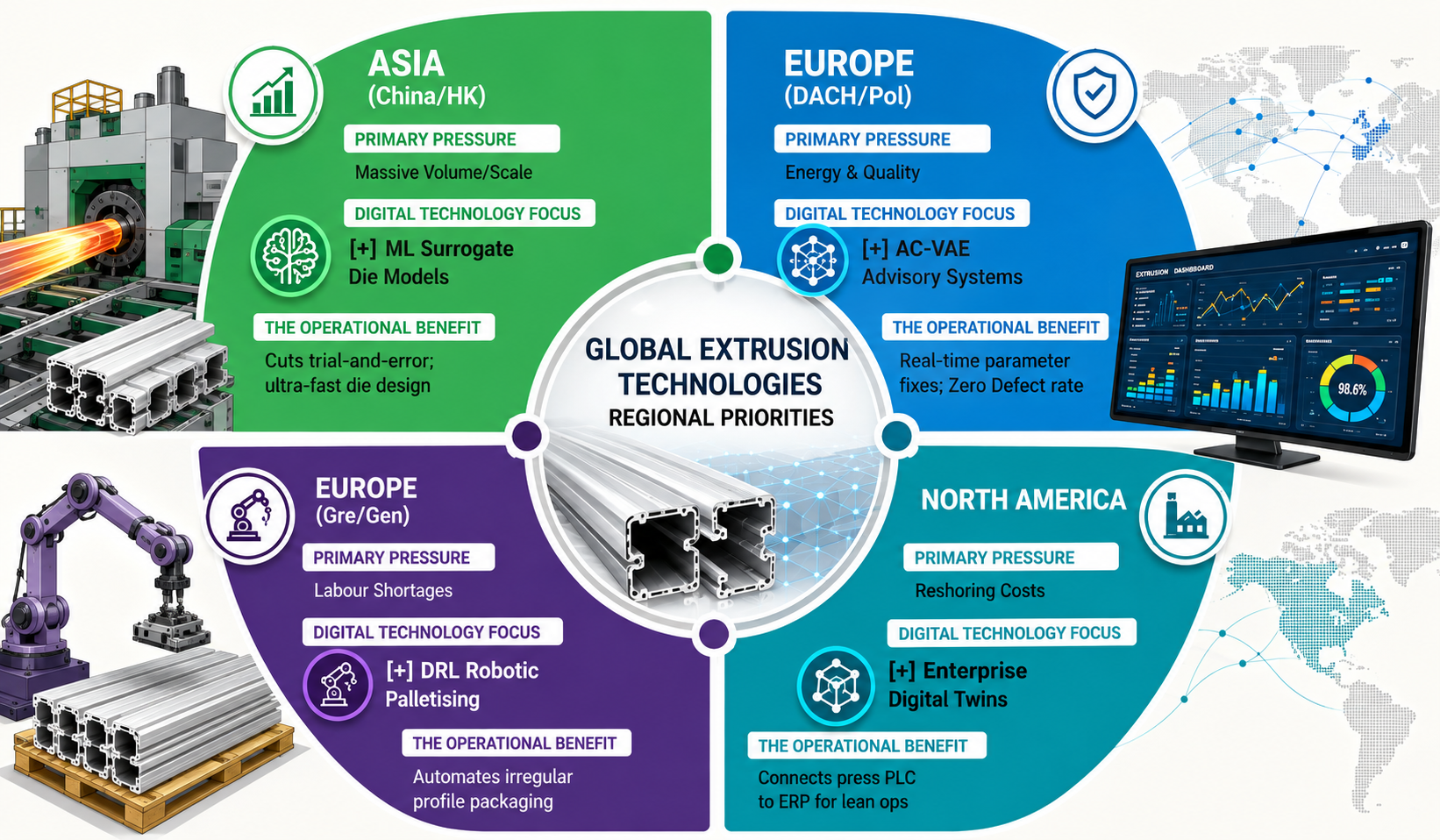
- The Asian acceleration (die design): Driven by the need for massive scale, Chinese manufacturers pioneered Machine Learning Surrogate Models. By automating the minimisation of extrudate curvature, they have cut die design lead times from weeks to milliseconds.
- The European vanguard (advisory & automation): To combat high energy costs and labour shortages, European facilities initiated their digitalisation push early. They now lead the globe in AI-driven process advisory systems and reconfigurable robotic palletising, achieving near-zero defect rates.
- North American reshoring (Digital Twins): Forced to offset high domestic labour costs amid aggressive reshoring, North American plants are deploying Enterprise Digital Twins to seamlessly connect shop-floor telemetry directly to top-floor enterprise systems for ultra-lean operations.
The global aluminium extrusion sector is currently trapped between rising energy premiums and strict carbon taxation policies at international borders, coupled with a relentless demand for complex, lightweight profiles. In this constrained macroeconomic environment, operating an extrusion plant based on historical intuition and manual trial-and-error is a guaranteed path to insolvency.
For decades, the extrusion industry accepted a fundamental level of inefficiency. Competitive advantage was defined simply by press tonnage and proximity to cheap raw materials. Die designers relied on empirical rules to fix curved profiles, while end-of-line packaging required armies of manual labourers sorting irregular batches.
Connect with verified aluminium extrusion buyers and suppliers through the AL Biz marketplace.
Today, that analogue factory model is officially obsolete.
As part of the AL Circle campaign Aluminium Extrusion Growth Markets, our objective is to spotlight the facilities, technologies, and regional strategies that are actively redefining the sector. The convergence of artificial intelligence (AI), automation, and digital manufacturing has triggered a structural reset. To understand how to position your company for the next decade, executives must examine the specific regional benchmarks that our campaign is tracking. By analysing the deep-tech implementations pioneered by extrusion hubs in Asia and Europe, and the aggressive reshoring strategies currently reshaping North America, global manufacturers can map their own digital transition and escape the margin trap.
The Asian acceleration: Erasing trial-and-error die design
The profitability of an extrusion run is dictated before the billet ever enters the container. If the extrusion die is poorly designed, the material flow becomes imbalanced, resulting in a profile that bends, twists, or fails dimensional tolerances.
Historically, fixing this required iterative Finite Element (FE) simulations, followed by cutting a physical prototype, running a test extrusion, and manually grinding the die bearings. This trial-and-error cycle is devastating to machine uptime.
The Asian extrusion market, led heavily by China, dominates global volume. However, facing unprecedented demands for complex, tight-tolerance profiles from the EV automotive sector, manufacturers realised that traditional analogy-based engineering was causing an unacceptable bottleneck. To solve this, the region accelerated the adoption of Data-Driven Surrogate Models.
- The Technology: Engineers parametrised complex geometries (like T-bar profiles) and deployed a Multi-Layer Perceptron (MLP) neural network. Instead of waiting hours for traditional software to calculate material flow, this AI system predicts die performance by calculating the "Curvature Factor" (CF), a metric for extrusion flow uniformity, in milliseconds.
- The Operational Benefit: By integrating this surrogate model with Genetic Algorithms (GA), the AI systematically evaluates thousands of combinations for sink-in depths and bearing lengths, adjusting parameters automatically. This aggressive optimisation entirely eliminates the physical prototype margin trap, guaranteeing perfectly straight material flow and reducing the die design cycle from weeks to a matter of seconds.
The European Vanguard: Advisory Systems and Defect Eradication
While Asia focused heavily on upfront die design to maximise throughput, our campaign data reveals that Europe began its intense digitalisation push earlier. This was driven by a completely different set of regional pressures: exorbitant energy costs, stringent environmental mandates like the Carbon Border Adjustment Mechanism (CBAM), and a severe shortage of manual factory labour.
Consequently, European extruders have become the global benchmark for in-process AI Advisory Systems. Extrusion is a highly dynamic process where minute fluctuations in billet temperature, ram speed, and quenching air velocity can instantly trigger surface defects like tearing, blistering, or die lines.
To combat this, the DACH region and Eastern Europe are actively abandoning static process manuals and deploying data-driven cyber-physical systems.
- The Technology: Rather than replacing operators, European plants are deploying AI-driven process advisory systems that use continuous data ingestion to monitor thermal-mechanical paths. As detailed in a major industrial deployment at the Warsaw University of Technology, Poland, these neural models analyse the specific, real-time impact of the die operator, the die supplier, and the extrusion speed. Similarly, research at the Austrian Institute of Technology details the deployment of Conditional Variational Autoencoders (CVAEs) to recommend real-time parameter corrections for billet preparation.
- The Operational Benefit: By acting on these AI-generated, real-time parameter recommendations, European facilities have achieved a massive reduction in surface and dimensional defects, allowing plants to confidently hit “Zero Defect" manufacturing targets while drastically reducing energy waste.
To know the production, demand and consumption forecasts of aluminium casting, explore our report "Global Aluminium Casting Market 2026-2032: Plant Economics, Alloy Segmentation, Pricing Intelligence, Supply Chain Analysis & Strategic Recommendations"
North American reshoring: Enterprise digital twins
The North American market is undergoing a massive supply chain realignment. Driven by geopolitical volatility and aggressive anti-dumping duties, extrusion volume is rapidly reshoring to the US and Mexico. However, this reshoring collides directly with exorbitant domestic labour costs and a severe shortage of skilled press operators.
To survive the margin trap of high-cost domestic manufacturing, North American extruders are leading the deployment of Enterprise Digital Twins and Industry 4.0 architecture.
- The Technology: Rather than relying on isolated press controls, advanced North American facilities are establishing robust data integration layers, often utilising Unified Namespaces (UNS) and the Industrial Internet of Things (IIoT). Press PLCs and temperature controllers send live telemetry directly to Manufacturing Execution Systems (MES) and Enterprise Resource Planning (ERP) software. Virtual replicas of extrusion lines simulate material flow, temperature distribution, and die stress before a billet is ever heated.
- The Operational Benefit: This top-down digital architecture enables predictive maintenance powered by AI, diagnosing key assets in real-time. By unifying the shop floor with the top floor, North American plants are neutralising their high labour costs, achieving seamless logistics, minimising unplanned downtime, and aggressively optimising production scheduling to remain globally cost-competitive.
Automating the Packaging Bottleneck (Greece & Germany)
Across all regions tracked by our campaign, the most sophisticated AI die designs and press controls are utterly useless if the finished profiles stack up at a manual packaging bottleneck. Extruded aluminium profiles arrive at the end of the line in irregular shapes, colour-orientated batches, and varying lengths, making them notoriously difficult to handle.
To eliminate this labour-intensive choke point, a European consortium (including the University of Patras, Greece, and Roboception GmbH, Germany) developed an AI-enabled Digital Twin Framework for reconfigurable robotic palletising.
- The Technology: The system utilises Deep Reinforcement Learning (DRL) and advanced Mask2Former computer vision architectures. Statically mounted cameras identify specific, irregularly shaped aluminium profiles in a cluttered pile. The AI automatically extracts the centre of gravity from the product's CAD file, calculating collision-free grasping points for the robotic grippers on the fly.
- The Operational Benefit: A DRL agent evaluates the customer order and calculates the most stable, high-density stacking configuration. Deployed in industrial packaging cells, this closed-loop system entirely automates the handling of highly heterogeneous cargo. It removes intense physical strain from the workforce, guarantees defect-free shipment packaging, and operates at an astonishing cycle time of 5 objects per second.
The strategic conclusion
The era of operating an aluminium extrusion plant based on mechanical brute force has concluded. Value is no longer generated simply by pushing metal through a die; it is generated by capturing, analysing, and weaponising manufacturing data.
The integration of ML surrogate models in Asia, Enterprise Digital Twins in North America, and AI advisory systems in Europe proves that the digital extrusion plant is not the future; it is the immediate, highly profitable present. Manufacturers who treat these AI tools as optional upgrades will find themselves unable to compete on price, quality, or delivery speed.
Note: This is exclusive coverage by AL Circle and may not be reproduced, republished or shared without prior permission.
Disclaimer: The opinions, information, claims, references, and images presented here are those of the author alone and AL Circle holds no responsibility.
PV module scheduled production slightly up M-o-M underpins frame production starts
Next articleAluminium casting market growth: Demand, end-use sectors & regional outlook to 2032
Grow with
AL Circle