Aluminium casting market growth: Demand, end-use sectors & regional outlook to 2032
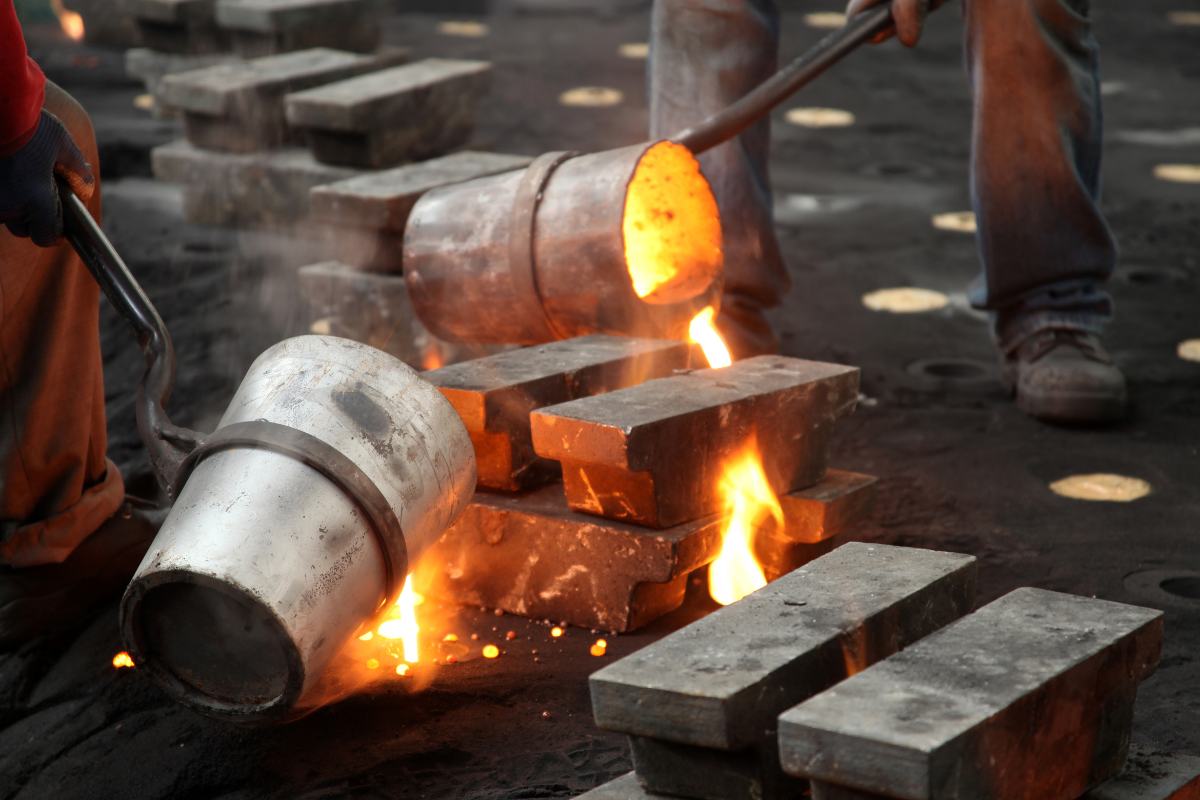
The image used in this article for referential purposes only
As industries worldwide accelerate lightweighting, electrification, automation and infrastructure investment, aluminium casting is entering a new phase of growth. Demand is rising across applications where weight, durability, thermal performance and design flexibility matter, from EV battery enclosures and structural components to industrial machinery and electrical equipment.
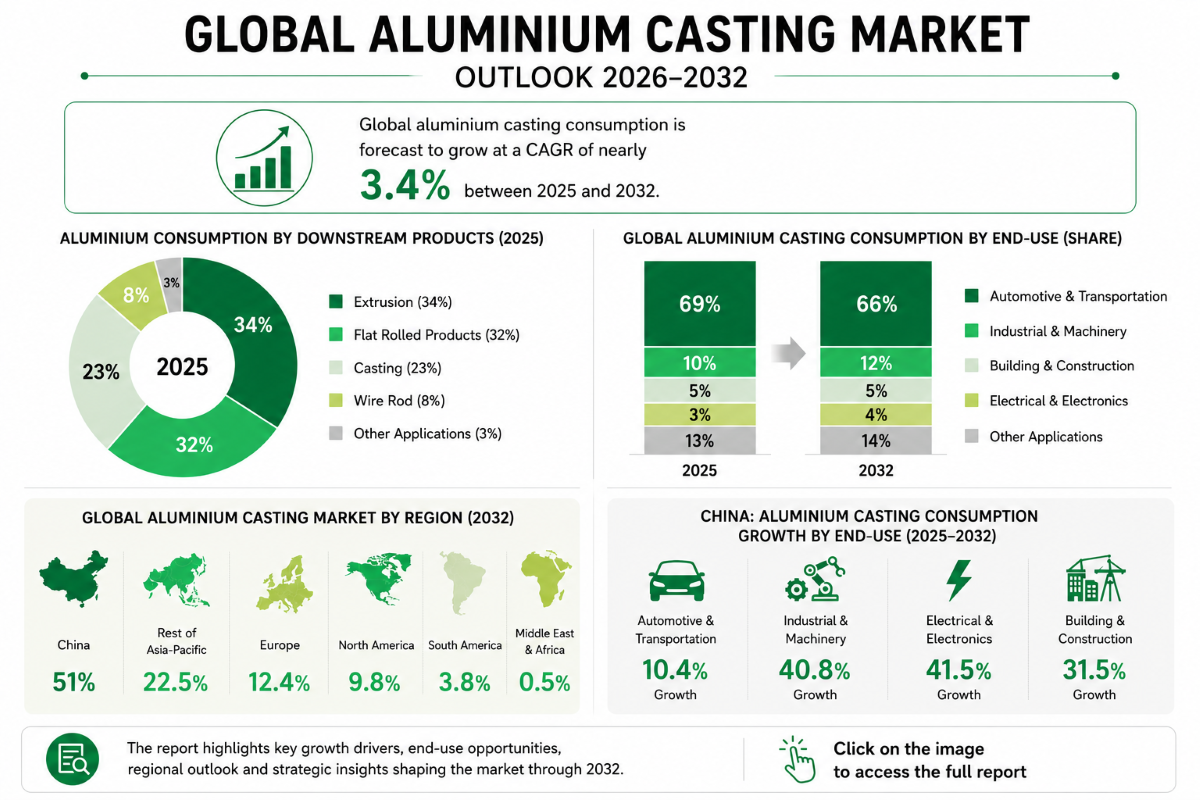
Owing to this, AL Circle’s latest report, “Global Aluminium Casting Market 2026-2032” highlights that the global aluminium casting consumption is forecast to grow at a CAGR of nearly 3.4 per cent between 2025 and 2032. While automotive and transportation will remain the primary demand engine, expanding applications across industrial machinery, electrical and electronics, and construction are expected to broaden the market’s growth base.
Global aluminium casting industry: Overview of a market increasingly shaped by lightweighting and electrification
In the downstream aluminium product demand, the global aluminium industry is witnessing a gradual shift, with casting accounting for 23 per cent of global aluminium consumption in 2025, behind extrusion at 34 per cent and flat rolled products at 32 per cent. Wire rod and other applications accounted for 8 per cent and 3 per cent, respectively.
Automotive lightweighting remains a key catalyst for aluminium casting demand. The rapid transition towards electric vehicles is increasing demand for battery housings, motor casings, structural components and thermal-management systems, while high-pressure die casting and giga-casting are enabling manufacturers to consolidate components and streamline production.
Rising recycled aluminium adoption is also reshaping the market, with secondary metal already representing the majority of automotive casting feedstock.
Aluminium casting industry outlook: Automotive remains dominant through 2032
By 2032, Automotive & Transportation is expected to account for approximately 66 per cent of global aluminium casting consumption, down from 69 per cent in 2025. The lower share reflects faster growth in other end-use markets rather than declining automotive demand.
Industrial & Machinery is forecast to reach approximately 12 per cent, while Building & Construction and Electrical & Electronics are expected to account for around 5 per cent and 4 per cent, respectively. Other applications will contribute approximately 14 per cent.
This changing composition points towards a progressively diversified aluminium casting market, in which demand is being generated not only by vehicle production but also by electrification, digital infrastructure and industrial investment.
End-use sectors driving aluminium casting demand
Automotive & Transportation: the dominant demand centre
Automotive & Transportation will remain the dominant end-use sector in 2032, accounting for approximately 66 per cent of global aluminium casting consumption. EV adoption is increasing casting intensity through battery enclosures, structural components, motor housings and thermal-management systems, while HPDC and structural casting are supporting demand.
Regionally, China is the leading regional driver of automotive casting demand, with its extensive vehicle manufacturing ecosystem, EV production and growing adoption of advanced manufacturing technologies positioning it ahead of other regions.
By 2032, China's automotive aluminium casting demand is projected to increase by 10.4 per cent between 2025 and 2032. Despite the moderation in share, China’s absolute demand continues to expand, supported by its extensive vehicle manufacturing ecosystem, rapid EV adoption and growing deployment of advanced casting technologies.
Industrial & Machinery: Automation creates a larger casting opportunity
This sector is projected to account for approximately 12 per cent of global aluminium casting consumption by 2032. Its continued dominance is underpinned by its large manufacturing base, rapid adoption of industrial automation and robotics and investments in semiconductor, data-centre and advanced manufacturing infrastructure.
For this sector as well, China remains the leading market, with its aluminium casting consumption in the sector being projected to increase by approximately 40.8 per cent between 2025 and 2032. China remains the leading market, with aluminium casting consumption in the sector projected to increase approximately 40.8 per cent between 2025 and 2032, supported by automation, robotics and semiconductor and data-centre investments.
Electrical & Electronics: Power infrastructure and AI boost demand
The sector is also creating additional demand for aluminium casting because of the continuous expansion of electricity grids, renewable energy, energy storage, data centres and AI infrastructure. Cast aluminium is particularly relevant for transformer housings, power-conversion equipment, cooling systems and electrical enclosures.
China remains the largest regional contributor, with aluminium casting consumption in the sector projected to increase approximately 41.5 per cent between 2025 and 2032. North America and Europe are also expected to strengthen their contribution, driven by grid modernisation, renewable energy deployment and rising investment in data centres and digital infrastructure.
Building & Construction: Infrastructure sustains long-term demand
Building & Construction is forecast to account for approximately 5 per cent of global aluminium casting demand by 2032. Infrastructure modernisation, transportation networks, renewable energy projects, HVAC systems, elevators and industrial facilities are supporting demand for aluminium cast components.
China leads regional demand, with aluminium casting consumption projected to increase approximately 31.5 per cent between 2025 and 2032, supported by infrastructure programmes, urbanisation and investment in construction and industrial facilities.
The Rest of Asia-Pacific (ROAP) is also gaining momentum, supported by infrastructure expansion and urban development across emerging economies, strengthening the region's contribution to future aluminium casting demand.
Regional usage of aluminium casting
- China is expected to account for approximately 51 per cent of global aluminium casting consumption by 2032, supported by automotive manufacturing, industrial capacity, electrification and infrastructure investment.
- The Rest of Asia-Pacific (ROAP) is emerging as the fastest-growing regional market and is forecast to represent around 22.5 per cent of global aluminium casting consumption in 2032. India and Southeast Asia are particularly important to this outlook as industrialisation, urbanisation, renewable energy deployment and manufacturing expansion accelerate.
- Europe is expected to account for approximately 12.4 per cent, supported by EV adoption, renewable energy, automation and infrastructure modernisation, although economic and energy pressures could moderate growth.
- North America is projected to hold around 9.8 per cent, benefiting from reshoring, advanced manufacturing, transportation electrification and energy investment.
- South America is expected to represent around 3.8 per cent and the Middle East & Africa approximately 0.5 per cent, with infrastructure, industrial diversification and energy investment offering longer-term opportunities.
Conclusion
The aluminium casting market is moving beyond its traditional dependence on automotive manufacturing. While automotive and transportation will remain the dominant demand centre, faster growth in industrial machinery, electrical and electronics, construction and other applications is broadening the market's growth base.
For aluminium producers, recyclers, foundries, die casters and technology providers, this creates opportunities across established and emerging markets. China will retain its market leadership, while the wider Asia-Pacific region is set to remain a key growth frontier through 2032.
AL Circle’s latest report, “Global Aluminium Casting Market 2026-2032” implies that aligning capacity, technology and investment strategies with the fastest-growing end-use sectors and regional markets will be critical to capturing aluminium casting opportunities through 2032.
AI, automation & digital manufacturing: The modern-day enablers of aluminium extrusion production
Next articleUK-based Eqonic confirms aluminium battery technology: envisions lower production costs
Grow with
AL Circle