Southeast Asia’s aluminium extrusion boom: Five new projects and 8.47% CAGR - what’s driving the growth?
The image used in this article is generated with an AI tool and does not depict any real-time moment
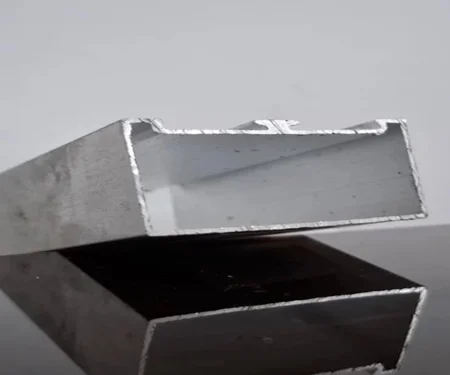
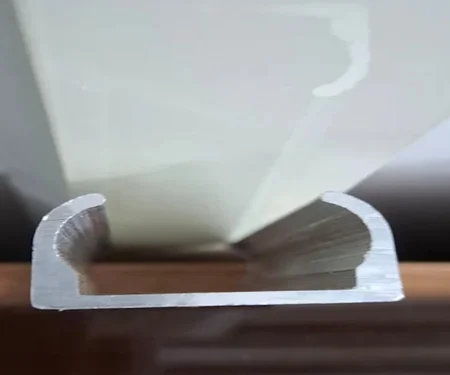
From a Hong Kong-backed plant in Vietnam to Malaysia's largest extrusion expansion in years and Indonesia's biggest extrusion press, Southeast Asia is witnessing a wave of aluminium extrusion investments. Although these projects span different countries, companies and end markets, they all point in the same direction: manufacturers increasingly see the region as the next major hub for downstream aluminium production.
The region's growing importance is also reflected in its market outlook. The extruded aluminium profiles market was valued at approximately USD 4.54 billion in 2024 and is forecast to reach USD 6.86 billion by 2032, expanding at a CAGR of 8.47 per cent as per various industry sources.
But now the question is: what is making Southeast Asia the preferred destination for aluminium extrusion investment? The answer lies in a combination of integrated supply chains, supportive government policies, expanding recycling capacity, growing export competitiveness and robust demand from industries ranging from automotive to renewable energy.
A new generation of extrusion projects is taking shape
The region's growing appeal is already reflected in a pipeline of investments that stretches across Vietnam, Malaysia and Indonesia. While each project differs in scale and target market, collectively they illustrate how manufacturers are positioning themselves for long-term growth rather than short-term capacity gains.
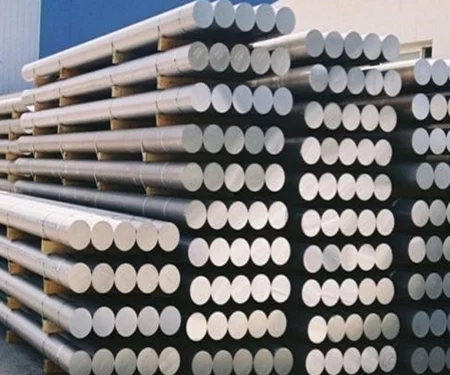
One of the largest investments is being made by Hong Kong-based Kam Kiu Aluminium Products Group, which has chosen Vietnam for its first overseas manufacturing facility. Through its subsidiary Joint Wise Corporation, the company is developing a nearly USD 100 million project at My Thuan Industrial Park in Nam Dinh province. The plant will manufacture high-quality aluminium alloy for automotive components and electronic products, with an annual production capacity of 100,000 tonnes of aluminium bars.
The project received approval from Nam Dinh's industrial parks authority as an approximately USD 90 million investment and has been granted an operating period until September 30, 2071.
Malaysia is also seeing one of its most significant downstream expansions in recent years.
Listed aluminium extruder PA Resources Bhd, through its subsidiary PA Extrusion (M) Sdn Bhd, is building a new automated extrusion plant on an 18-acre site in Kuala Selangor. Scheduled to commence operations in 2027, the facility will more than double the group's monthly extrusion capacity from 3,500 tonnes to 8,500 tonnes.
The company describes the project as its largest expansion in years. Beyond increasing production, the facility is designed with higher levels of automation to support a broader product portfolio, including windows and doors, harvesting poles and other extrusion products alongside its established solar-panel-frame business. The expansion also supports the group's RM1.31 billion (USD 321.22 million) contract renewal with First Solar for the period from July 2026 to December 2027, the largest order in its history.
To know the production, demand and consumption forecasts of aluminium casting, explore our report "Global Aluminium Casting Market 2026-2032: Plant Economics, Alloy Segmentation, Pricing Intelligence, Supply Chain Analysis & Strategic Recommendations"
Not every expansion is centred on a new greenfield facility. Malaysia's Press Metal, Southeast Asia's largest integrated aluminium producer, continues strengthening its extrusion business through incremental capacity additions. The company has built 760,000 tonnes of smelting capacity and 160,000 tonnes of extrusion capacity, while its Press Metal International operations in Malaysia and China together provide a combined extrusion capacity of 230,000 tonnes.
The downstream business has become an increasingly important contributor to the company's earnings. During FY2025, extrusion generated RM3.1 billion (USD 796 million) in revenue, making it Press Metal's second-largest business segment after smelting.
Similarly, LB Aluminium Berhad and several Malaysian exporters are expanding extrusion capacity in response to changing regional trade flows during 2026, although no individual greenfield project with a disclosed investment value has yet emerged.
Indonesia, meanwhile, is focusing on technological capability.
ALCA Metals recently unveiled a 6,000 Mt aluminium extrusion press at its fully integrated 50-hectare manufacturing complex in North Sumatra, covering billet casting, extrusion, surface treatment and precision fabrication. Capable of producing aluminium profiles up to 600 mm wide, the equipment has been described as the largest aluminium extrusion press in Southeast Asia, underlining the region's ambitions to move into higher-value downstream manufacturing.
These investments span multiple countries and business models, but together they raise a broader question:
What is enabling Southeast Asia to attract so much downstream aluminium investment at the same time?
The recent surge in extrusion investments reflects more than individual project announcements. Southeast Asia is building a complete aluminium ecosystem, supported by upstream expansion, higher-value manufacturing, recycling growth, favourable government policies and rising domestic and export demand.
- Building an integrated aluminium value chain
Indonesia, Vietnam and Malaysia are investing heavily in alumina refining, primary aluminium smelting and downstream processing, creating integrated value chains that support both domestic manufacturing and exports. Indonesia and Vietnam are leveraging abundant bauxite reserves, while Malaysia's hydro-powered smelters provide relatively low-cost, lower-carbon aluminium for downstream production. Established industrial parks and supportive government policies promoting domestic value addition and integrated manufacturing hubs are further encouraging extrusion investments.
The economics also favour downstream manufacturing. Indonesian bauxite currently trades at USD 28-34 per tonne, but converting it into primary aluminium can increase its value by up to 16 times or more, with extrusion and other downstream products generating even higher margins. As aluminium consumption grows across Southeast Asia, manufacturers are increasingly investing closer to raw material sources, improving regional self-sufficiency while strengthening exports of higher-value aluminium products. Connect with verified aluminium extrusion buyers and suppliers through the AL Biz marketplace.
- Recycling is becoming another competitive advantage
Recycling is emerging as another key driver of Southeast Asia's extrusion industry. Vietnam and Thailand are leading the region's secondary aluminium market as increasing scrap availability improves access to recycled billet, enabling extrusion manufacturers to lower production costs, reduce carbon emissions and diversify feedstock beyond primary aluminium.
Vietnam is rapidly strengthening its recycling ecosystem, with an estimated 700,000 tonnes of annual scrap-processing capacity-well above its domestic ADC12 demand of around 120,000 tonnes. The sector is further supported by a 10 per cent corporate income tax rate for recyclers for up to 15 years and a new Extended Producer Responsibility (EPR) framework, effective from May 2026, requiring a 22 per cent recycling rate for aluminium packaging. Thailand, meanwhile, remains the region's more established secondary aluminium hub, backed by stronger automotive integration and a mature industrial base.
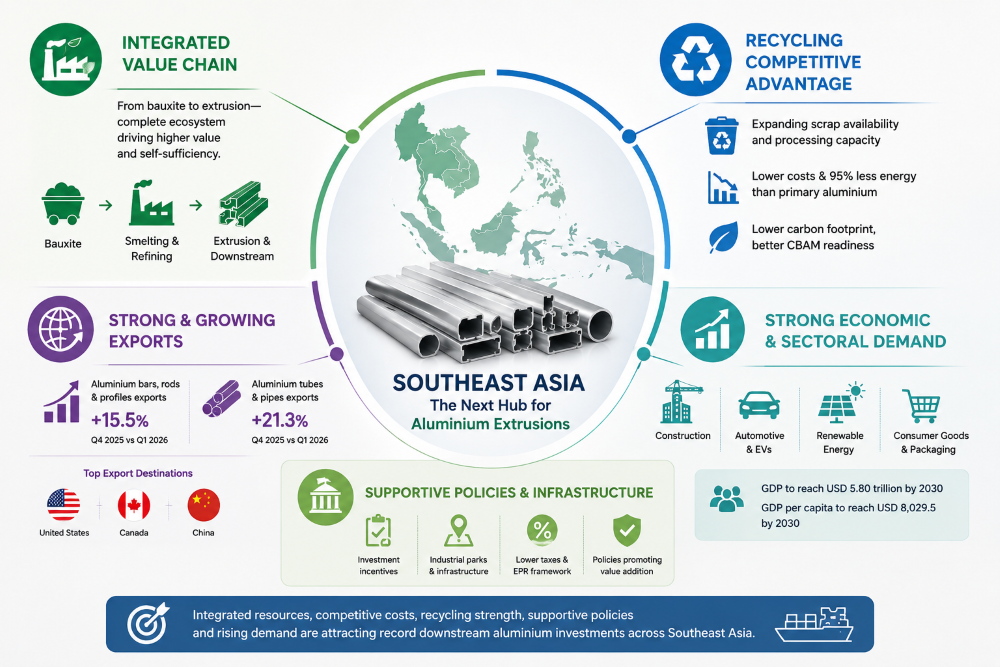
Changing global scrap flows are also benefiting the region. Potential EU export levies on aluminium scrap, tighter inspections in competing markets and growing demand for lower-carbon feedstock are directing more scrap into Southeast Asia. Since recycled aluminium requires around 95 per cent less energy than primary production, Malaysia and Thailand have emerged as key regional remelting centres, processing imported scrap into secondary ingot for domestic use and exports.
This expanding recycling network directly strengthens the extrusion industry. On one hand, extrusion producers are major consumers of secondary aluminium, with rising scrap availability in Vietnam and Thailand providing access to lower-cost, lower-carbon billet, improving both cost competitiveness and carbon performance-an increasingly important advantage for exporters subject to the European Union's Carbon Border Adjustment Mechanism (CBAM). On the other hand, extrusion plants are also suppliers of secondary raw materials.
The manufacturing process generates offcuts, trim and butt-end scrap, traded as the "95/5 extrusions" category with its own Southeast Asian price benchmark. These materials are recycled through the region's growing remelting network, creating a circular aluminium supply chain that further supports the expansion of extrusion capacity.
- Export markets are beginning to reflect the shift
The region's growing manufacturing capability is already translating into stronger exports. Thailand and Vietnam are expanding aluminium extrusion shipments to Western markets particulay US, as improving product quality and favourable trade policies enhance competitiveness.
Thailand's exports of aluminium bars, rods and profiles increased from 15,432 tonnes in 2024 to 18,289 tonnes in 2025. Quarterly exports also rose 15.5 per cent, from 4,821.723 tonnes in Q4 2025 to 5,562.170 tonnes in Q1 2026, with the United States and Canada and China remaining the largest destinations. Exports of aluminium tubes and pipes also increased from 477.616 tonnes to 579.089 tonnes over the same period, reflecting broader growth across downstream product categories. Rather than exporting raw materials, Southeast Asia is increasingly supplying value-added aluminium products to international markets.
Connect with verified aluminium extrusion buyers and suppliers through the AL Biz marketplace.
If we look at Malaysia, exports of aluminium bars, rods and profiles increased from 75,244 tonnes in 2024 to 85,658 tonnes in 2025, marking a year-on-year growth of 13.8 per cent. The upward trend continued into 2026, with exports rising from 24,548 tonnes during January-April 2025 to 28,480 tonnes in the corresponding period of 2026, an increase of 16.0 per cent.
- Economic growth is strengthening long-term demand
Beyond exports, strong economic growth is expected to sustain long-term demand for aluminium extrusions. Southeast Asia's GDP is projected to increase from USD 4.25 trillion in 2025 to USD 5.80 trillion by 2030, while GDP per capita is forecast to rise from USD 6,113.8 to USD 8,029.5. Rising incomes, urbanisation and industrialisation are expected to drive aluminium consumption across construction, transportation, electrical equipment, consumer goods and packaging.
The automotive and renewable energy sectors are expected to provide additional momentum. Expanding vehicle production, particularly electric vehicles, is increasing demand for lightweight aluminium components, while rapid solar deployment is driving consumption of aluminium extrusion products such as solar panel frames, mounting systems and structural components. Together with integrated value chains, expanding recycling capacity and supportive government policies, these demand drivers are reinforcing Southeast Asia's emergence as a leading hub for downstream aluminium manufacturing.
AL Circle is coming up with a new Magazine "ALuminium’s Frontline: OEM Edition 2026." Feature your brand and opinion in the edition
Oswego restart, Bay Minette aluminium project fuel Novelis’ 71% Q1 FY27 profit
Next articlePV module scheduled production slightly up M-o-M underpins frame production starts
Grow with
AL Circle