420 billion cans, one 20-year-old fix: The Six Sigma Case for can-to-can recycling
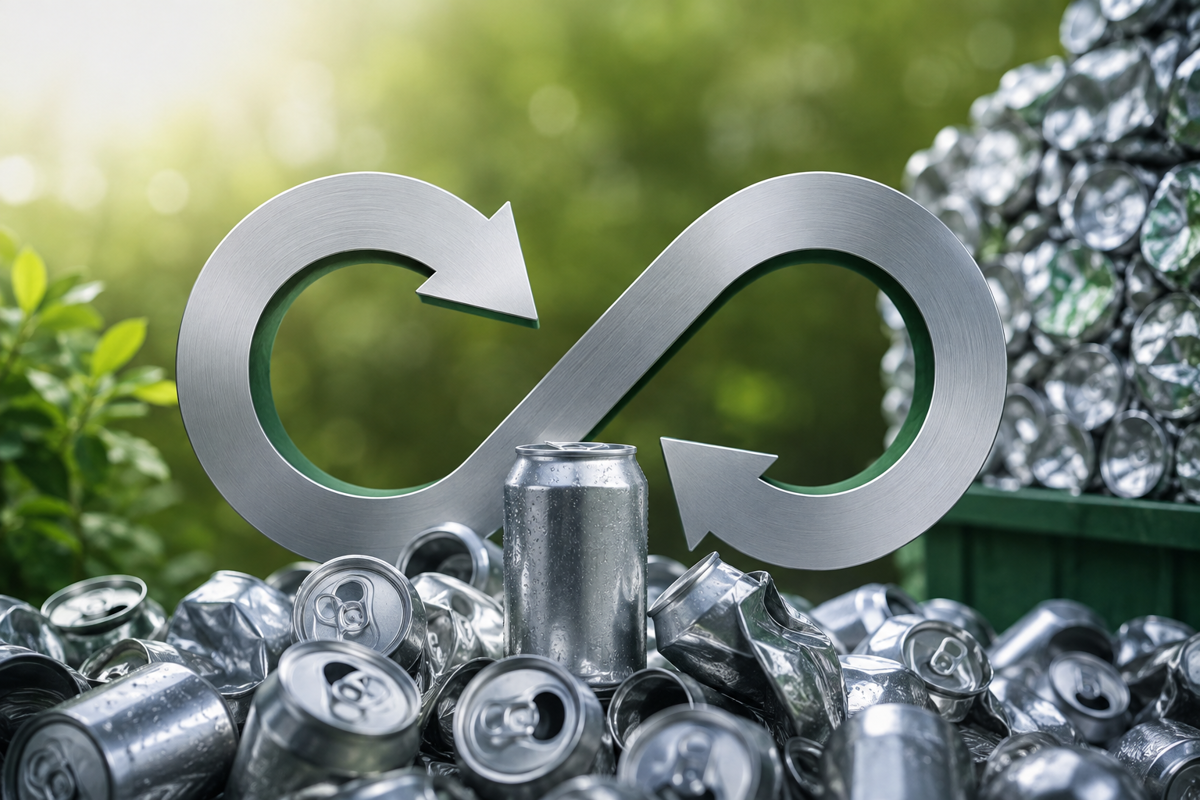
Images (s) used in this article are AI-generated and do not represent a realtime moment
New IAI data show that closing the can-to-can loop, not simply collecting more cans, will decide whether the industry produces 207 billion or 685 billion recycled cans by 2050. A Six Sigma study from Kentucky, co-authored nearly two decades ago by Dr Subodh K. Das, offers a strikingly relevant blueprint for treating every unrecycled can as a preventable process defect.
Aluminium's most-quoted recycling statistic keeps getting bigger, but a new analysis from the International Aluminium Institute (IAI) suggests that scale alone will not decide how much of that metal comes back as new cans.
According to the IAI’s September 2025 factsheet, "Can-to-Can Recycling: Performance, Potential and Pathways," the industry currently puts around 420 billion aluminium beverage cans on the market every year.
At today’s can-to-can recycling rate of 33 per cent, recycling that base of cans repeatedly through to 2050 would generate roughly 207 billion new cans. Lift the can-to-can rate to 62 per cent, achievable, the IAI argues, largely through better sorting and remelting practice rather than new technology, and the same 420 billion cans could yield 685 billion new cans.
Push on to 95 per cent circularity, with near-universal collection, recycling-friendly alloy design and consistently clean scrap, and the number approaches six trillion.
The gap between those scenarios is not really a story about how recyclable aluminium is. Aluminium can be remelted indefinitely without loss of quality, and the industry has known this for decades. The gap is a story about process, about exactly where, between a used can leaving a consumer’s hand and a new one leaving a mill, material falls out of the can-to-can loop.
To know the aluminium casting demand forecast in the construction sector, explore our report "Global Aluminium Casting Market 2026-2032"
A familiar diagnosis, twenty years on
That framing will sound familiar to Dr Subodh K. Das. In 2006, Das and co-author Margaret Hughes published “Improving Aluminum Can Recycling Rates: A Six Sigma Study in Kentucky” in JOM, describing what was then the first attempt to apply formal process-improvement methodology to aluminium can recycling.
Working with Secat Inc. and the University of Kentucky’s Center for a Sustainable Aluminum Industry, the study treated every can that went unrecycled as a “defect” in a measurable process — mapping the journey from household to recycling centre and pinpointing exactly where cans were being lost, from curbside bin access and pickup reliability to the historically low recycling participation of 18-29-year-olds.
The scale and the context were different; the study responded to a decline in U.S. beverage can recycling from 67 per cent in 1992 to 50 per cent in 2003, and back then any recycling counted as success. But the underlying insight is the same one the IAI’s 2025 data is now making at global scale: an unrecycled can is not an unfortunate accident. It is a defined, measurable process failure, and process failures can be engineered out.
A more granular funnel
What has changed since 2006 is the resolution of the diagnosis. The Fayette County study was concerned mainly with getting cans into the recycling stream in the first place. The IAI’s 2025 data effectively treats collection as the solved part of the problem — globally, 71 per cent of cans placed on the market are recycled in some form, and instead exposes losses further downstream, after a can has already reached a recycling facility.
Two findings stand out. First, only 47 per cent of recycled cans currently go back into new cans, even though the IAI estimates 87 per cent could, using existing alloys and remelter operations, with no new technology required.
In simpler terms, roughly half of the shortfall between today’s 33 per cent can-to-can rate and the achievable 62 per cent is not a collection problem or a technology problem — it is closer to a sorting-and-logistics problem. Second, more than a fifth of recycled cans are downcycled into products such as engine blocks, where incompatible alloys prevent the metal from ever returning to can stock.
In Six Sigma terms, the defect identified in Kentucky in 2006 sat mainly in the Measure and Analyze phases at the front end of the process: cans not entering the system at all. The defect the IAI has now quantified sits closer to the Improve and Control phases, further down the line: cans entering the system but exiting it at the wrong point, into the wrong product stream, because the process map from collection bin to can-body stock was never fully closed. It is, in effect, the same DMAIC discipline applied one stage further down the value chain.
To explore trade opportunities of secondary aluminium, visit AL Biz
Why the regional data reinforces the point
The IAI’s country-level figures show these are genuinely separate variables, not two names for the same thing. The United States has a closed-loop can-to-can rate of 97 per cent, almost every can that does get recycled becomes a can again, yet its overall recycling rate is only 43 per cent, meaning most cans never reach a facility at all. That is a collection problem, exactly the kind the 2006 Kentucky study was built to address. Thailand, by contrast, recycles a large majority of its cans, with 72 per cent of those returning directly to can stock. Vietnam collects reasonably well but loses ground specifically to export duties and missing domestic infrastructure — a downstream, structural loss rather than a consumer-behaviour one.
Three countries, three different points of failure in the same funnel. A single national campaign to “recycle more” will not fix all three; each needs its own process map, in the spirit of the one first built for Fayette County.

The next twenty-five years
The distance between 207 billion and 685 billion recycled cans by 2050 is, on the IAI’s own telling, largely achievable with tools the industry already has: better sorting of used beverage cans (UBCs), alloy design that keeps body and lid stock compatible with remelting, and policy that discourages scrap leakage across borders. None of it requires reinventing aluminium’s chemistry. What it requires is the kind of granular, point-by-point process discipline that a small Kentucky county applied to its own recycling bins nearly twenty years ago, now scaled to a 420-billion-can global supply chain.
Unlock key insights from industry experts on aluminium's applications in end-user with our magazine - Sustainability & Recycling: Aluminium's Dual Commitment
Note: This is exclusive coverage by AL Circle and may not be reproduced, republished or shared without prior permission.
Germany recycled 75kt of building aluminium scrap through AUF network in 2023
Next articleMore US aluminium scrap heads to Asia amid domestic supply concerns
Grow with
AL Circle