European aluminium billet market is beginning its new calendar year, keeping a cautious look over its shoulder, as demand remains sluggish amid hidebound buying practices, while production cuts intend to leave the supply chain vulnerable to sudden fluctuations.
Platts, part of S&P Global Commodity Insights, has publicised that the European aluminium 6060/6063 billet premium at London Metal Exchange (LME) cash plus $555 per tonne DDP Germany January 10, on net 30-day payment spans, up 46 per cent Y-o-Y, but contemplating a 12 per cent decline from 2024’s peak of $630 per tonne DDP (Delivery Duty Paid) in late August owing to softer demand.
The Italian premium was evaluated at LME cash plus $555 per tonne DDP on January 10 for net 60-day payment terms, ascending 48 per cent year-on-year but similarly declining 11 per cent from a 2024 peak of $625 per cent DDP in July.
speed breakers in production and supply
European secondary aluminium production houses are lacerating billet production amid high input scrap and ingot expenses. Producers have further discussed additional cuts, which could aid in upholding premiums in the near term, sources say.
According to International Aluminium Institute (IAI) data, the European aluminium industry has steadily declined across the past decade, with Western and Central European primary aluminium production deflating 25.5 per cent from 2010 (production during this year was 3.8 million tonnes) to 2.83 million tonnes in 2024. Meanwhile, primary aluminium production in Russia and Eastern Europe only fell 5.57 per cent (production during calendar year 2024 was 4.16 million tonnes) from 4.25 million tonnes produced in 2010, IAI data showed.
From 2020 to YTD November 2024, the EU’s imports of bars, rods, and profiles, primarily extruded from aluminium billets, have consistently exceeded their exports, reflecting a trade deficit in this category. Import volumes rose sharply in 2021, increasing from approximately 396,778 tonnes in 2020 to 488,064 tonnes, a 23 per cent year-on-year (Y-o-Y) growth. Imports peaked in 2022 at 553,081 tonnes, showcasing a further 13 per cent increase. However, there was a decline in 2023 to 446,566 tonnes (-19 per cent), followed by a continued decrease to 369,245 tonnes YTD November 2024, showing a downward trend after the 2022 peak.
Exports, on the other hand, showed moderate growth from 2020 to 2021, increasing from 282,563 tonnes to 326,498 tonnes (16 per cent Y-o-Y growth). This was followed by a slight decline in 2022 to 322,657 tonnes (-1 per cent). Exports continued to fall in 2023, reaching 292,299 tonnes (-9 per cent), with a marginal dip to 290,672 tonnes by YTD November 2024. This gradual decline indicates a weakening export performance.
Overall, while both imports and exports displayed demand inflation in 2021, imports outpaced exports significantly, widening the trade deficit. The subsequent years saw a decline in both, but imports declined more sharply, suggesting a cooling demand or potential trade policy shifts.
“There are always conversations on cutting capacity,” a producer expressed, adding, “When you look at scrap, energy and primary aluminium costs, they are not workable for a remelter.”
Platts analysed the European P1020 aluminium premiums over LME cash at $350-$380 per tonne Duty Paid In-Warehouse Rotterdam on January 10, up 51 per cent on the year.
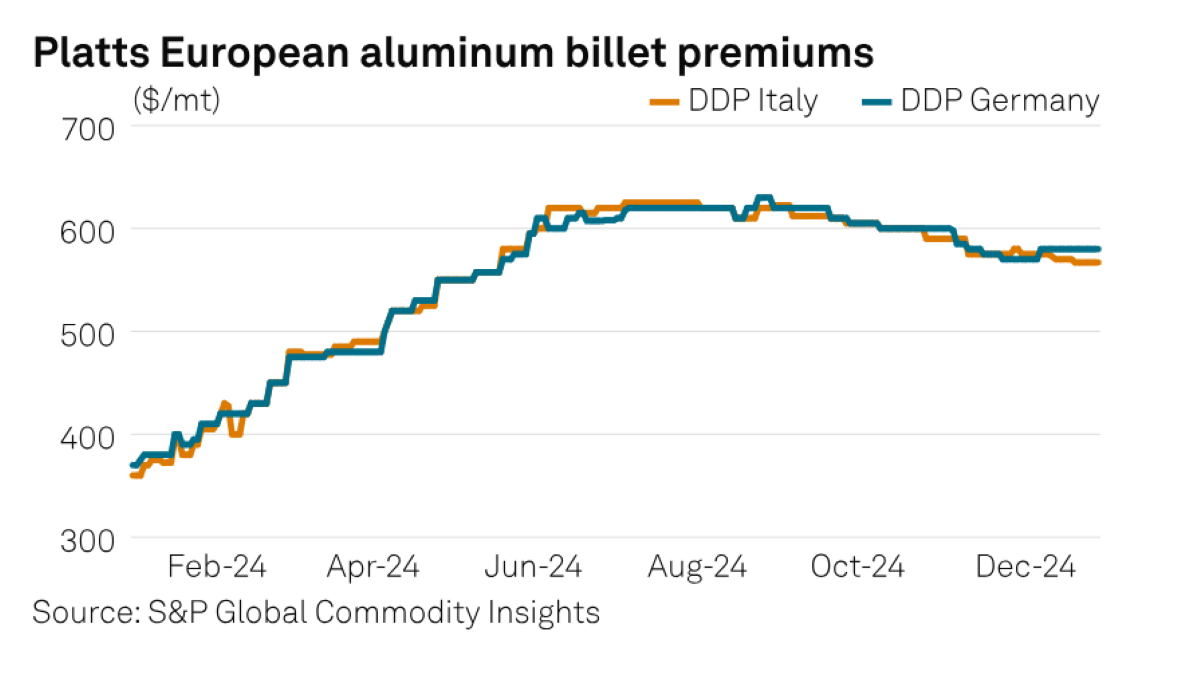 Image Source: S&P Global Commodity Insights
“We are forecasting possible tightness in February,” another producer shared, noting a number of producers had extended production stoppages in late 2024 for the festive break. “We don’t need booming demand to create tightness.”
The producer noted that a minimum billet premium of $570 per tonne, delivered duty paid (DDP) to Italy, with 60-day payment terms, is necessary to finalise a deal. Offering a price below this could lead to losses. Decreasing production margins have prompted some flexible producers to shift their focus toward more profitable products.
“We have put a limit on our [billet] sales, as we enjoy the flexibility of switching between products. Although demand doesn’t seem good, I don’t expect a collapse in billet premiums,” a third producer said.
Furthermore, European supply may experience a further decline as some traders reduce imports due to high financing costs and prolonged transit times. These delays are caused by ongoing disruptions in the Red Sea, resulting from Houthi attacks on vessels that started in October 2023.
“You need at least US$600 per tonne DDP [with 60 days payment terms] to replace metal here from the Middle East,” a trader mentioned, with the following disclaimer, “Financing costs are very high, with material taking 78 days to arrive to Italy. We have reduced imports as it makes no sense financing two months extra.”
“Traders will not take the risk of carrying inventories for too long with these financing costs and will only import units that have been booked,” another seller added.
An Asia-based producer stated that they were shipped to Europe through long-term contracts but would abstain from spot deals, as current premiums do not incentivise shipments.
Market participants are closely monitoring the impact of a new non-preferential tariff quota on slabs and billets of unwrought aluminium alloys, introduced by the European Commission in December. This quota amounts to 573,000 tonnes and will take effect on January 1, 2025. Imported volumes up to this limit—from countries not benefiting from preferential tariffs—will be subject to the existing 4 per cent duty. However, any amounts exceeding this quota will now incur a 6 per cent charge. For products imported from Russia and Belarus, the duty remains at 6 per cent.
From 2020 to YTD November 2024, the EU’s imports of unwrought aluminium significantly exceeded its exports, reflecting a consistent trade deficit. Imports increased steadily from 5,338,588 tonnes in 2020 to 6,579,628 tonnes in 2022 (a 23 per cent rise over two years). However, they slightly declined to 6,348,074 tonnes in 2023 (-3.5 per cent) and further to 5,446,903 tonnes YTD November 2024, indicating a downward trend post-2022.
Exports showed moderate fluctuations, rising from 477,752 tonnes in 2020 to 520,785 tonnes in 2021 (+9 per cent) before declining to 495,213 tonnes in 2022 (-5 per cent). The downward trend continued in 2023 (461,951 tonnes) and YTD November 2024 (334,897 tonnes).
While both imports and exports peaked in 2022, imports consistently outpaced exports by over tenfold, emphasising the EU’s heavy reliance on unwrought aluminium imports to meet domestic and industrial demands.
Initial reaction from sources suggests minimal impact, with a large share of imports arriving from duty-free origins, such as Iceland and Norway, and the majority of other volumes entering Europe falling within the quota and remaining subject to the 4 per cent duty.
Buying trend on the shift
Despite consistently lower production levels, buyers seem unconcerned about the availability of billets. They are choosing to maintain minimal stock levels to avoid overcommitting in light of uncertain demand. As a result, many buyers have increased their reliance on the spot market and shifted to monthly bookings, moving away from traditional quarterly contracts since the second half of 2024. This trend is expected to continue into 2025 as long as demand remains under pressure.
While switching to spot purchasing provides buyers with greater flexibility, it may also expose the market to sudden fluctuations in supply and demand, according to various sources.
“There is a lot of metal in local regional warehouses, and customers are not booking because they see safety of supply,” a fourth producer said. “But when they see premiums going up, they will start booking, and it will be on a first-come, first-served basis.”
Weak demand is expected to continue being a significant challenge for the European aluminium billet market. The struggling building and construction sector, a major consumer of billets, shows little indication of recovery. Market participants believe this may hinder any substantial increase in premiums, despite issues on the supply side.
The latest HCOB Eurozone Construction PMI survey data, compiled by S&January 7al on January 7, indicates that construction companies remain pessimistic about their activity in 2025. During the December 2024 survey period, firms in France and Germany expressed negative outlooks, even though sentiment regarding order intake and future activity improved compared to November. Meanwhile, growth expectations in the Italian construction sector continued to decline.
Delivery postponements from 2024 are further reducing the need for new bookings, as buyers work through existing stockpiles, before placing new orders.
“We postponed 15-20 per cent of volumes from Q4 into next year due to deteriorating demand,” a consumer said.
A second consumer expressed optimism, predicting a 3-5 per cent increase in demand during 2025. However, they cautioned that if demand rises sharply, concerns may arise about billet availability due to recent production cuts.
Information credit: S&P Global