The definitive aluminium alloy matrix – Upgrading from commodity to deep-tech metal
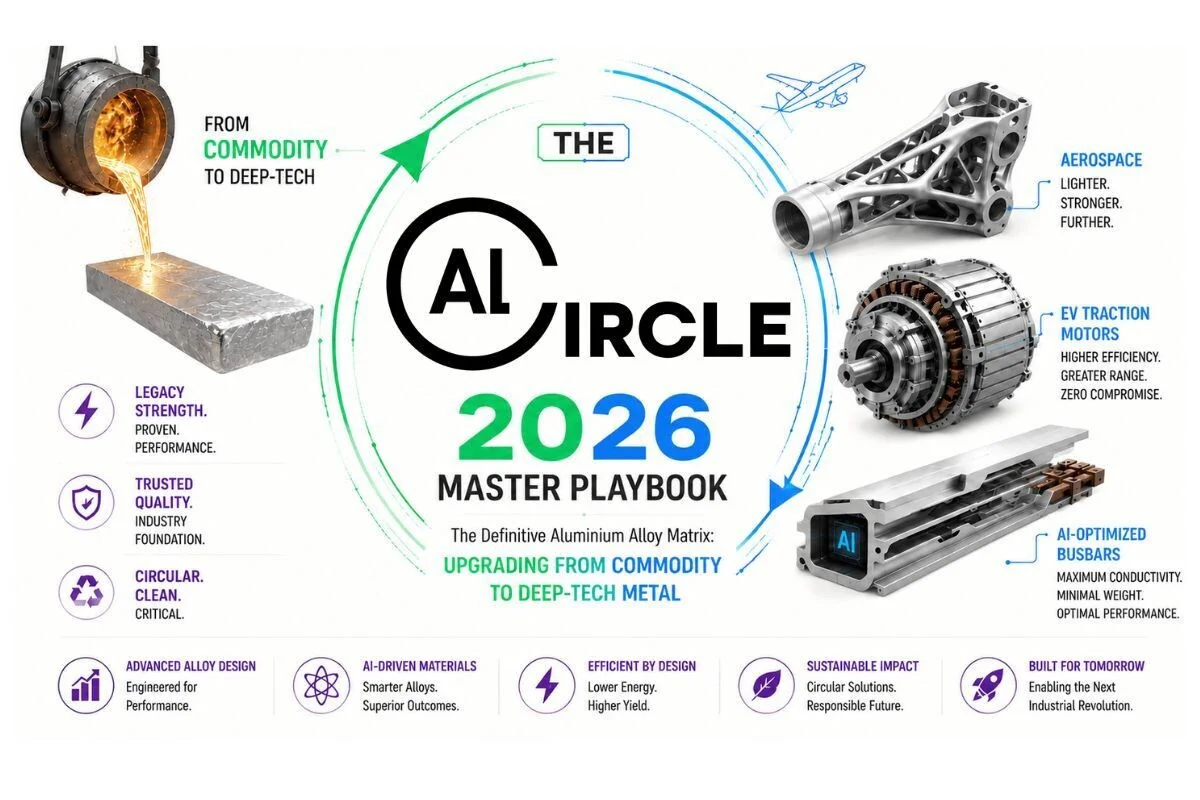
The image used in this article is generated with an AI tool and does not depict any real-time moment
EXECUTIVE SUMMARY:
- The commodity death spiral: Sourcing standard, legacy aluminium alloys (like basic ADC12, 1350, or 6061) for next-generation, high-stress applications is a guaranteed margin trap. These materials warp under extreme EV manufacturing scale, suffer structural creep in high-voltage grids, and trigger crippling carbon tariffs at the European border.
- The nanolevel revolution: The global industry is rapidly pivoting to highly engineered, deep-tech metallurgy. From Oak Ridge's impurity-tolerant RidgeAlloy to zirconium-doped conductors and scandium microalloying, atomic-level chemistry is now the primary driver of corporate gross margin.
- The strategic imperative: This master playbook provides downstream foundries, extruders, and procurement officers with the exact chemical, mechanical, and thermodynamic benchmarks required to escape the low-margin commodity trap and secure high-value contracts.
For half a century, the global aluminium value chain operated on a predictable, linear model. If you needed a cheap die-casting, you bought ADC12. If you needed electrical wiring, you bought 1350. If you needed an aerospace frame, you bought 7075 and mechanically riveted it together.
Today, those traditional metallurgical windows are functionally dead.
The extreme lightweighting demands of EVs, the explosive thermal and electrical loads of AI data centres, and the incoming financial penalties of the CBAM have completely rewritten the rules of alloy selection. If a plant manager attempts to force a legacy alloy into a next-generation application, the result is catastrophic: giga-castings tear in the mould, electrical terminations creep and catch fire, and high-carbon primary metal wipes out the profit margin at the border.
To survive, procurement officers and plant managers need a new map. Here is the definitive AL Circle Master Matrix, detailing exactly how the industry's most critical alloy families are being upgraded, doped, and engineered for the next industrial era.
The global aluminium casting usage is expected to reach 24.2 million tonnes in 2026. To know about the future market trends, prebook our upcoming report “Global Aluminium Casting Market 2026-2032
The master alloy comparison matrix
_0_0.png) The image used in this article is generated with an AI tool and does not depict any real-time moment
The image used in this article is generated with an AI tool and does not depict any real-time moment
The foundry revolution: RidgeAlloy, rheocasting, and active cooling
For decades, ADC12 (Al-Si-Cu) was the undisputed king of high-pressure die casting (HPDC). However, the EV "Giga-casting" revolution, pioneered by single-shot underbodies replacing hundreds of stamped parts, has exposed ADC12's fatal structural flaws. Traditional HPDC alloys require high iron content to prevent the metal from soldering to the steel die, but that iron creates brittle, needle-like intermetallic phases that warp and crack catastrophically during T6 heat treatment. Furthermore, turbulent metal injection at velocities exceeding 50 m/s inevitably folds air and surface oxides into the casting, generating destructive oxide bifilms.
The chemistry upgrade: RidgeAlloy - As foundries shift toward circular economies, they must learn to process post-consumer scrap without relying on expensive primary metal dilution. The breakthrough is ridgealloy, engineered by the U.S. Department of Energy’s Oak Ridge National Laboratory.

Utilising high-throughput computing, metallurgists developed a novel Al-Mg-Si-Fe-Mn composition that can absorb a massive 1.5 wt% iron and 1.5 wt% silicon simultaneously without losing ductility.
- The metallurgical mechanism: RidgeAlloy alters the solidification path, forcing the iron to precipitate as benign, rounded intermetallic phases rather than sharp, brittle needles. This allows the alloy to maintain a highly ductile elongation rate of 7 to 13 per cent.
- The commercial ROI: Automotive casters can transition to 100 per cent highly contaminated post-consumer scrap for structural parts, slashing raw material energy costs by 95 per cent and bypassing the need for primary virgin ingots.
The physical upgrade: Semi-solid metal (SSM) rheocasting To eliminate oxide bifilms, advanced foundries are abandoning turbulent liquid injection entirely in favour of SSM Rheocasting.
This process manipulates the aluminium alloy as a semi-solid slurry. By carefully controlling the cooling rate of the melt prior to injection, the aluminium achieves a partially solidified state characterised by a non-dendritic, highly globular microstructure.
- The metallurgical mechanism: When mechanical pressure is applied, the viscosity of the globular slurry temporarily drops, allowing it to flow into complex die cavities as a cohesive, laminar front. Because the flow is laminar rather than turbulent, it effectively pushes ambient air out of the die, preventing gas entrainment and oxide bifilm formation.
- The commercial ROI: Near-zero porosity allows the casting to undergo aggressive post-casting T6 heat treatments and structural welding. This makes Rheocasting the gold standard for producing complex, thermally demanding EV motor housings and inverter casings.
Integrated thermal management: The CoolCast imperative Active liquid cooling is essential for next-generation EV drivetrains. Casting lightweight, hollow aluminium tubes directly into a structural HPDC component was historically impossible because extreme injection pressures (up to 1,200 bar) instantly crushed the tubes.
This bottleneck is resolved via ZLeak Tube technology, developed under the CoolCast research project.
- The metallurgical mechanism: A highly specialised, two-layer sacrificial filler insert is placed inside the aluminium tube before casting. The filler consists of a water-soluble outer layer and a coarse-grained, media-permeable inner core. This solid filler matrix provides the internal resistance necessary to prevent the tube from collapsing under the intense pressure of the molten metal.
- The commercial ROI: Once the casting solidifies, the internal filler structure is easily flushed out using high-pressure water. This leaves behind a perfectly formed, completely clear, and inherently leakage-free hollow cooling channel seamlessly bonded within the monolithic casting.
The electrification & AI backbone: Zirconium, CCA, and busbars
Driven by the explosive price of copper and the sheer physical limits of modern electrical infrastructure, the world is frantically substituting copper with aluminium. However, standard 1350 electrical-grade aluminium suffers from severe "creep" (permanent deformation under sustained mechanical and thermal stress). This causes mechanical connection joints to loosen over time, forming highly resistive oxide layers (Al₂O₃) that trigger catastrophic electrical fires.
The grid upgrade: Zirconium-doped TAL: To build offshore wind grids and high-voltage transmission lines, the industry is pivoting to Thermal Resistant Aluminium Alloys (TAL). By doping the melt with 0.02 to 0.05 per cent zirconium (Zr) and a trace amount of boron (B), metallurgists permanently alter the alloy's performance boundaries.
- The metallurgical mechanism: The zirconium precipitates into dense, nano-scale, coherent Al₃Zr particles. Because these nanoparticles share a perfectly matching atomic lattice with the primary aluminium matrix, they act as microscopic anchors. This "Zener pinning" effect physically blocks the movement of grain boundaries, preventing recrystallisation and grain sliding at high operating temperatures. Simultaneously, boron precipitates out conductivity-killing transition metal impurities (like titanium and vanadium).
- The commercial ROI: Zr-doped TAL can operate safely at continuous temperatures of 150°C without creeping or losing tensile strength, securing a dominant share of the multi-trillion-dollar global grid upgrade market.
The EV motor upgrade: The 1370 CCA core: Inside the EV traction motor, heavy copper hairpin windings are being replaced by copper-clad aluminium (CCA). This bimetallic wire utilises a soft 1370 aluminium core co-extruded inside a highly conductive copper cladding.
- The metallurgical mechanism: To prevent the wire from fracturing during the violent transition from a round bar to a rectangular 3X2 mm hairpin, the copper cladding volume must be kept at a strict 42 per cent. Furthermore, direct co-extrusion must be performed at 150°C using a 40° semi-die angle with a sealed-cup billet design. This precise configuration constrains the softer aluminium core, preventing premature aluminium outflow and limiting the brittle intermetallic (IM) layer to exactly 1.45 µm after partial annealing.
- The commercial ROI: Automakers achieve a 50 per cent reduction in winding weight and massive cost savings. By exploiting the high-frequency skin effect, where electrical current naturally concentrates along the outer copper periphery, the wire achieves a highly efficient 78.3 per cent IACS electrical conductivity.
The AI data centre upgrade: 6xxx Series Busbars Next-generation AI server racks, packed with advanced GPUs, consume up to 100 kW of power. Delivering this immense power via traditional copper cables is impossible; the sheer weight of the copper cables exceeds the structural load-bearing limits of raised data centre floors.
- The metallurgical mechanism: Data centre architects are pivoting to massive, overhead power tracks extruded from highly conductive 6xxx series aluminium alloys. These alloys are engineered to balance mechanical yield strength (Mg₂Si precipitation) with maximum electrical conductivity.
- The commercial ROI: Because aluminium busbars are 50 per cent lighter than copper systems of equal ampacity, tech giants can safely build denser, multi-storey AI facilities, speed up installation, and drastically reduce structural engineering costs.
The scrap & extrusion mandate: ShAPE and nanocomposites
Downstream manufacturers face immense pressure from OEMs to transition from high-carbon primary metal to 100 per cent recycled secondary scrap. However, processing post-consumer scrap via traditional extrusion is a metallurgical nightmare: tramp iron impurities cause extruded profiles to snap and automotive sheets to fracture during stamping.
The process upgrade: ShAPE technology Pacific Northwest National Laboratory's Shear Assisted Processing and Extrusion (ShAPE) fundamentally disrupts the extrusion lifecycle.
- The metallurgical mechanism: Traditional extrusion requires energy-intensive billet preheating and homogenisation. ShAPE completely bypasses this. It utilises a rotating head paired with a hydraulic press. As the unheated scrap feedstock is forced against the rotating head, extreme localised shear generates intense internal frictional heat, softening the metal. At the nanolevel, this extreme plastic deformation mechanically breaks down macro-impurities and iron intermetallics into harmless, nanoscale sizes.
- The commercial ROI: ShAPE enables the direct extrusion of 100 per cent highly contaminated, post-consumer scrap into structural automotive profiles without a single drop of primary metal dilution, slashing energy input by 90 per cent.
The material upgrade: Metal matrix nanocomposites (MMNCs) - By uniformly dispersing nano-sized ceramic particles like silicon carbide (SiC) or titanium carbonitride (TiCN) into the secondary aluminium melt, metallurgists are engineering properties beyond the limits of monolithic alloys.
- The metallurgical mechanism: These ceramic nanoparticles act as physical barriers against dislocation movement and recrystallisation, effectively overpowering the detrimental, embrittling effects of tramp iron impurities.
- The commercial ROI: MMNCs deliver massive increases in yield strength and fatigue resistance from otherwise unusable low-grade scrap, allowing extruders to capture high-value structural contracts using low-cost feedstock.
The aerospace apex: The scandium upgrade
The highest-margin sectors in the world, aerospace and defence, have hit a 50-year metallurgical plateau. The 7000 Series (Al-Zn-Mg-Cu) represents the absolute pinnacle of commercial strength, but these alloys suffer from a catastrophic flaw: they are notoriously unweldable. The intense heat of a welding arc destroys the carefully engineered microstructure in the Heat Affected Zone (HAZ), leading to severe hot cracking. This historically forced aerospace OEMs to rely on millions of heavy, expensive rivets.
The next-gen upgrade: Scandium microalloying - Adding trace amounts of Scandium (typically 0.1 to 0.5 wt%) to the melt represents the most powerful microalloying strategy in modern metallurgy.
- The metallurgical mechanism: During solidification and ageing, Scandium precipitates into billions of dense, coherent, nano-scale Al3Sc particles. Because these nanoparticles share a perfectly matching atomic lattice with the primary aluminium matrix, they exert immense thermodynamic control.
- The commercial ROI: Scandium microalloying completely eliminates the hot-cracking crisis, allowing aerospace fuselages to be welded seamlessly, eliminating millions of heavy rivets and slashing assembly costs.
Expanding the scandium effect across alloy series:
- The 5000 series (Al-Mg) transformation: In marine and armour alloys, Sc microalloying introduces a powerful secondary strengthening mechanism. Doping standard 5083 with Sc pushes the yield strength comfortably to 400 MPa while retaining complete immunity to marine corrosion and unlocking exceptional superplastic forming capabilities.
- The additive manufacturing (3D Printing) revolution: Standard wrought alloys perform terribly in 3D printers, experiencing severe hot tearing. The introduction of Sc-microalloyed powders, most notably Scalmalloy (Al-Mg-Sc-Zr), has made high-strength aluminium 3D printing viable. The rapid cooling rates of selective laser melting actively favour scandium, spontaneously precipitating billions of Al₃Sc nuclei and resulting in printed components with yield strengths exceeding 450 MPa.
The fifth dimension: Carbon as a physical property (CBAM)
The era of purchasing aluminium based solely on the London Metal Exchange (LME) cash price and standard regional premiums is over. Value and margin are now dictated by the carbon premium.
Under the CBAM, the carbon footprint of imported metal is legally treated as a physical property. High-carbon primary aluminium faces crippling border taxes. Conversely, secondary aluminium derived from post-consumer scrap carries a zero upstream carbon burden.
The carbon algebra: Equations 57 and 58 - To enforce this carbon tariff, the European Commission has codified a strict mathematical framework.
The financial impact scenario - By incorporating localised grid emission factors into the default calculation, carbon-intensive regions are heavily penalised. For example, the national grid factor applied to Chinese industrial production is rated at a massive `1 tCO2e/MWh-approximately 2.7 times higher than the European Union grid average. When combined with the confirmed initial CBAM certificate price of €75.36 per tonne, the financial impact on a 1,000-tonne shipment of extrusions is stark, potentially leading to massive additional costs for exporters.
 The image used in this article is generated with an AI tool and does not depict any real-time moment
The numbers are inescapable. As pricing agencies like Fastmarkets embed CBAM costs directly into billet premiums, sourcing cheap, coal-fired primary metal triggers a carbon tax bill exceeding EUR 1.35 million (USD 1.54 million) on a minor shipment, completely wiping out processing margins.
Unlock key insights from leading companies and experts across the aluminium ecosystem with our e-Magazine - Mine to Market: ALuminium Producers & Manufacturers 2026
The strategic conclusion
The aluminium industry has transitioned into a highly complex, deep-tech area. The operators who continue to view aluminium as a simple commodity will be crushed by energy volatility, carbon tariffs, and technological obsolescence.
The future belongs to the operators who master the kinetics of zirconium, the precipitation of scandium, the impurity tolerance of RidgeAlloy, and the zero-carbon footprint of secondary scrap. By connecting the upstream chemistry directly to the downstream manufacturing process, advanced casters, extruders, and procurement officers can secure the highest-margin contracts of the next decade and insulate themselves from the commodity death spiral.
Note: This is exclusive coverage by AL Circle and may not be reproduced, republished or shared without prior permission.
Disclaimer: The opinions, information, claims, references, and images presented here are those of the author alone and AL Circle holds no responsibility.
Germany’s Q1’26 aluminium exports dip 26% as bars, rods, profiles post steeper fall
Next articleAluminium foil reflector shown to improve Wi-Fi coverage and reduce signal leakage
Grow with
AL Circle