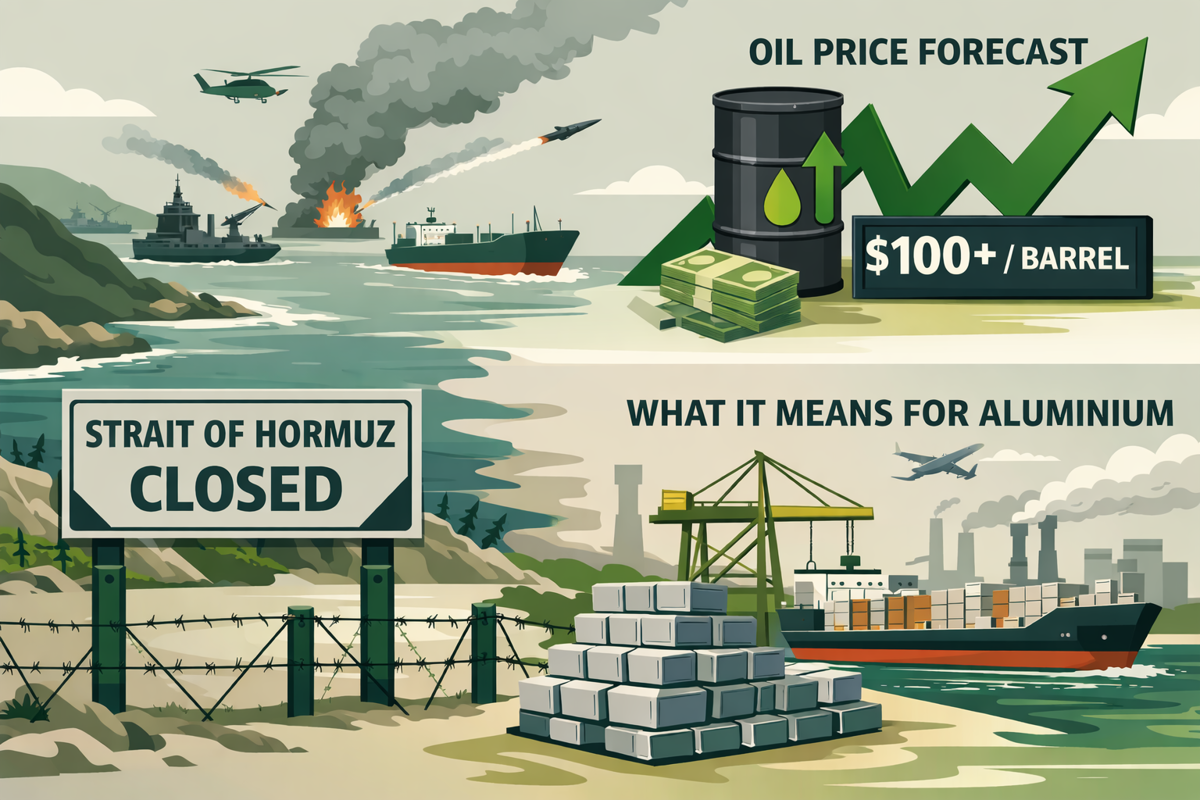
The escalating tensions surrounding the US-Israel conflict with Iran percolating down to the entire Middle East have triggered economic shockwaves across the globe. Aluminium and oil sectors are particularly vulnerable, and for obvious reasons. The Middle East is a pivotal region in aluminium production and oil extraction and also controls the world trade of these two commodities through the Strait of Hormuz, one of the most critical maritime shipping routes connecting the Persian Gulf to the Gulf of Oman and the Arabian Sea. Annually, the Strait of Hormuz handles an export volume of 5.14 million tonnes of primary aluminium, accounting for around 75 per cent of the region’s total production. Additionally, it serves as the passage for 20 to 21 million barrels of crude oil and petroleum liquids daily, representing 20 to 30 per cent of global consumption.
The effect of the Strait of Hormuz closure is already being felt
On the news of the closure of such a critical trade route, the fear of supply chain disruptions of both aluminium and oil intensifies, leading to a record surge of commodity prices. On March 2, primary aluminium price on the London Metal Exchange gained 2.17 per cent overnight, reaching USD 3,226 per tonne, up by 5 per cent over a week from USD 3,077 per tonne. On the other hand, crude oil price rose 3.84 per cent from the previous day, standing at USD 80.93 per barrel as of March 3, 2026.
Why is the impact so intense in the aluminium market?
The Middle East is a global leader in primary aluminium production, contributing nearly 10 per cent to the world’s output. A lion’s share of production in the Middle East is concentrated in the UAE, Bahrain, Saudi Arabia, Oman, Qatar, and Iran. Barring Iran, the other GCC countries produce over 6 million tonnes of primary aluminium, while Iran alone produces over 550,000 tonnes of metal annually. So, overall, the region churns out more than 6.5 million tonnes of primary aluminium, which are destined primarily to the United States and Europe.
Together from Bahrain, Qatar, and the UAE, the United States imported 497,000 tonnes of primary aluminium in 2024, which was nearly 14 per cent of the United States’ total primary metal imports. Separately, from Oman and Bahrain, the United States also secures 112,800 tonnes of aluminium plates, sheets and bars, according to the US Geological Survey data.
The European Union, on the other hand, imported over 1 million tonnes or 21 per cent of its primary aluminium from the Middle East last year, according to the UN COMTRADE Data. From the UAE, the European Union imported 526,759 tonnes, while that from Bahrain, Oman, and Qatar secured 389,213 tonnes, 114,238 tonnes, and 43,485 tonnes, respectively. So, together the Middle Eastern countries supplied 1.07 million tonnes of primary aluminium to the EU.
But wait! The United States and EU are not the only two regions dependent on the Middle East for primary aluminium. India is another importer of unwrought aluminium from the Middle East. In 2024, the country secured around 47,597 tonnes of the metal from the UAE, while it hauled 54,308 tonnes of the metal from Bahrain, 55,493 tonnes from Qatar, and 33,679 tonnes from Oman. So, altogether the Middle East supplied 191,077 tonnes of primary aluminium to India.
Oil crisis and what could be the repercussions
Well, all these regions’ sufferings are not only limited to aluminium. The closure of the Strait of Hormuz threatens the lifeblood of global oil trade, particularly for oil-importing nations in Asia. India, one of the largest oil consumers from the Middle East, is the country most vulnerable to crude supply shocks if the Middle East conflict leads to a prolonged disruption in shipments from the region. As of January, the Middle East accounted for about 55 percent of India's crude imports, at about 2.74 million barrels per day. Since India reduced its intake of Russian oil under the pressure of Washington, the Middle East has been the primary source. In FY2025, about 50 per cent of India’s crude and 54 per cent of LNG imports were routed through the Strait of Hormuz.
China is another major oil consumer from the Middle East, but its substantial reserve for the next six months at least ensures a buffer against any short-term disruptions. The broader Asian market, comprising countries like Japan and South Korea are also heavily reliant on the Middle East for oil. They reportedly source around 95 per cent and 70 per cent of their oil from the Middle East.
Europe and the United States, on the other hand, are not the major buyers of crude from the Middle East, but should the strait be closed for any prolonged period, oil price spikes would trigger inflationary pressures across economies.
For 2026 aluminium market outlook, download our report TOC: Global Aluminium Industry Outlook 2026
A global chain reaction – from oil prices to power costs to impacts on the aluminium industry
History is the witness that disruptions in oil supply chain never limit their impacts on oil prices but translate into high energy costs as ripple effects. The calculation goes like this – from 1 barrel of crude, 1.7 MWh of thermal energy is produced. But given the power plant efficiency at 35 to 40 per cent, usable electricity per barrel of oil is 0.6 to 0.7 MWh. Based on the present oil price at USD 80.93 per barrel, fuel cost per MWh would likely be USD 12-135/MWh. And after factoring in other costs related to transmission, capacity payments, and profit margins, final power price could reach USD 150-200 per MWh. Subject to the continuation of the conflict between US-Israel and Iran, analysts believe crude oil could even climb towards USD 100 per barrel.
In a report, Equirus Securities said, “If Iran’s 3.3 million barrels per day (3 per cent of global supply) is disrupted, and assuming a 3–5 per cent price response per 1 per cent supply shock, that implies a 9–15 per cent move. On a USD 70 per barrel (bbl) base, this translates into roughly USD 6–11/bbl upside, lifting crude towards USD 76–81/bbl purely on direct supply loss. However, markets do not price wars linearly. If escalation threatens the Strait of Hormuz, the premium becomes structural rather than proportional. Even partial disruption risk could embed a USD 20–40/bbl geopolitical premium, reopening a pathway towards USD 95–110+, well beyond the mechanical impact of Iran’s barrels alone.”
Must read: Key industry individuals share their thoughts on the trending topics
Crude oil price hike, rising energy costs, aluminium disruptions: What it means for the metal market
This event adds to the growing concerns over the aluminium supply chain. With China nearing its 45 million tonne cap, US smelters being repurposed into data centres, and the European Union still grappling with high power costs for primary aluminium production, the disruption in GCC countries further complicates the outlook. Market analysts need to now reassess how the expected 2026 demand of 105 million tonnes will be met.












_md.webp)