Six months into Donald Trump’s 2025 tariff regime and it seems to be a never-ending roller-coaster journey with new sets coming in. So, what’s the update this time? More than 400 additional aluminium and steel product categories have come under the fold of 50 per cent tariffs.
What are included? Auto parts, auto components, railcars construction materials, wind turbines specialty chemicals, and household items like refrigerators, freezers, dryers, and furniture components. In short, anything that contains or is contained in aluminium and steel. Brian Baldwin, vice president of customs at Kuehne + Nagel International AG, quipped anything and everything that looks shiny, metallic, or remotely like aluminium or steel, is included in the new list of product categories hit by tariffs.
The new set of tariff was published on last Friday by US Customs and Border Protection and brought to effect on Monday.
The US Department of Commerce said these 407 product categories are added to the list of ‘derivative’ steel and aluminium products covered by Section 232 sectoral tariffs, which include a 50% tariff on any steel and aluminium content of these products plus the country rate on the non-steel and non-aluminium content.
“Today’s action expands the reach of the steel and aluminium tariffs and shuts down avenues for circumvention – supporting the continued revitalisation of the American steel and aluminium industries,” Jeffrey Kessler, the Commerce Department’s undersecretary for industry and security, said in a statement.
Evercore ISI, an investment banking company, has shown that these 407 product categories represented more than USD 200 billion worth of imports last year.
Products with maximum volume of imports – auto parts at the epicentre
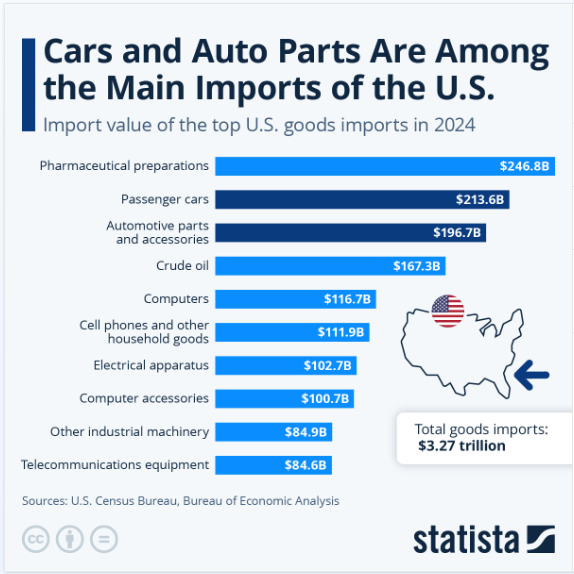
Auto parts are one of the most critical imports now hit with the 50 per cent tariff. According to the US Census Bureau, passenger car imports amounted to USD 214 billion last year, with auto parts adding another USD 197 billion to the equation. Among the other products facing derivative US tariffs, electrical apparatus imports were valued at USD 102.7 billion, cell phones and household goods valued at USD 111.9 billion, computer accessories USD 100.7 billion, telecommunications equipment USD 84.6 billion, and industrial machinery USD 84.9 billion.
Already, a group of foreign automakers have urged the White House to exempt auto parts from the tariff, bringing to the notice that the United States lacks the domestic capacity to meet the current demand. Even Tesla requested the Commerce to exempt steel products from the tariff list on the ground the United States lacks sufficient production capacity.
Ripple effects: more costs, more inflation
More tariffs mean more sufferings. Jason Miller, a professor of supply chain management at Michigan State University, has found out that steel and aluminium tariffs at present affect about USD 320 billion worth imports from the prior estimation of roughly USD 190 billion. Now, with more tariffs in place, be ready for almost everything becoming expensive. That means higher costs for businesses, higher prices for consumers, and inflationary pressure that might risk slowing the economy.
Although Donald Trump and his supports claim that the US economy has remained robust amidst tariffs, there are some analysts like Hinrich Foundation who find the price increase from all 2025 tariff rises has led to an average income loss of USD 2,700 per household. They have also estimated that US consumers will face an overall average effective tariff rate of 18.6 per cent. This means if an American would have had to pay USD 102.5 for a basket of goods, the same now costs USD 118.6.
For electronics, consumers should expect a price rise of 17 per cent, while metals will witness the highest increase, rising 41 per cent in prices in the short term and 17 per cent in the longer term.
Washington’s stand: revenue and industry backing
US Treasury Secretary Scott Bessent welcomed the tariff, expecting tariff revenues under President Trump to exceed his earlier USD 300 billion estimate, with the money going to pay down the federal debt rather than rebate checks for Americans.
S&P Global Ratings also confirmed that the United States’ AA+ long-term credit rating with a stable outlook as, according to them, tariff revenues will help offset the fiscal blow from President Trump's recent tax and spending bill.
Both Aluminum Association and the American Primary Aluminum Association ((APAA) have applauded the tariff.
Charles Johnson, president & CEO of the Aluminum Association, said: "This expansion of Section 232 tariffs to cover a wider scope of products containing aluminum is a major win for U.S. aluminium makers. This targeted action gets to the heart of the problem facing the industry today -- too many countries are circumventing trade rules by importing unfairly produced and traded aluminium in end products. These ‘derivative’ products, which contain aluminium from China and other non-market actors, are too often making their way across the U.S. border. The Trump administration's decision to expand the list of covered products is exactly the kind of pro-growth trade policy U.S. aluminium producers need. Targeted enforcement, strong trade partnerships and energy reforms will advance U.S. economic and defense priorities by keeping American aluminium competitive, sustainable and growing for generations to come. We look forward to further adjustments to the current tariff policy that will drive future growth in our industry.”
APAA commented, “We are grateful to President Trump and Commerce Secretary Howard Lutnick for continuing to take a stand against the unfair foreign trade practices that threaten the domestic primary aluminium industry. The additional products now subject to the 50% aluminium tariff consume significant amounts of aluminium, largely sourced from foreign entities that do not play by free market rules," remarked APAA President Mark Duffy. "Thanks to the new parameters of this tariff, American aluminium producers will be better positioned to compete on a level playing field, protect vital domestic jobs, and invest in the future of U.S. manufacturing. This action sends a clear message that the United States will continue to strengthen the tariff program to combat ongoing predatory trade behaviors that harm our industry and the hardworking Americans it supports."













_md.webp)