Replacing copper in EVs: The aluminium motor transition and the hidden defect trap costing suppliers in millions
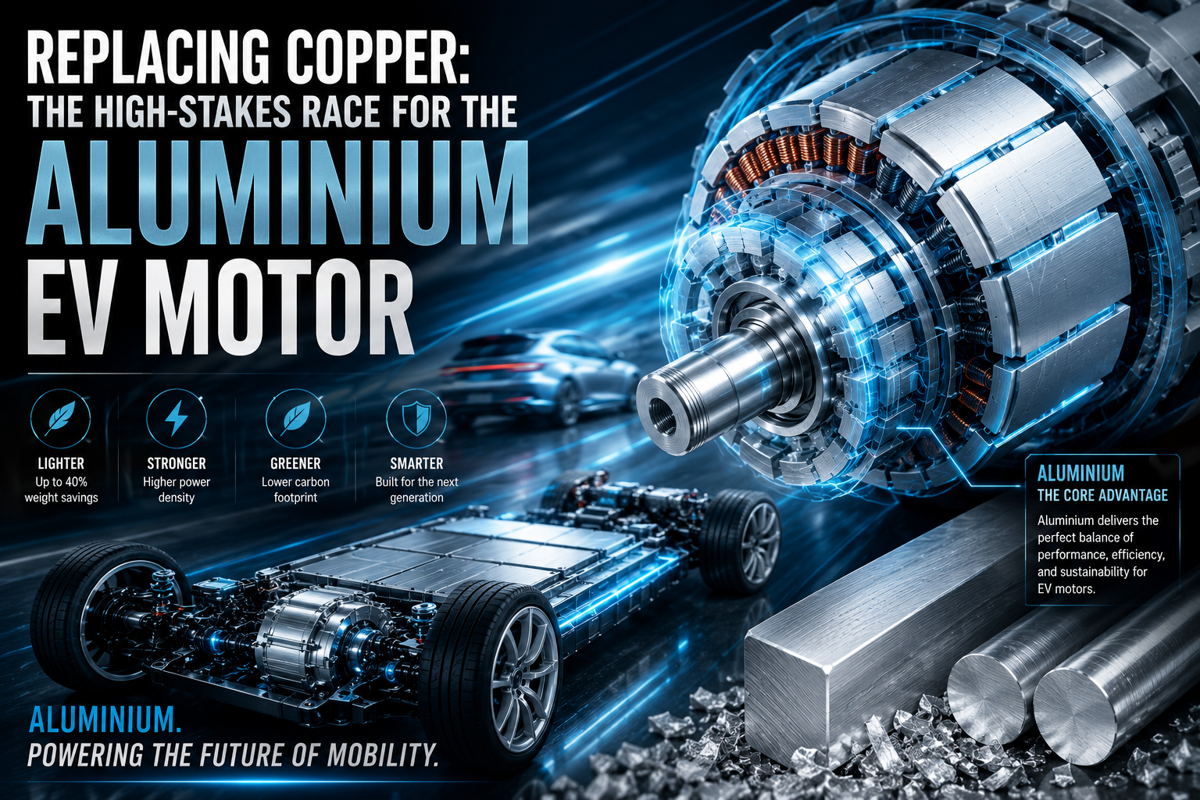
The image used in this article is generated with an AI tool and does not depict any real-time moment
EXECUTIVE SUMMARY:
- The macro mandate: Global automakers are desperate to increase EV range and reduce vehicle weight. The heaviest components are the battery and the traction motor. To slash weight, OEMs are issuing a clear mandate to their Tier 1 suppliers: replace heavy copper motor windings with lightweight aluminium.
- The cost-cutting trap: Suppliers are rushing to produce "Copper Clad Aluminium" (CCA) windings to win these lucrative OEM contracts. However, attempting to cut corners by using excessively thin copper cladding (20 per cent) is resulting in catastrophic factory-floor defect rates, fractured wires, and immediate OEM rejections.
- The strategic solution: To survive this transition and capture the EV motor market, suppliers must abandon basic extrusion methods. Pilot-scale data proves that winning the aluminium motor contract requires strict adherence to a 42 per cent cladding ratio and a mathematically precise 40° manufacturing die angle.
The race to dominate the global electric vehicle (EV) sector has entered a new phase. For the last decade, automakers focused entirely on battery chemistry. Today, the battleground has shifted to the drivetrain.
To achieve faster acceleration, higher efficiency, and longer driving ranges, automakers are frantically trying to reduce the gross weight of their vehicles. Outside of the battery pack, the traction motor is the heaviest component in the car. Historically, these motors have been packed with dense, heavy copper wire.
The mandate from automotive boardrooms in Detroit, Stuttgart, and Shenzhen is now universal: the industry must replace the heavy copper in EV motors with aluminium.
Because aluminium is significantly lighter and boasts a far more stable global price point, it is the ultimate substitution metal. By transitioning to rectangular "hairpin" motor windings driven by a solid aluminium core, automakers can drastically slash the weight of the drivetrain. To maintain electrical conductivity at high frequencies, the aluminium core is encased in a thin protective layer of copper, creating Copper Clad Aluminium (CCA).
On paper, this is a multi-billion-dollar growth story for the aluminium sector. In reality, it is creating a devastating margin trap for Tier 1 automotive suppliers who underestimate the metallurgical complexity of the transition.
To learn about the autonomous furnace tending in aluminium cast houses from RIA Cast House Engineering, join the webinar Autonomous furnace tending in aluminium cast houses: Improving safety, productivity and yield
The margin trap: When cost-cutting destroys the product
The transition from a theoretical aluminium motor to a mass-produced reality is exposing a severe vulnerability on the factory floor.
EV motors require hairpin windings with a perfectly rectangular profile to tightly pack the motor and maximise power. Taking a round bimetallic billet and rolling it into a perfect 3X2 mm rectangle is an extreme manufacturing challenge. The inner aluminium and the outer copper behave differently under immense pressure.
In a bid to maximise profit margins on these new EV contracts, many suppliers are attempting to use the absolute bare minimum amount of copper possible, often rolling wires where the cladding encompasses only 20 per cent of the total volume.
Recent pilot-scale metallurgical research exposes the fatal flaw of this cost-cutting strategy.
When manufacturers force a 20 per cent CCA wire through high-speed rolling mills, the thin outer layer fails mechanically at the corners. The metal shears, creating "ears" and deep fractures that leave the inner aluminium core exposed and structurally compromised. For a Tier 1 supplier, sending a batch of fractured, delaminating motor windings to a major automaker guarantees an immediate product rejection, voided contracts, and millions of dollars in scrapped material.
_0_0.png)
The image used in this article is generated with an AI tool and does not depict any real-time moment
Furthermore, basic manufacturing setups suffer from "premature aluminium outflow". Because the 1370 aluminium core is significantly softer than the outer shell, applying high-pressure extrusion causes the aluminium to shoot out faster than the exterior tube. This disproportionate flow results in an inconsistent product, multiple fractures along the length of the wire, and completely unusable scrap.
To survive this transition, suppliers must stop treating bimetallic wire as a cheap commodity and start treating it as a precision-engineered aerospace component.
The manufacturing fix 1: The 42 per cent rule
The solution to securing these lucrative EV motor contracts relies on strict volumetric control to protect the aluminium core.
The industry must respect the mathematics of bimetallic strain. To enable the aluminium core to survive the pressure, non-symmetrical strain of rectangular wire rolling without corner fracture, the cladding volume percentage must be increased to a strict 42 per cent (+_1%).
At this precise volume, the wire can be aggressively rolled into a 3X2 mm rectangular profile without a single seam, split, or delamination. When subjected to severe ASTM B566 bend testing, the 42 per cent wire maintains flawless adhesion. The correctly proportioned cladding successfully absorbs the mechanical strain, entirely protecting the structural integrity of the aluminium core, ensuring it passes strict OEM quality control.
To know about the latest technical development of aluminium casting and market is growing to reach 24.2 Mt usage, explore our comprehensive report: “Global Aluminium Casting Market 2026-2032”
The manufacturing fix 2: The 40° "sweet spot"
Even with the correct material volumes, the success of the aluminium substitution depends heavily on the specific tooling used in the factory.
To achieve a true metallurgical bond between the inner aluminium and the outer shell, there must be sufficient compressive stress. If the extrusion die angle is too steep, friction skyrockets, overloading the multi-million-dollar extrusion press. If the angle is too shallow, the materials simply do not bond, and the wire falls apart.
Extensive pilot-scale testing across various die geometries has revealed the exact factory-floor sweet spot. A 40° semi-die angle provides the optimal distance for the two metals to join together while keeping friction levels manageable. When paired with a sealed billet design that physically constrains the softer aluminium from flowing out prematurely, the 40° die produces a pristine, defect-free bimetallic bar ready for high-speed rolling.
Mastering the interface for maximum conductivity
The final hurdle in producing motor-grade aluminium hairpins is managing the intermetallic (IM) layer. When aluminium and copper are heated and pressed together, they form brittle intermetallic compounds at their boundary. If this layer grows too thick, it acts as a resistor, destroying the wire's electrical conductivity and defeating the purpose of the EV motor upgrade.
However, metallurgical analysis proves that if the manufacturing temperature is strictly controlled at 150°C during extrusion, the resulting IM layer remains ultra-thin (approximately 1.45 µm). Because this layer is significantly thinner than the average grain sizes of the surrounding metals, it has a net-zero detrimental effect. The finished rectangular aluminium-cored wire achieves a highly efficient 78.3 per cent IACS electrical conductivity, perfectly satisfying the automaker's demands.
The final verdict
The electrification of the automotive industry guarantees a historic demand cycle for lightweight traction motors. The aluminium-cored rectangular hairpin winding is the undisputed future of this architecture.
However, the OEM contracts will not be awarded to suppliers who view this as a simple cost-cutting exercise. Manufacturers attempting to service this high-stakes market with unprotected aluminium cores, outdated billets, and 20 per cent cladding ratios will be crushed by defect rates and automaker rejections.
Conversely, the advanced suppliers that deploy 40° co-extrusion dies, mathematically protect their aluminium with the correct 42 per cent cladding ratios, and master their thermal kinetics will capture the most lucrative, high-margin contracts in the EV supply chain. The transition away from copper is inevitable, but only the most precise manufacturers will survive it.
Note: This is exclusive coverage by AL Circle and may not be reproduced, republished or shared without prior permission.
Disclaimer: The opinions, information, claims, references, and images presented here are those of the author alone and AL Circle holds no responsibility.
Aluminium takes centre stage in Opsun’s new rooftop inverter racking system
Next articleAluminium du Maroc positions itself as a key supplier to Morocco's construction industry
Grow with
AL Circle





















