The aluminium industry is on a determined mission to build a truly closed-loop supply chain, and the spotlight is firmly on aluminium dross. Around the globe, smelters are ramping up efforts to minimise waste and supercharge recycling, driven by ambitious sustainability goals. Thanks to cutting-edge advances in dross processing technology over the past few years, companies are making remarkable strides.
The impact - Of the total aluminium dross generated in 2024, an estimated 60-70 per cent was recovered and processed in various in-house facilities of aluminium producers as well as at third-party recycling facilities. Not only this, top region wise also the aluminium recovery rate from dross has shown significant results. Like –
- China generated over 2 million tonnes of dross, of which 70-75 per cent made it to recovery facilities, yielding considerable aluminium metal recovery.
- It is estimated that Europe generated more than 400,000 tonnes of dross, of which 80-85 per cent were collected and processed, and a huge amount of metal was recovered.
- North America generated approximately more than 450,000 - 500,000 tonnes of aluminium dross, of which about 75-80 per cent were collected and sent for further processing to extract valuable aluminium.
Want to know the amount recovered, click here to read.
The question now is how far this momentum can carry us toward a zero-waste aluminium future. The progress so far suggests the industry is well on its way. Billion-dollar transactions in the aluminium sector resulted from this recovery effort, demonstrating the value of modern dross processing technologies.
Below is a list of such cutting-edge technologies in dross processing taken up by companies –
Rethinking dross not as waste, but as a resource - Alcoa
In the aluminium world, where every gram counts and every process has environmental consequences, Alcoa is rewriting the rules with its bold Dross-to-Pot initiative, a game-changing leap toward full-circle sustainability. Dross, the often-overlooked by-product of aluminium smelting, is typically rich in aluminium oxide and trace metal materials too valuable to waste.
In 2023, this initiative gained strong momentum. At Baie-Comeau, alloyed dross recycling was successfully stabilised, while Alumar fully implemented pure dross recycling. Meanwhile, dross from Deschambault, Portland, and most of Fjardaal is no longer heading to landfills, with only minimal volumes awaiting further process optimisation. The company has also started trial operations at Bécancour, the next potential hub for this sustainable practice.
Hydro's groundbreaking innovation in reducing dross during post-consumer scrap recycling
Hydro, a global powerhouse in aluminium recycling, is tackling one of the industry's most persistent challenges head-on and transforming it into an opportunity for innovation. At the heart of this effort lies a familiar hurdle: the generation of dross, a common by-product and source of metal loss when recycling post-consumer scrap (PCS), especially thin or fragmented aluminium pieces. By integrating this technology across its remelting and recycling facilities, the company is set to boost post-consumer scrap (PCS) processing by up to 20 per cent at each plant.
To tackle the challenge head-on, Hydro has engineered a breakthrough. A screw extruder technology purpose-built for processing thin-gauge aluminium scrap. This innovative system compacts lightweight, fragmented scrap such as chips and shavings into denser, more uniform forms, dramatically reducing their exposure to air during remelting.
The result? Significantly less oxidation, lower dross formation, and higher metal recovery. By increasing the effective size and density of the metal input, Hydro not only preserves more aluminium but also boosts overall recycling efficiency—marking a significant step forward in the sustainable processing of post-consumer scrap.
Alucyc - Complete recovery of aluminium from dross
The Alucyc project has successfully developed an innovative process to recover metallic aluminium from dross, pushing the boundaries of efficiency. This breakthrough technology boosts recovery rates from the industry standard of 95 per cent to an impressive 99 per cent, setting a new benchmark in aluminium recycling. What sets Alucyc apart is its zero-waste approach. By-products like cryolite and residual aluminium oxide are repurposed as valuable additives in primary aluminium melting, reinforcing a closed-loop, sustainable system.
The main hero of this innovation is a novel phase model, a revolutionary electro-slag furnace with non-consumable electrodes, and advanced process and power control systems, all seamlessly integrated for maximum performance. Backed by strong interest from primary aluminium producers, Alucyc's high efficiency and eco-friendly design signal a clear path to rapid industry adoption and widespread commercial success.
Novacium's breakthrough in transforming black aluminium dross into green hydrogen
Black aluminium dross—a hazardous and toxic by-product of aluminium recycling has long been one of the industry's toughest environmental challenges worldwide. Tackling this stubborn problem is key to unlocking a cleaner, more sustainable future for aluminium. Novacium SAS, a subsidiary of HPQ Silicon, has developed a unique waste-to-energy process that turns black aluminium dross into green hydrogen and valuable by-products. This cutting-edge technology is a game-changer, boosting sustainability and unlocking new value across the aluminium recycling chain. Novacium's breakthrough represents a major leap forward in the aluminium industry's path to sustainability. By transforming troublesome industrial waste into a clean source of renewable energy, this technology has the potential to revolutionise waste management in the sector while making a meaningful contribution to the global green hydrogen economy.
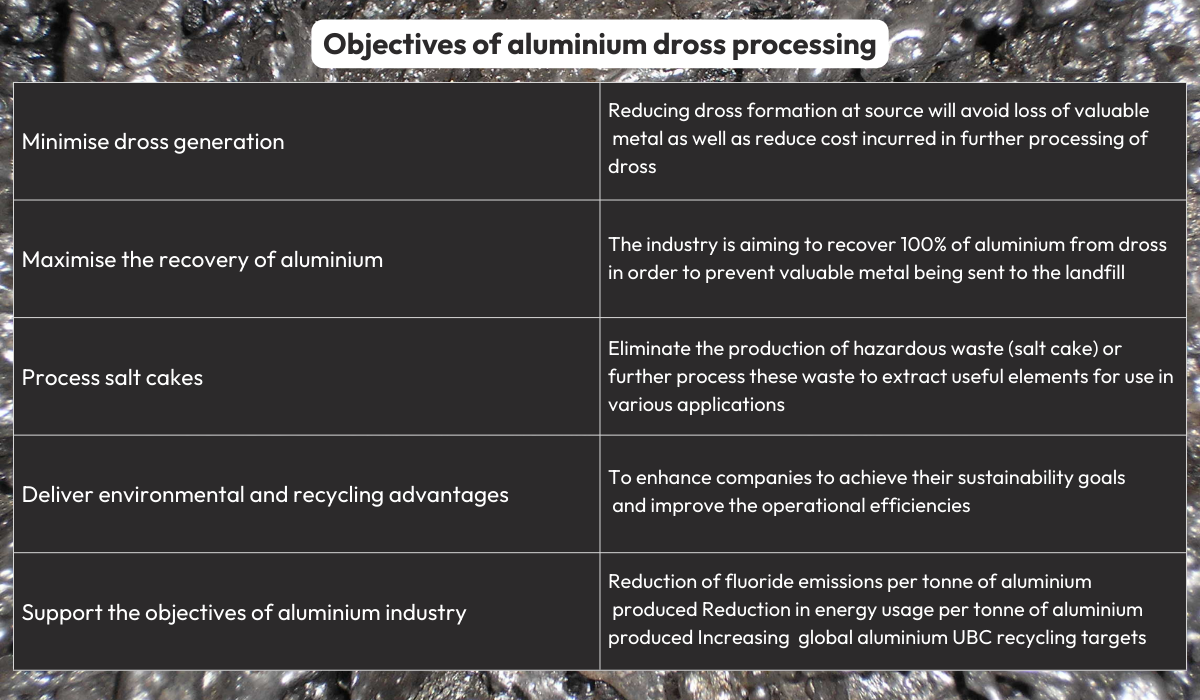
Now comes the question – What is the objective of dross processing?
Each year, vast quantities of aluminium dross are dumped into landfills, leading to a significant loss of valuable metal resources. Recovering the metallic content from dross adds tremendous value to the generating facility. Industry estimates suggest that every 10 tonnes of recovered dross can boost aluminium production by 3 to 5 tonnes or more, thanks to today's advanced recovery technologies.
Not only this, as per AL Circle’s report –
- Dross generation in primary aluminium smelting typically accounts for 0.8 per cent to 1.5 per cent of total output
- Secondary aluminium sector witnessed a growth of approximately 2.25 per cent
- Dross formation in downstream segment typically ranged from 0.3 per cent to 2 per cent,
Further processing of dross produced an huge quantity of metal recovery. But how is dross utilised?
Applications of aluminium dross
Beyond aluminium metal recovery, dross holds potential for a range of other valuable applications. Over the years, numerous studies have explored ways to transform dross into value-added products. While some of these innovations have successfully made their way into commercial use, others remain proven concepts or theoretical possibilities. Here are a few notable examples:
- Aluminium dross, when conditioned by washing with boiling water, can serve as an effective additive in concrete. This treated dross acts as a filler, boosting flexural strength by 25 per cent and compressive strength by 5 per cent compared to standard cement. The result is reduced cracking, enhanced durability, and lower costs by cutting down on traditional materials like cement and gravel.
- Dross particles smaller than 70 microns show potential as fillers in concrete and asphalt to improve abrasion resistance and control microcracks, though this application remains unproven
- Aluminium dross can also be a valuable source of calcined alumina, widely used in refractory materials
- Additionally, dross can be processed into sintered calcium aluminates, which serve as protective covers for liquid metals during high-temperature processes
- Aluminium dross has been used to substitute green silica sand in mould material for aluminium alloy castings.
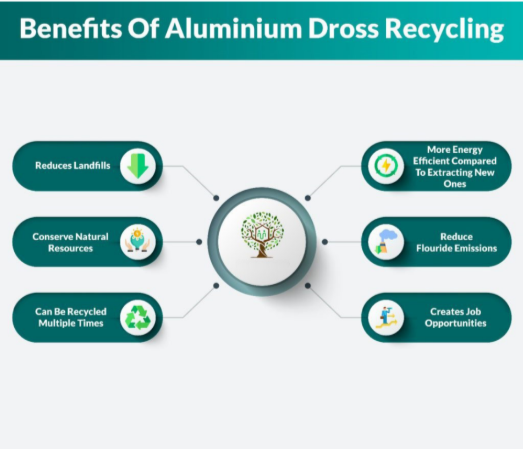
For today’s sustainability leaders, aluminium dross recovery isn’t just about managing waste. It’s a vital step toward achieving a truly circular economy -
- Energy efficiency: Recovering aluminium from dross uses only 5 per cent of the energy needed for primary aluminium production, making it one of the smartest energy-saving moves a company can make.
- Lower emissions: By processing dross instead of extracting aluminium from bauxite, producers significantly cut greenhouse gas emissions—an increasingly critical metric for ESG reporting.
- Smarter resource use: Dross recovery extends the lifecycle of mined materials, aligning with global mandates for resource efficiency and conservation.
At its core, sustainable aluminium dross processing is about transforming yesterday’s waste into tomorrow’s resource. By recovering valuable materials and minimising environmental harm, it turns a once-overlooked by-product into a powerful asset. This approach not only reduces the industry’s ecological footprint but also preserves natural resources and reinforces the principles of a circular economy—where nothing is wasted and everything has value.
The aluminium industry’s journey toward a zero-waste, closed-loop future is no longer just aspirational—it’s actionable, and it’s happening now. Dross, once written off as an inevitable by-product, is being transformed by innovation into a cornerstone of sustainability. Whether it’s Alcoa’s Dross-to-Pot initiative, Hydro’s screw extruder breakthrough, Alucyc’s near-total metal recovery, or Novacium’s green hydrogen leap, the message is clear: what was once waste now fuels progress.
Dross recovery isn’t just about salvaging lost metal it’s about reimagining the system. It’s energy-smart. It’s emissions-light. It’s resource-wise. And with over 60-70 per cent of dross already processed in 2023-24, this isn’t a trend it’s a transformation. But this story is still being written. The next chapter depends on how boldly the industry continues to invest, collaborate, and innovate. Could aluminium dross help meet global green hydrogen targets? Will we soon see commercial buildings strengthened with dross-enhanced concrete?













_md.webp)