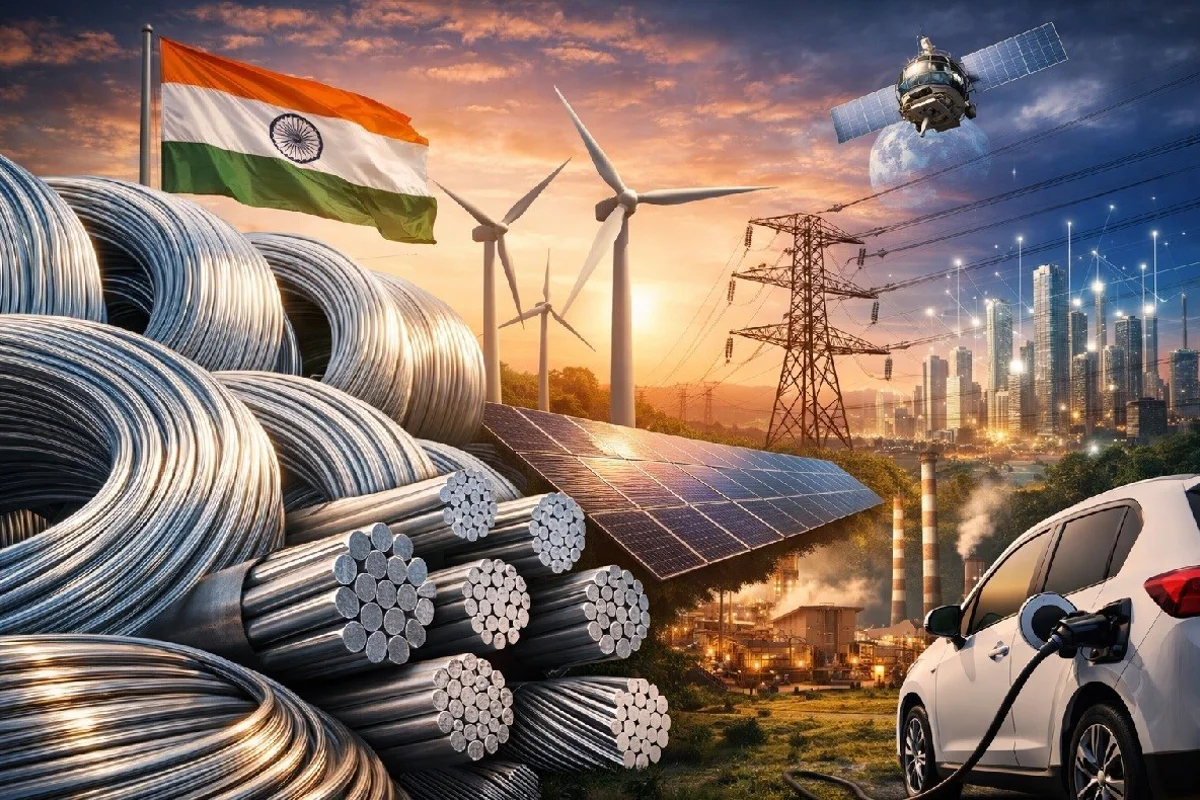
Across modern power systems, one of the important product is aluminium wire rods. Their growth mirrors the expansion of electricity networks around the world. Global aluminium wire rod usage has increased from 7.6 million tonnes in 2020 to about 8 million tonnes in 2023, to 8.16 million tonnes in 2024 and 8.32 million tonnes in 2025. The global wire and cable market, valued at USD 191.6 billion in 2022, is projected to grow at a CAGR of 6.30 per cent from 2023 to 2032.
Much of this momentum is tied to transmission and distribution. Over seven decades, aluminium cables and conductors have taken the place of copper as the main carrier of electricity. Today, bare conductors account for 70 - 75 per cent of the aluminium used in cable and conductor applications, with insulated cables forming the rest.
China leads aluminium wire rod production, followed by India, and together both countries make up about 68 per cent of global usage - a share expected to hold as total demand is projected to surpass 10.1 million tonnes by 2030. To access more accurate data, download :ALuminium Wires & Cables - Insights & Forecast to 2030.
India’s renewable commitments push demand higher
India stands just behind China as a major user of aluminium wire rods. Consumption is estimated at 1.41 million tonnes in 2023, rising to 1.44 million tonnes in 2024 and an estimated 1.50 million tonnes in 2025. By 2030, usage is projected to reach about 2.11 million tonnes, growing at a CAGR of 5.93 per cent.
The trend aligns closely with India’s energy outlook. The country is the third-largest energy consumer globally. It ranks fourth in renewable installed capacity including large hydro, fourth in wind power, and fifth in solar power, as noted in the REN21 Renewables 2024 Global Status Report. At COP26, India committed to developing 500 GW of non-fossil fuel-based capacity by 2030 under the Panchamrit pledge.
Renewable capacity has already crossed 150+ GW, and by May 2024, total renewable capacity including large hydropower reached 195 GW. National targets include reducing carbon intensity by less than 45 per cent by 2030, ensuring 50 per cent cumulative installed power capacity comes from renewables, and achieving net-zero carbon emissions by 2070. India also plans to install 500 GW of renewable capacity and produce 5 million tonnes of green hydrogen by 2030, supported by 125 GW of renewable energy.
Fifty solar parks with 37.49 GW of capacity have been approved. Offshore wind has a target of 30 GW by 2030, with sites identified. Activities eligible for carbon credit trading under Article 6.2 include renewable energy with storage, solar thermal, offshore wind, green hydrogen, ocean-based technologies, HVDC linked to renewables and green ammonia.
Electricity remains the main destination for aluminium wire rods in India. Around 90 – 95 per cent - roughly 1.08–1.14 million tonnes are used in high-voltage lines, including more than 50,000 ckms under the Green Energy Corridor. Aluminium’s weight and cost benefit also reduce support requirements, and IEEMA notes that aluminium conductors dominate India’s transmission and distribution systems.
Construction absorbs 3–5 per cent (36,000–60,000 tonnes), including wiring and reinforcement tied to PMAY housing plans covering about 2.5 crore units. Automotive and renewables account for 2–4 per cent (24,000–48,000 tonnes), including EV harnesses, battery cabling and solar and wind farm connections using alloys such as 6061.
Telecom and other applications take 1–2 per cent (12,000–24,000 tonnes), including 5G optical fibre grounding and appliances. India’s per-capita electrical aluminium consumption stands at 0.9 kg, below the global average of 1.3 kg.
Producers are aligning capacity with grid modernisation, renewable build-outs and digital infrastructure. Vedanta Aluminium uses technology from Southwire (USA) and Continuus-Properzi (Italy) to produce wire rods in EC-grade diameters of 7.6 mm, 9.5 mm, 12 mm and 15 mm, along with specialty alloys such as T4, AL59 and the 8xxx series. These serve AAC and ACSR conductors, HT/LT cables and transformer windings.
Vedanta was the first aluminium producer in India to receive BIS certification for both wire rods and rolled products under Government Quality Control Orders, and it complies with the Aluminium Stewardship Initiative Performance Standard. Through Restora and Restora Ultra, the company offers low-carbon aluminium verified below 4 tCO₂e per tonne, with Restora Ultra recording one of the lowest footprints globally.
India is planning major capacity expansions through 2030 under programmes such as Saubhagya, the Green Energy Corridor and Atmanirbhar Bharat. Key developments include:
Vedanta Aluminium (BALCO): Doubling capacity from 0.57 MTPA to 1 MTPA by late 2025, with more than 200,000 tonnes of wire rods in FY25 fully absorbed domestically and new EC-grade lines aimed at exports to Southeast Asia and Africa.
Hindalco and others: New Jharsuguda wire rod lines supporting transmission and distribution, alongside Power Grid Corporation’s USD 30+ billion investment through 2030 covering more than 50,000 ckms of lines for renewable integration.
NALCO: Progress on alloy wire rod units for specialised uses.
Vedanta Aluminium has announced that BALCO’s expansion forms part of its broader 1 MTPA plan and responds to rising demand across digital and industrial infrastructure. With 5G rollout, rural broadband, smart cities and cloud capacity accelerating, aluminium is chosen for conductivity, corrosion resistance, light weight and strength. In FY25, BALCO produced more than 200,000 MTPA of BIS-certified wire rods, all used domestically, particularly in Gujarat, Maharashtra and Rajasthan, in conductors, cable sheathing, tower grounding and optical fibre cabling. India’s wire rod production in 2025 is sufficient for national consumption, with full absorption and no import reliance.
Rajiv Kumar, CEO of Vedanta Aluminium, says, “Our products are more than materials, they are enablers of national priorities like renewable integration, e-mobility, and digital infrastructure. Aluminium wire rods, for instance, form the backbone of India’s electrification journey, powering everything from transmission lines to advanced cable systems. As demand for aluminium surges globally, driven by clean energy, we are committed to delivering world-class products that combine performance with responsibility.”













_md.webp)