As soon as the news broke about the US President Donald Trump’s decision to double aluminium and steel tariffs from 25 per cent to 50 per cent, effective from June 4, 2025, major producers and exporters of aluminium and steel worldwide began assessing the implications of the double-whammy, steep tariffs. India, being a country among the top 10 aluminium exporters to the United States, has assessed that its metal exports worth USD 4.56 billion would face headwinds. A report by the Global Trade Research Initiative (GTRI) warned that Indian exports would become more expensive in the US market, potentially reducing their competitiveness and affecting overall trade volumes.
GTRI said "For India, the consequences are direct. In FY2025, India exported USD 4.56 billion worth of iron, steel, and aluminum products to the US.”
USD 4.56 billion export under threat - is it for real?
But is it so? Of the total metal exports worth USD 4.56 billion, aluminium and related products account for USD 860 million, iron and still stand for USD 587.5 million, and iron and steel articles account for USD 3.1 billion. Point to be noted here that the US tariffs are not applicable to iron. And as far as steel is concerned, India exports a limited volume of the ferrous metal. Indian Union Minister HD Kumaraswamy said on Monday a "minor impact" is expected because we are not exporting in a big way. Overall, the United States only imports approximately one-fourth of its steel requirement, and India contributes a very minimal volume.
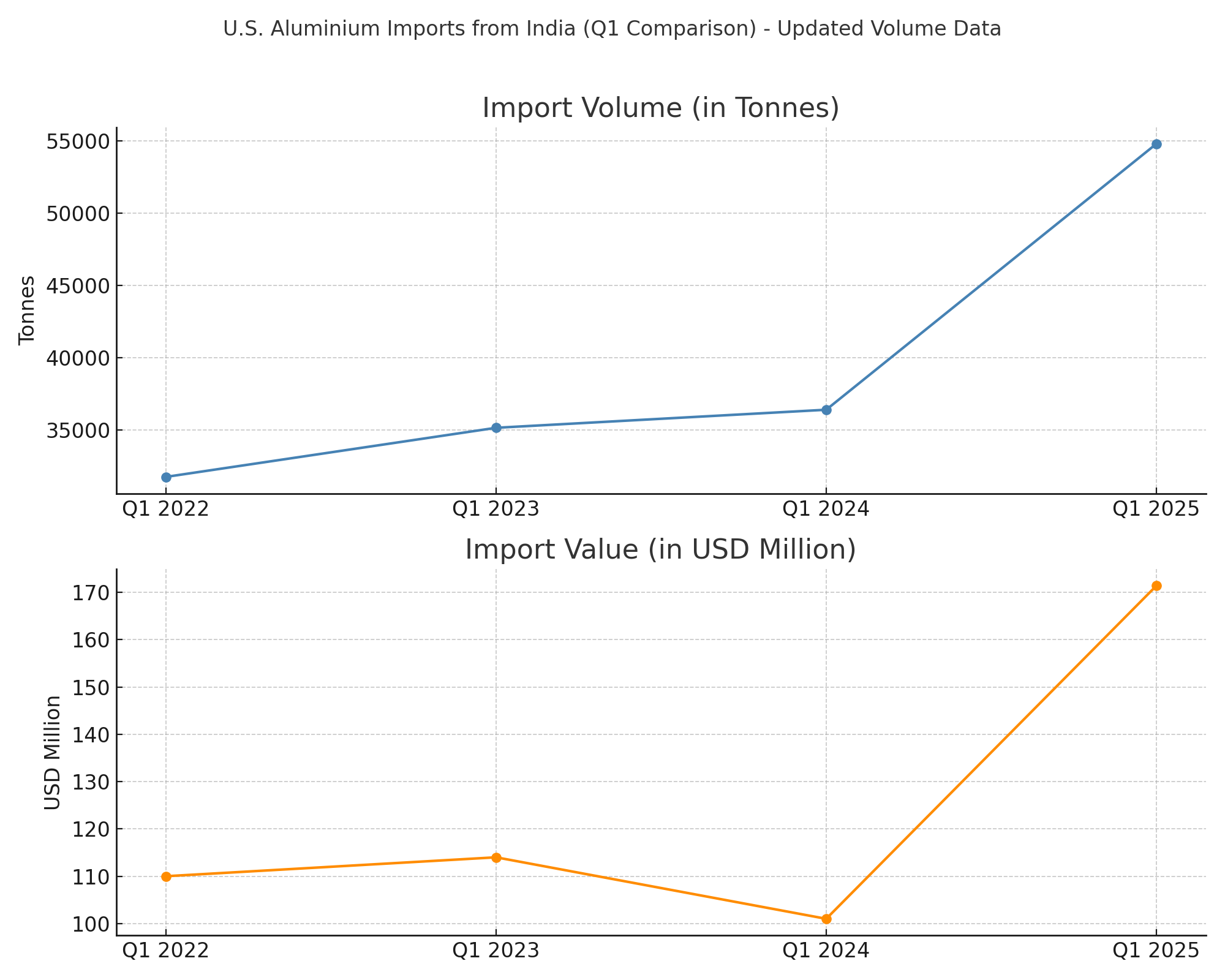
Aluminium export is one area where India is witnessing a considerable year-on-year growth. According to the International Trade Administration (ITA), the United States imported 54,798 tonnes of aluminium and aluminium products (excluding scrap), compared to 36,411 tonnes during the corresponding period of the previous year, That marked a year-on-year hike of 51 per cent, following a slight 4 per cent increase Y-o-Y the earlier month from 35,163 tonnes. As per the ITA data, the United States’ aluminium imports from India grew Y-o-Y in Q1 2025 for the third year in a row, from 31,768 tonnes in Q1 2022.
In terms of value, the United States aluminium imports from India were worth of USD 171.4 million in Q1 2025, up by 69.7 per cent Y-o-Y. In contrast, during the first three months of 2024, import value stood at USD 101 million, witnessing a fall of 11.4 per cent Y-o-Y from USD 114 million, which was, however, 4 per cent higher than USD 110 in Q1 2022.
The significant uptick in India’s both aluminium export volume and value to the US could be attributed to the surge in buying sentiment in the US market ahead of the implementation of tariffs in April. However, in general, India’s aluminium export to the US remains steady through each year.
According to the Ministry of Commerce, India’s aluminium export value to the US in the full year of 2021-22, ended March 31, reached USD 1.1 billion, marking a sharp rise of 117.5 per cent Y-o-Y, compared to USD 507.34 million in 2020-21. In FY 2023, the value continued to grow and reached USD 1,097 million. The observation goes India's aluminium export value rose each year from just USD 350 million in 2016-17, despite the 10 per cent duty imposed by Donald Trump on Indian aluminium imports during his first term. This consistent growth indicates that the earlier tariff was insufficient to deter imports from India, which remains the world’s second-largest aluminium producer after China.
Possibility not to overrule; wait-and-watch is advised
But if the tariff was not successful then, will it be effective now? Some industry experts argue the new 25 per cent tariffs are far more comprehensive than those introduced in 2018, as they encompass a broader spectrum of semi-finished and finished aluminium products. This, they argue, could significantly disrupt India's exports and impact revenue streams. However, others take a more measured view, pointing out that aluminium exports to the US account for only around 12 per cent of India's total aluminium exports.
But now with 50 per cent tariff, the impact could be far more severe than initially anticipated under the 25 per cent duty.
India has already taken the matter to World Trade Organization, signaling its intent to impose retaliatory tariffs on US goods. India may retaliate by proportionately suspending concessions given to American imports (for example almonds and walnuts) and levy higher customs duties on metals coming from the US.
Already, in mid-April, the country had turned to WTO, claiming the tariff imposed by Donald Trump was in essence safeguard measures instead of national security move. But the US had rejected the claim justifying the tariff action was not a safeguard measure; instead, the country held India responsible of not being consistent with the multilateral trade rules.
“Accordingly, there is no basis for India’s proposal to suspend concessions or other obligations under Article 8.2 of the Agreement on Safeguards with respect to these measures,” said the Trump administration in its latest communication to WTO.