The global aluminium and steel industries are in for another jolt as US tariffs take a sharp new turn. Just a day after a Federal Court ordered a halt to the implementation of tariffs, sending through global optimism, President Donald Trump reversed course dramatically. Not only did he secure a suspension of the court's ruling, but he also announced a doubling of tariffs on aluminium and steel imports, from 25 per cent to 50 per cent, effective Wednesday, June 4, 2025.
What seemed like a moment of relief quickly turned into renewed uncertainty as celebrations over the court's block were cut short by the President's swift and unexpected escalation.
Trump’s decision to doube tariffs - whimsical or strategic?
While addressing a rally in Pittsburgh, Pennsylvania, President Trump reiterated the same justification for doubling the tariffs, and that was nothing but ‘national security’. Dismissing all the labels the Federal Court attached to the tariff, such as calling the move a safeguard measure, Trump emphasised that the decision is aimed squarely at strengthening the domestic aluminium and steel industries and cutting dependence on China.
But why he singled out China when he applied double tariff equally to the European Union, India, Canada, Brazil, Mexico, and other key trade partners? China is indeed the largest exporter of both steel and aluminium outside the Americas, valued in the range of USD 800 to USD 810 million. Moreover, Trump held China responsible of violating a recently negotiated tariff truce, despite the two countries having agreed to reduce tit-for-tat duties following talks in Geneva earlier in May. Without offering specifics, Trump claimed that China had broken the agreement. US Trade Representative Jamieson Greer only added that China had failed to remove non-tariff barriers as promised under the deal.
Donald Trump began by saying, “We're going to bring it from 25 per cent to 50 per cent—the tariffs on steel into the United States of America—which will even further secure the steel industry in the United States.”
Later he posted about his decision on social media that the tariff hike would also cover aluminium “Our steel and aluminum industries are coming back like never before. This will be yet another BIG jolt of great news for our wonderful steel and aluminum workers.”
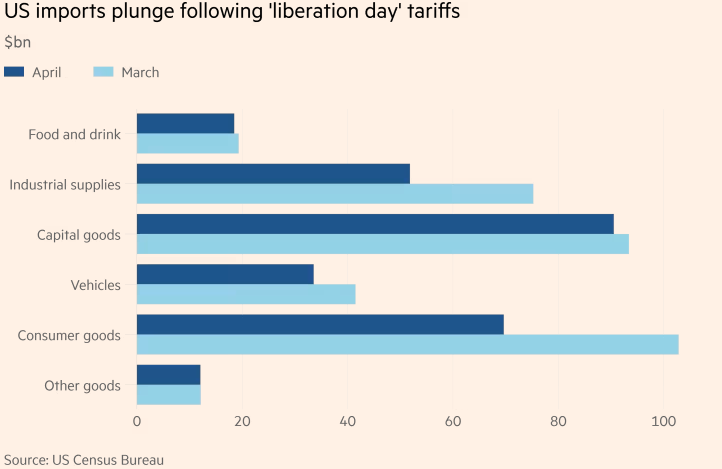
But how we wonder when reports indicate US imports had a record fall in April by nearly a fifth as President Donald Trump’s tariffs prompted companies to slam the brakes on shipments to the world’s biggest economy. According to Census Bureau’s reports, imports of goods in April totalled USD 276.1 billion, down USD 19.8 per cent from March. But talking of only aluminium and that too until March 2025, the United States’s YTD aluminium imports increased Y-o-Y from 1.4 million tonnes worth USD 4.27 billion to 1.57 million tonnes (excluding scrap) worth USD 5.36 billion, showed the International Trade Administration. This increase could be triggered by the fear of potential price hike with the implementation of tariff in April.
And that was what happened; April saw the steepest drop in the United States overall imports in the bureau’s data back to 1992, marking a stark turnaround from March, when companies rushed to buy foreign goods before Trump’s April 2 “liberation day” tariff announcement.
Now the question haunts that if imports have already lessened into the United States, then why the sudden increase in tariff? Well, Wayne Winegarden, a senior fellow at the Pacific Research Institute, argues that the Trump Administration has yet to fully explain the exact math behind the number for the steel and aluminum tariffs.
“They've never given any justification why 25% is the right number, let alone why 50% is,” Winegarden says. “It was just doubled.”
Will the decision last long?
Already, the industrialists and economists are questioning the longevity of Trump’s latest decision, considering his flip-flopping approach towards tariff. Already in March, Donald Trump had decided to increase aluminium and steel import tariffs to 50 per cent but only until Ontario withdrew the decision of implementing 25 per cent surcharge on US electricity.
Moreover, economists argue that US tariffs have already put the domestic aluminium and steel markets through lower imports, price hikes, and job cuts, no matter how much Trump claims the tariffs to bring large amounts of money to the US aluminium and steel industries. At the very beginning of tariff implementation, the prediction was a massive loss of about 20,000 employments in the US aluminium industry and a further 80,000 jobs across the value-chain sectors that support it.
So, it is indeed to see how long Donald Trump sticks to his decision, especially when his trade allies are warning of countermeasures. The European Union spokesperson said, We strongly regret the announced increase of U.S. tariffs on steel imports from 25 percent to 50 percent ,” adding that the escalation “undermines” the possibility of a “negotiated solution.”
The EU confirmed it is prepared to reinstate and expand its countermeasures if the situation does not improve. “If no mutually acceptable solution is reached, both existing and additional EU measures will automatically take effect on 14 July, or earlier, if circumstances require,” the spokesperson told.
United Steelworkers’ national director for Canada, Marty Warren, reacted to double tariff by saying, “This isn’t trade policy, it’s a direct attack on Canadian industries and workers. Thousands of Canadian jobs are on the line, and communities that rely on steel and aluminium are being put at risk. Canada needs to respond immediately and decisively to defend workers.”
Australia’s trade minister Don Farrell has also described Donald Trump’s latest tariff hike decision as “”unjustified and not the act of a friend.” He further explained that the United States 2.5 per cent aluminium imports come from Australia, and it is less than 10 per cent of Australia’s total exports of the metals.
Farrell stated, “they are an act of economic self-harm that will only hurt consumers and businesses who rely on free and fair trade. We will continue to engage and advocate strongly for the removal of tariffs.”












_md.webp)
_md.webp)
_md.webp)