Vedanta Chairperson Anil Agarwal has reportedly called for imposing a 12 per cent safeguard duty on aluminium imports into India, similar to the one recently applied to steel. According to Agarwal, such a measure is essential to protect the domestic aluminium industry from a surge in cheap imports.
Image source: Vedanta Aluminium
In April, the Indian government introduced a safeguard duty on steel imports for 200 days, aimed at protecting local producers from an influx of low-quality steel. The move targets explicitly imports priced below the global benchmark.
Agarwal is now urging the government to implement a similar safeguard on aluminium, arguing that India, a rapidly growing economy, is increasingly vulnerable to cheap imports. He pointed out that, with the United States no longer a viable market due to its 25 per cent blanket tariff on aluminium and steel imports, exporting countries will likely shift their focus to emerging markets like India.
In a tweet last week, Agarwal stated, "We all know there are two countries central to the trade war, US and China. But did you know there are two commodities also centrestage – steel and aluminium."
Commending the Indian government's decision on steel, he added, "Big players who are losing conventional markets will look to sell cheap in emerging economies like India."
Agarwal also highlighted that even the United States' closest trade partners, such as Canada and Mexico, have been impacted by import tariffs, which may prompt them to look for alternative export markets like India.
Let us now examine the current volume of aluminium imports into India and assess how much this figure could rise if the United States' trade allies begin redirecting their exports towards the Indian market.
According to data from the Ministry of Commerce and Industry, India imported 2.9 million tonnes of aluminium and aluminium products (including scrap) in 2024, marking a 5.45 per cent increase from 2.75 million tonnes in 2023. A review of the past five years reveals a consistent upward trend in aluminium imports, from 1.92 million tonnes in 2020 to 2.37 million tonnes in 2021, reflecting a 23.44 per cent jump. In 2022, imports rose by 7.17 per cent year-on-year to reach 2.54 million tonnes, followed by an 8.27 per cent increase in 2023 to 2.75 million tonnes. However, a notable insight from this data is that while imports grew steadily, the year-on-year growth rate has gradually slowed.
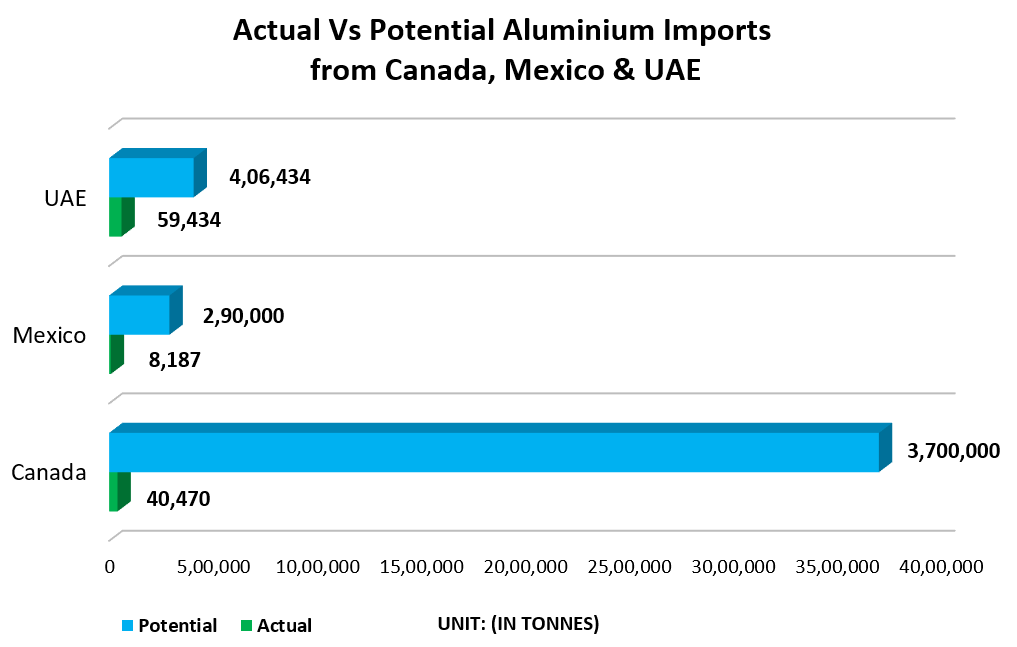
In 2024, India imported 40,470 tonnes of aluminium from Canada and 8,187 tonnes from Mexico, two of the United States' major trade allies. Imports from Canada saw a slight year-on-year decline of 1.3 per cent from 41,022 tonnes, whereas imports from Mexico surged by 37.9 per cent from 5,936 tonnes.
If Canada and Mexico were to redirect their aluminium exports, previously destined for the US to India, India's imports from these countries could potentially rise to around 3.7 million tonnes and 290,000 tonnes, respectively. According to the US Geological Survey, Canada exported 3.36 million tonnes of aluminium to the US, and Mexico exported 282,000 tonnes.
Other key trade partners of the United States include Argentina and the United Arab Emirates, which exported 347,000 tonnes and 165,000 tonnes of aluminium in 2024. India's imports will grow further if these volumes from Argentina and the UAE are redirected to India. Among the major export destinations of the UAE's aluminium, India already imports 59,434 tonnes (as of 2024).