The non-ferrous green metal has changed the nation’s economic sustainability for countries like USA and UAE. Yes, we are talking about aluminium’s indispensability in domestic as well as commercial sectors across the globe. However, India is yet to utilise the full potential of one of the most promising base metals. With timely interventions, India can depend upon aluminium as the cornerstone of its Viksit Bharat vision, nurturing a bright economic future for the republic.
Recent global incidents have endowed India with a hoard of opportunities and challenges, wherein bullish trade dynamics in aluminium are resurging off the back of its versatile applications. China’s decision to put a stop to its export tax rebate policy is a significant development that is likely to increase the price of Chinese aluminium in international markets. This creates a potential opportunity for Indian producers. However, India’s aluminium industry is stagnating due to a surge in primary and scrap imports from both Free Trade Agreement (FTA) and non-FTA countries. This influx undermines local manufacturers and deters new investments in expanding production capacity.
Aruna Sharma, Practitioner Development Economist and Former Secretary, Govt of India, has shared her insight on the matter through a national media platform, “The Indian government has signalled its intent to revitalise manufacturing with new incentives as preparations for Budget 2025 gather steam. These efforts align with broader economic ambitions, including transformative infrastructure projects like the ambitious Bharatmala Pariyojana project and a concerted push toward renewable energy and EVs.” She has also voiced, “Global aluminium demand remains resilient, driven by the rising usage in solar panels, EVs, and expanded power-grid infrastructure. Domestically, aluminium consumption is projected to double to 10 million tonnes per annum (MTPA) by 2030, requiring significant capacity expansion. However, achieving this will necessitate overcoming substantial policy and structural barriers.”
Among the crucial policy changes in this aspect remains the raising of import duties on primary and downstream aluminium products from 7.5 per cent to 10 per cent and aligning scrap duties at 7.5 per cent, which will, in turn, lure new investments in the aluminium sector. These bars are the mirror to creating a level playing field for domestic producers who are contending with aggressive pricing from global competitors attempting to flood the Indian market with surplus production.
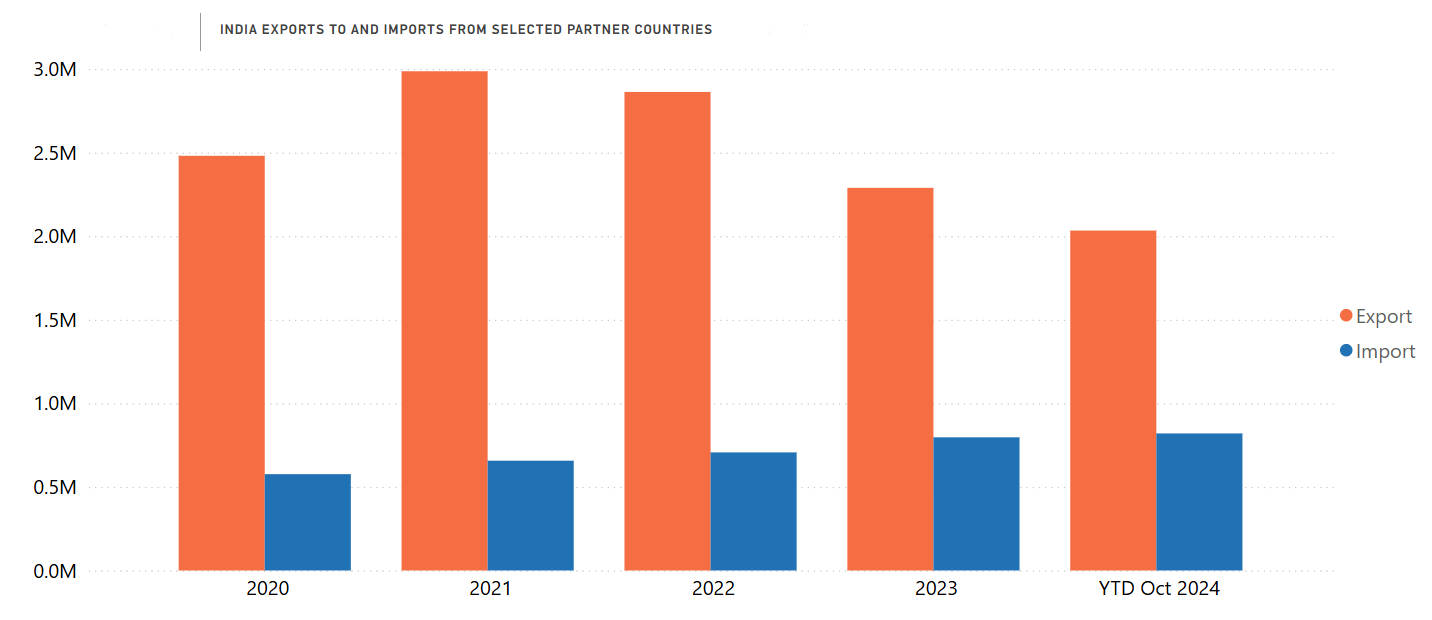 Image Source: International Trade Association
International Trade Association provides data on the cumulative export and import quantities of aluminium products from India for the years 2020 to 2023 and the year-to-date (YTD) period up to October 2024. Exports consistently exceed imports, with export quantities peaking at 2,986,482 tonnes in 2021 but declining to 2,289,048 tonnes in 2023 and further to 2,033,494 tonnes in YTD October 2024. Imports have steadily increased from 576,303 tonnes in 2020 to 819,843 tonnes in YTD October 2024.
The broader implications of strengthening the domestic aluminium industry cannot be overstated. It is closely tied to strategic sectors such as defence, renewable energy, and electric vehicles (EVs). Advanced aluminium alloys are essential in aerospace, naval vessels, and missile systems. The metal’s role in renewable energy is equally critical, with 85 per cent of solar panel components relying on aluminium for their production. With India aiming for 500 GW of non-fossil fuel capacity by 2030, the demand for aluminium in the nation’s progress is set to increase significantly in the coming years. Creating an enabling environment for a strong domestic industry is essential to meet this demand effectively.
Meeting future requirements will necessitate an additional investment of INR 3 lakh crore (USD 36 billion) over the next six years. This level of investment is achievable only if domestic players find the sector attractive for investment. Protecting the industry from cheap imports and addressing regulatory challenges will position India as a global leader in aluminium. Disruptions in supply chains (example Guinea) caused by ongoing geopolitical tensions have further emphasised the importance of self-reliance.
Sharma has conveyed factually, “The surge in low-quality aluminium scrap imports has been facilitated, particularly by the meagre 2.5% import duty that currently exists. This creates duty arbitrage, allowing substandard foreign inputs to quickly enter and flood the market. Such imports affect the viability of domestic manufacturing and compromise their safe usage in applications like food packaging and key infra projects. Encouraging high-quality domestic recycling through policy incentives could shift this balance, promoting a circular economy while reducing reliance on imports.”
As stated by Mr Sunil Gupta, COO at Vedanta Aluminium in one of his recent articles for a media platform, “With the country targeting 50 per cent of electricity generation from renewable sources by 2030, aluminium is an important cornerstone of India’s changing energy landscape.” He has also mentioned, “Currently, India is the world’s fourth-largest consumer of electricity, the demand for which will rise by 8 per cent within this year itself and could grow at 10 per cent annually in the future. To power India’s needs sustainably, the government is incentivising companies to enhance renewable energy capacity, improve grid infrastructure, and promote energy efficiency. Aluminium is critical to serve these initiatives well.”
However, the nation is holding steady in production front. In a Government of India press release from 2024, India was ranked as the 2nd largest aluminium producer, 3rd largest lime producer and 4th largest iron ore producer in the world. Continued growth in the production of iron ore and limestone in the financial year 2024-2025 reflects the robust demand conditions in the user industries, viz., steel and cement. Coupled with growth in aluminium, these growth trends point towards continued strong economic activity in user sectors such as energy, infrastructure, construction, automotive and machinery.
As the world acknowledges aluminium as a strategic and critical metal, India must reassess its policies. This is not merely about economic competitiveness but also about securing the nation’s future in a world that increasingly prioritises sustainability, resilience, and strategic autonomy.