Germany’s aluminium alloy ingot imports during 2019-21 excel in volume and cost; a marginal growth of 0.6% is estimated for 2022
Germany is known as the home of Automotive Engineering. Aluminium alloy ingots are extensively used in the sand casting process for making critical components of various Engineering and Automotive Industries. Popular components like Aluminium alloy wheels of cars and the oil sump of auto engines are made using this alloy.
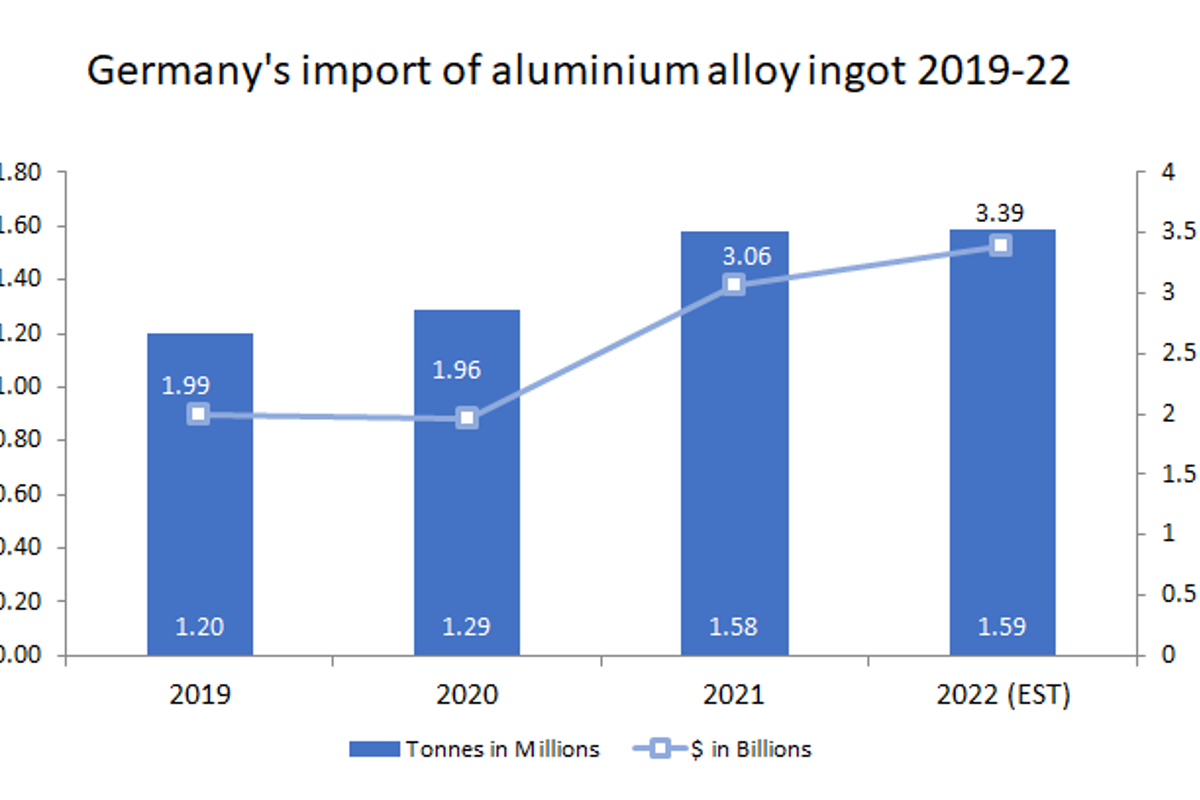
The largest manufacturing economy in Europe, Germany imported 4.07 million tonnes of aluminium alloy ingots during 2019-21, incurring a revenue outflow of around $7.01 billion for the import.
In 2019, the Western European nation, Germany imported 1.2 million tonnes of aluminium alloy ingot, which counted an expenditure of $1.99 billion, whereas, in 2020, the import witnessed a growth of 7.50%, as the import volume excelled to 1.29 million tonnes, while expenditure sunk to $1.96 million.
Aluminium alloy ingot import to Germany was recorded at 1.58 million tonnes, an upsurge of 18.35% and expenditure ascended to $3.06 billion. To a great extent, aluminium alloy ingots are used by the automobile industry in Germany for pressurized die casting components. Aluminum Alloy Ingots have increased in demand in markets around the world because of the growth in automobile and ancillary industries.
The import for 2022 is evaluated with further marginal growth of 0.68%, as the import volume is projected to scale up at 1.59 million tonnes and expenditure to pick up the pace and stand at $3.39 billion.

Germany’s major trading destinations for aluminium alloy ingot are Austria, Bahrain, Bosnia Herzegovina, Belgium, Czech Rep., Canada, Greece, Hungary, India, Netherlands, Norway, UAE, Saudi Arabia, etc.
China’s A00 aluminium ingot price further escalates to RMB 20160/t; Aluminium powder price inches up by RMB0.10/kg
Next articleLME aluminium price plunges by US$79.5/t to US$2,500.50/t; SHFE price slumps by US$62/t
Grow with
AL Circle