From tightening scrap flows to renewable power deals, aluminium’s transition moves beyond recycling into a broader structural shift

For a long time, recycled aluminium has been seen as the industry’s safety valve-helping both with decarbonisation and raw material security. That role remains intact, but the market is beginning to show some strain. The United States still dominates as a major exporter of aluminium scrap, backed by a strong collection ecosystem and steady surplus. Much of this material continues to move to Asian processing hubs, keeping a familiar West-to-East trade route active.
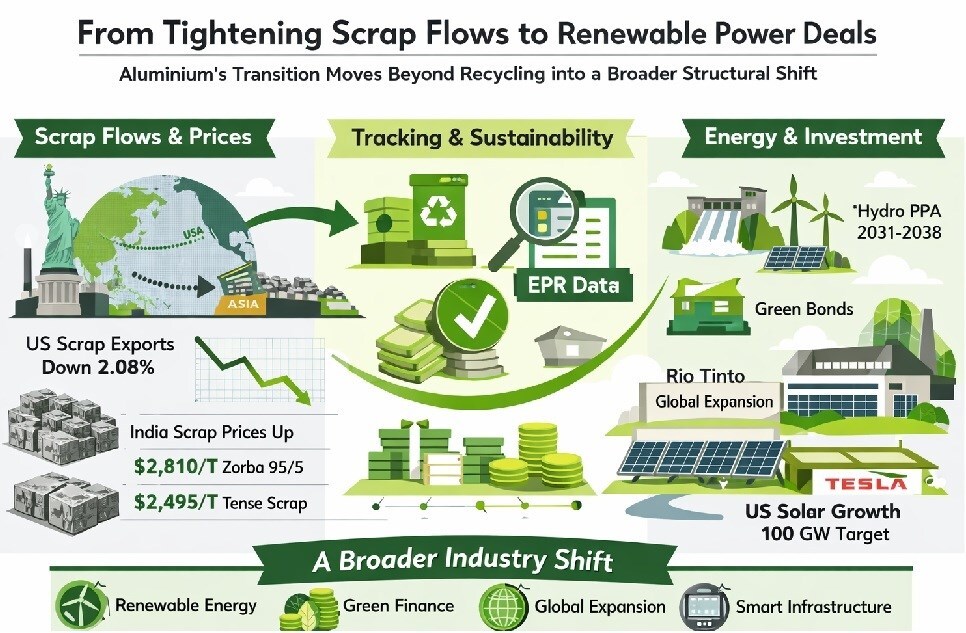
But the pace has eased slightly. USGS data shows exports at 1,880,000 tonnes for January–November 2025, compared with 1,920,000 tonnes a year earlier-a 2.08 per cent drop. It’s not a sharp fall, but enough to suggest that supply is tightening at the margins. Read the full story here.
India is already feeling the impact. Imported scrap prices have moved up sharply week-on-week. UK-origin Zorba 95-5 rose by USD 115 per tonne to USD 2,810 per tonne CFR Nhava Sheva, while US-origin Tense 6-7 per cent increased by USD 120 per tonne to USD 2,495 per tonne. The move reflects not just demand strength, but also the way geopolitical tensions are starting to interfere with flows. Read here.
Recycling focus shifts from collection to tracking
With supply no longer as abundant, the conversation is shifting. It’s less about how much is collected, and more about how efficiently it is tracked, sorted, and recovered.
In Europe, that shift is visible through the launch of the re-alu alliance under AMS Europe e.V. The initiative brings together companies across the aluminium packaging chain, with a clear goal-push recycling rates of small-format packaging to 55 per cent by 2035, in line with EU PPWR targets. These smaller items have typically been harder to recover, and that’s where the focus now lies.
At the same time, Polytag is making the case for better data. Its report calls for stronger digital tracking within Extended Producer Responsibility (EPR) systems, arguing that verified recycling data will be essential as aluminium packaging gains ground across food, beverage, and pharmaceutical sectors.
Companies bring sustainability into daily operations
Away from policy and trade, companies are quietly turning sustainability into something measurable. Vedanta Limited, for instance, reported that it recycled or reused nearly 15 million tonnes of waste in FY25. It has also maintained 100 per cent utilisation of fly ash since FY21, which is notable given the scale of that by-product. Click here for the full story.
Water management is another area of focus. The company recycled and reused 85 million m³ of water across its operations in FY26, pointing to a broader push on resource efficiency.
At the same time, its aluminium business marked the 55th National Safety Month at Jharsuguda with a series of structured initiatives. The idea here is not just compliance, but building a workplace culture where safety becomes a shared responsibility. Read here.
Energy, capital and expansion shape the next phase
Beyond recycling, the next layer of the story is unfolding around energy and long-term investment.
Hydro Energi AS has secured a long-term PPA with Alpiq, ensuring 219 GWh of annual supply from 2031 to 2038 in Norway’s NO3 price area-1.75 TWh in total. It’s a reminder that access to stable, low-carbon power is becoming central to aluminium production. For more, click here.
On the financing side, Gränges has issued two five-year green bonds worth SEK 6 million (USD 64 million), maturing in 2031 under its MTN programme. The direction is clear—capital is increasingly flowing towards low-carbon positioning. To know more about the structure read.
Meanwhile, Rio Tinto is leaning further into aluminium, seeing it as a key part of its long-term portfolio. The company is now looking beyond Canada, with expansion plans across Europe, Asia, and Latin America.
At a broader level, India’s power system is also playing a role in this transition. Installed capacity has crossed 520 GW, with over 40 per cent coming from non-fossil sources. A decade ago, the country was dealing with a 4–5 per cent power deficit; today, it operates close to surplus. Improvements in grid management-like 15-minute scheduling and digital controls-are making supply more reliable for energy-intensive industries. Read the whole article here.
At the same time, Tesla is preparing to scale up solar manufacturing in the United States. The company is reportedly in advanced talks with Chinese suppliers for equipment worth around USD 2.9 billion, targeting up to 100 GW of capacity by 2028. Some shipments could arrive before the end of the year, covering both solar cells and panels.

TOMRA marks 30 years of AI sorting and unveils new deep learning solutions at IFAT 2026
Next articleGACC: China Jan-Feb aluminium scrap imports rise 1.8% Y-o-Y
Grow with
AL Circle