China’s aluminium dross generation is estimated to rise 3.3% in 2026: How technology and policy are shaping dross management
The image used in this article is generated with an AI tool and does not depict any real-time moment
China accounted for nearly half of the world’s aluminium dross generation, underlining the scale of its primary aluminium production, secondary aluminium recycling and downstream processing industries. In 2025, the country generated approximately 2.75 million tonnes of aluminium dross, representing 47 per cent of the global total of 5.86 million tonnes
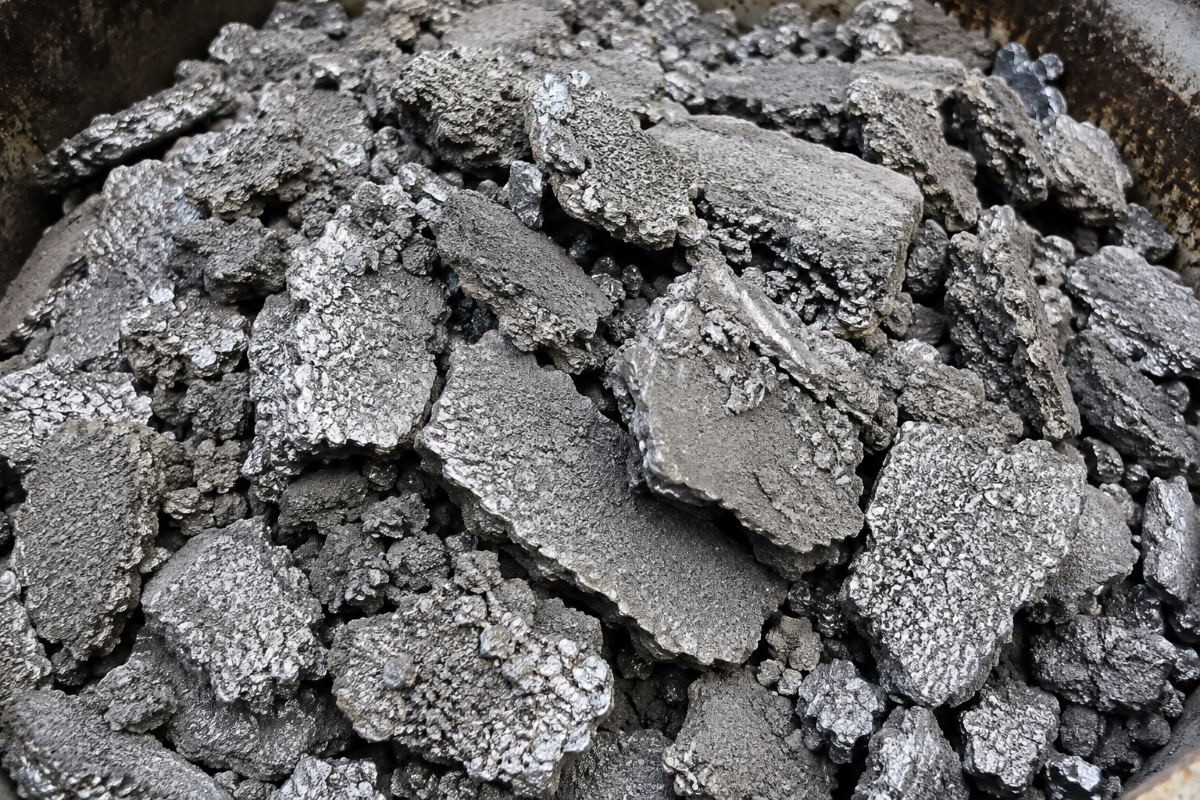
Aluminium dross is an inevitable by-product of aluminium melting, smelting, alloying, casting and recycling. When molten aluminium comes into contact with atmospheric oxygen, a surface layer forms. This layer contains aluminium oxides, entrapped metallic aluminium, nitrides, carbides, chlorides, fluorides and other impurities and is commonly known as aluminium dross.
The quantity and composition of dross can vary depending on the furnace type, feedstock quality, melting temperature, holding time and operating practices.
How much dross does China generate across the aluminium value chain?
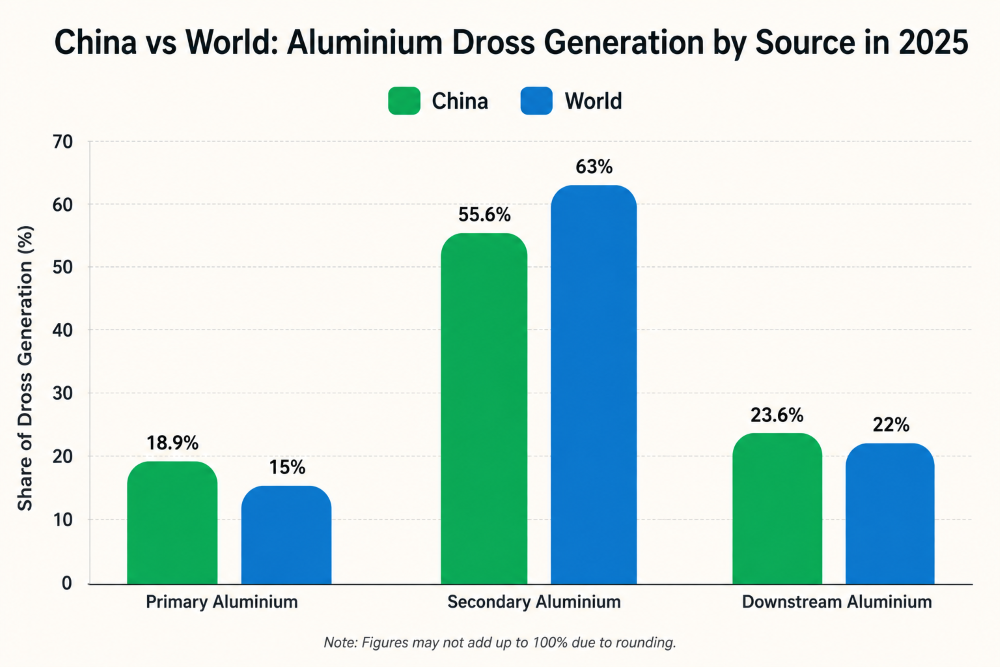
China generated approximately 2.75 million tonnes of aluminium dross in 2025. Of this, 0.52 million tonnes came from primary aluminium, 1.53 million tonnes from secondary aluminium and 0.65 million tonnes from downstream aluminium.
Secondary aluminium was therefore the largest contributor, accounting for 55.6 per cent of China’s dross generation. Downstream aluminium contributed 23.6 per cent, while primary aluminium accounted for 18.9 per cent.
The distribution is broadly similar to the global aluminium industry, where secondary aluminium is the largest source of dross as of 2025. Globally, secondary aluminium accounted for 63 per cent of total dross generation, compared with 15 per cent for primary aluminium and 22 per cent for downstream aluminium. To learn about the market potential of aluminium dross, explore "ALuminium Dross Processing: Generation, Recovery & Strategic Roadmap"
If we look at the dross recovery of China, out of 2.73 million tonnes total dross generation approximately 2.16 million tonnes is expected to be recovered, while metallic aluminium extraction is estimated at 757.80 thousand tonnes.
How is China processing its dross?
China uses several methods to treat dross, depending on its type and quality. These include pyrometallurgical processing, mechanical processing, hydrometallurgical treatment and comprehensive resource recovery.
The traditional route is pyrometallurgical, or high-temperature, processing. In the rotary furnace or salt-cake process, dross is melted with sodium or potassium chloride fluxes to separate metallic aluminium from the oxide fraction.
Tilting rotary furnaces, similar to systems such as those supplied by ALTEK, are used by many Chinese processors. Some facilities are paired with salt-slag treatment lines that recover chlorides for reuse.
While the process is effective, it also produces hazardous salt slag, creating a major environmental concern in China.
Another route is cold or mechanical processing, which is widely used by smaller and mid-sized recyclers. Dross is crushed, milled and screened while still warm or hot to separate metallic aluminium particles from the oxide fraction without adding salt flux.
Chinese equipment manufacturers, many of them clustered in Henan, Jiangsu, Guangdong, Shaanxi, Zhejiang and Hebei, produce dedicated dross-recycling machinery. These manufacturers claim 85-95 per cent metal extraction rates from dross using this approach.
The method is increasingly favoured because it avoids the hazardous chloride salt slag produced by rotary-furnace processing.
Plasma heating technology is also used at some facilities, particularly for converting dross directly into refractory materials. Aluminium dross does not require pretreatment for this application and can directly replace about 5 per cent of raw materials, although its moisture content must be tightly controlled.
For lower-grade or secondary dross containing less metallic aluminium, hydrometallurgical processing is another option. It uses chemical leaching and generally consumes less energy than pyrometallurgical processing. In China, hydrometallurgy is seen as having stronger application prospects for closed-loop and comprehensive treatment.
China has also conducted industrial-scale tests using new processes to produce alumina and chemical hydrates from secondary aluminium dross. The aim is to fully valorise the waste stream rather than simply recover the metallic aluminium.
To explore trade opportunities of secondary aluminium, visit AL Biz
China looks beyond recovering metallic aluminium
The focus is also shifting from recovering only metallic aluminium to making greater use of the other materials contained in dross.
Under comprehensive or closed-loop resource recovery, the aim is to recover metallic aluminium as well as Al₂O₃, SiO₂ and chloride salts for reuse.
The alumina-rich output can be used in refractory materials, steelmaking flux in the form of calcium aluminate, cement and other construction materials. Researchers have also reported the production of calcium aluminate refining agents from aluminium dross for China’s large steel industry.
However, China still faces difficulties in safely treating the full dross stream resulting in waste as well as environmental and ecological risks.
Research institutions, including Nanchang University and similar institutions, are working on improved hydrometallurgical and pyrometallurgical hybrid routes to address these challenges.
Regulation adds pressure to dross management
Technology is only one part of China’s approach to aluminium dross management. Regulation has also become stricter.
Aluminium dross has been classified as hazardous waste under China’s National Hazardous Wastes Catalogue since 2016, with separate codes for primary and secondary dross.
Since 2021, hazardous waste, including dross, cannot be stored on factory premises for more than one year. This has increased the need for faster processing.
The policy direction became clearer on March 28, 2025, when China’s Ministry of Industry and Information Technology, together with nine other ministries, released the Action Plan for the High-Quality Development of the Aluminium Industry (2025–2027).
The plan directly targets waste and resource efficiency across the aluminium industry. Its targets include increasing clean energy adoption in aluminium production to over 30 per cent, increasing recycled aluminium output to more than 15 million tonnes, and improving energy efficiency across at least 30 per cent of capacity by 2027.
AL Circle is coming up with a new Magazine "ALuminium’s Frontline: OEM Edition 2026." Feature your brand and opinion in the edition
Analysis
China’s dross-management challenge comes as global aluminium production and secondary recycling continue to expand. In 2025, global aluminium production exceeded 73.9 million tonnes, while annual aluminium dross generation was estimated at around 5-6 million tonnes.
Global aluminium dross generation is forecast to rise to 6.04 million tonnes in 2026 and around 7.24 million tonnes by 2032.
_(1)_0_0.png)
If China maintains its 47 per cent share of global dross generation, its output could reach approximately 2.84 million tonnes in 2026, up 3.3 per cent from around 2.75 million tonnes in 2025, and rise to 3.40 million tonnes by 2032, an increase of 23.6 per cent from the 2025 level.This represents an increase of around 0.09 million tonnes in 2026 and 0.65 million tonnes by 2032, assuming China’s share of global dross generation remains unchanged.
Baheti Recycling starts FY27 strong: Revenue jumps 89% on aluminium demand
Next articleUK aluminium recycling growth depends on access to global markets
Grow with
AL Circle