CANPACK, one of the leading global manufacturers of high-quality packaging solutions, with a legacy that began over 30 years ago has shown remarkable results in their sustainability report for 2024. Headquartered in Wayne County, Pennsylvania, the company is touted as the fourth largest supplier of aluminium beverage cans in the world. In 2024, CANPACK bagged the position as the second largest supplier of aluminium beverage cans in Europe. This is not just it; the company has also managed to reduce its Scope 2 emissions by 96 per cent in 2023 and has unlocked several other milestones followed by bagging prestigious recognitions. Renowned for its advanced technology, deep industry expertise, and strong commitment to sustainability, CANPACK continues to set new standards in packaging innovation. Let us take a closer look at what CANPACK’s 2024 Sustainability report reveals.
A global trendsetter and achiever in sustainability
CANPACK stands at the forefront of global packaging, operating through four dynamic divisions, namely:
- Aluminium beverage cans and ends
- Glass packaging
- Food and industrial packaging
- Metal closures
This expansive portfolio caters to an impressive range of end-user markets from soft drinks, energy drinks, beer, spirits to packaged water and even industrial and chemical applications, etc. At CANPACK, beverage can bodies are primarily crafted from the aluminium alloy Al3004, while the can ends are typically made from Al5182. Both of these alloys are not only lightweight and durable but also highly recyclable. In fact, aluminium alloys like Al3004 and AA5182 can be recycled endlessly without any degradation in quality making them a smart, sustainable choice for modern packaging.
To ensure comprehensive action and alignment with industry standards, CANPACK has maintained membership in the Aluminium Stewardship Initiative (ASI) since 2021. By 2023, 77 per cent of the company’s aluminium suppliers were certified under the ASI Chain of Custody, marking a significant increase from 50 per cent in 2022.
In 2023 aluminium beverage cans and ends led the charge generating 86 per cent of the company’s net sales followed by the glass packaging industry at 7 per cent, food and industrial packaging at 4 per cent and metal closures at 3 per cent. Regionally, Europe contributed 66 per cent of net sales, with the Americas accounting for 21 per cent, and the remaining 13 per cent coming from other international markets.
With a global footprint spanning 27 cutting-edge production facilities in 16 countries across Europe, Asia, Africa, South America, and North America, CANPACK delivers high-quality packaging solutions to around 100 countries worldwide. Its bold expansion into the US market highlighted by the launch of advanced aluminium can plants in Olyphant, Pennsylvania, and Muncie, Indiana underscores CANPACK’s unwavering commitment to growth, innovation, and meeting the ever-evolving needs of its customers around the globe.
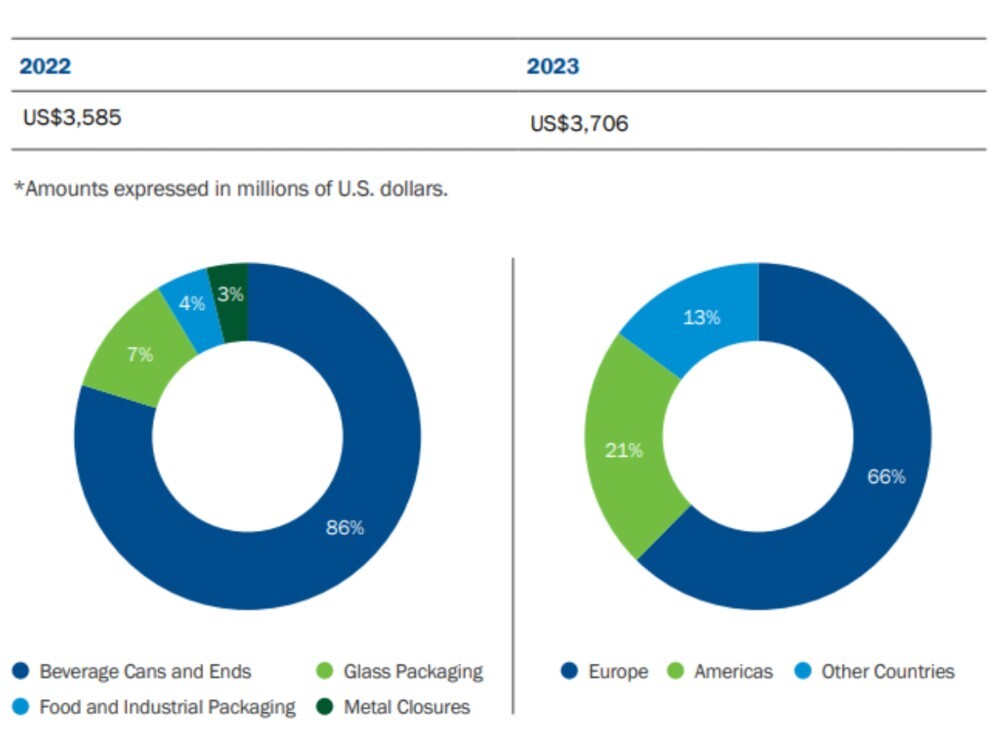
CANPACK 2024 sustainability report
In 2023, the recycled content in its aluminium cans rose to 66 per cent, up from 52 per cent in 2021, reinforcing the circularity of its products. The company also introduced a sustainable procurement policy to elevate environmental standards across its supply chain. Recognising these efforts, EcoVadis awarded CANPACK a Gold Medal in December 2023, placing it among the top 5 per cent of sustainable companies.
CANPACK also earned an A- from CDP for supplier engagement and climate change, and a B- for water security. CANPACK maintained an impressive A- score for climate change in both 2022 and 2023, placing the company among the top 11 per cent of organisations to reach Leadership level within its activity group in 2022. In water security, CANPACK demonstrated meaningful progress, improving its score from a C in 2022 to a B- in 2023 reflecting enhanced action on water-related challenges.
The company’s commitment to sustainability across its value chain is further evident in its supplier engagement scores, with an A in 2022 and an A- in 2023. These results showcase strong collaboration with suppliers to drive environmental performance. While opportunities remain to bolster governance and risk mitigation within the supply chain, CANPACK remains in the top 23 per cent of companies achieving Leadership level (A/A-) through the adoption of best practices.
Reduction in Scope 2 emissions & increased use of recycled aluminium
CANPACK has made significant progress in reducing its Scope 2 emissions. Since 2022, the company has sourced 100 per cent renewable electricity through a combination of on-site installations, direct contracts with energy suppliers, and the purchase of renewable electricity certificates. This approach led to a 96 per cent reduction in Scope 2 emissions by 2023 compared to 2021 levels. CANPACK remains dedicated to sustaining this achievement while continuing to optimise energy use, with a particular focus on improving efficiency in heating and cooling processes.
With over 90 per cent of its total emissions falling under Scope 3 mainly driven by purchased goods and services aluminium remains a critical focus for CANPACK. Aluminium accounted for 77 per cent of the company’s total carbon footprint in 2022, decreasing to 66 per cent in 2023. This reduction was largely due to lower aluminium coil purchases in 2023 following an excess in 2022. The company also made substantial strides in cutting Scope 3 emissions: after an 8 per cent increase in 2022, CANPACK realised a significant 25 per cent reduction in 2023, driven by the rise in recycled aluminium content in coils from 50 per cent in 2020 to 66 per cent in 2023.
While Scope 1 emissions rose due to increased production capacity growing 16 per cent in 2022 and an additional 18 per cent in 2023, Scope 2 emissions saw a dramatic decline of 94 per cent in 2022 and 96 per cent in 2023.
By 2030, CANPACK aims to achieve a 25 per cent reduction in absolute Scope 1 and 2 greenhouse gas emissions, using 2020 as the baseline year. For Scope 3 emissions, primarily related to purchased goods and services the company is targeting a 12.3 per cent reduction within the same timeframe.
The Science Based Targets initiative (SBTi) has classified CANPACK’s Scope 1 and 2 targets as aligned with a “well below 2°C” pathway, indicating that the goals are grounded in the latest climate science and are designed to support efforts to limit global warming to well below 2°C above pre-industrial levels. In addition, CANPACK is actively exploring ways to align its emissions reduction targets with a more ambitious 1.5°C trajectory.
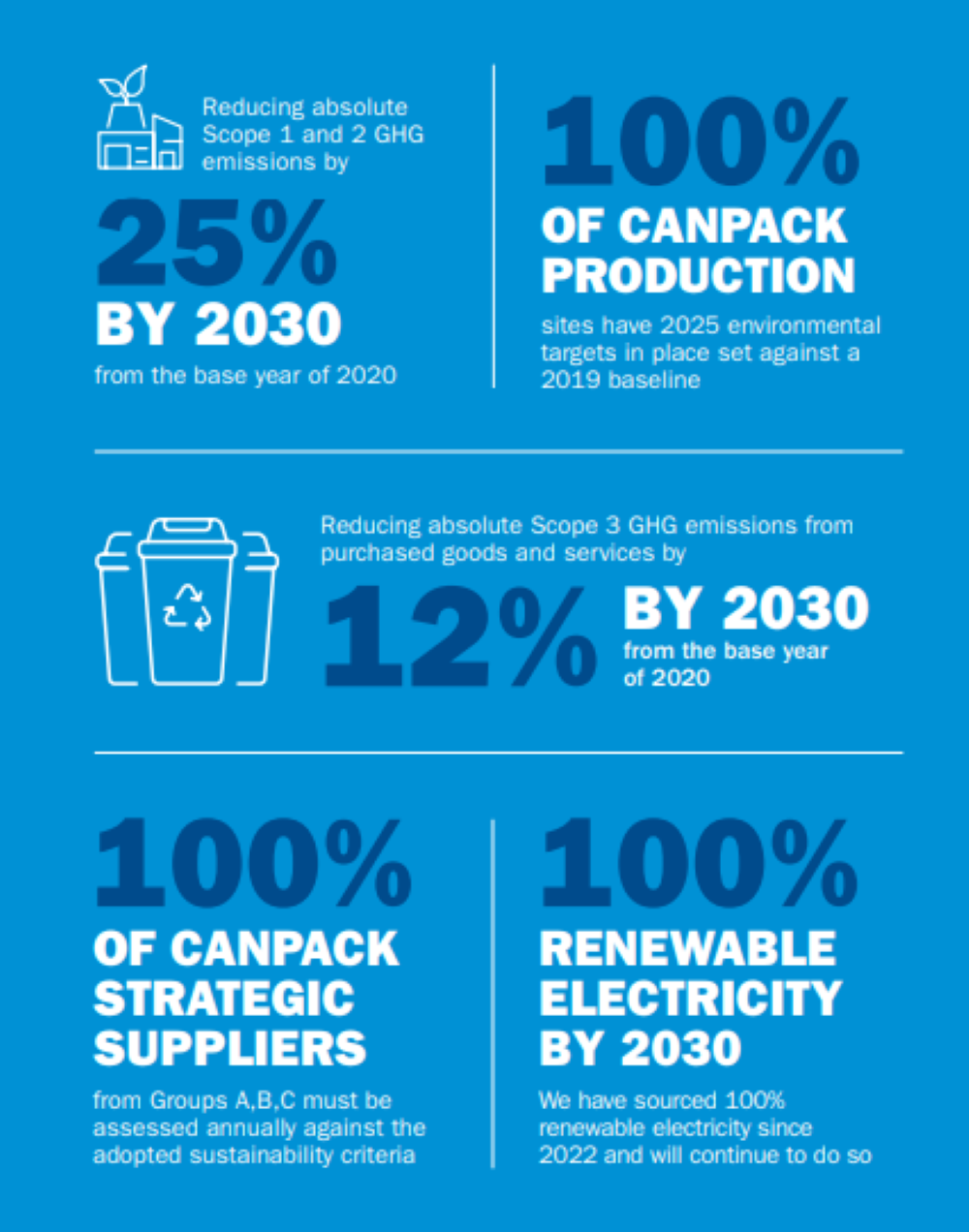 CANPACK 2024 sustainability report
CANPACK’s waste management plans
A central objective of CANPACK’s sustainability policy is to achieve zero operational waste to landfill by 2030. To reach this goal, the company has implemented comprehensive waste management plans and work processes focused on reducing, reusing, and recycling waste. For instance, by 2025, CANPACK’s aluminium can business aims to reduce waste generation by 5 per cent and reach a 94 per cent recycling rate, using 2019 as the baseline year. These initiatives are key components of the company’s broader zero-waste-to-landfill ambition.
In Poland and Romania, the company operates dedicated entities to collect used beverage cans from the market and prepare them for efficient recycling. It collaborates with regulators, local governments, and waste management companies to raise public awareness and create favourable conditions for recycling. Additionally, CANPACK’s plant in Dubai, United Arab Emirates, participates in a Recycling Coalition alongside other packaging producers and customers to promote circular practices.
CANPACK’s 2024 Sustainability Report paints a powerful picture of a company not just keeping pace with global climate goals, but actively leading the charge. From ramping up the use of recycled aluminium to slashing Scope 2 emissions by 96 per cent, CANPACK is proving that industrial scale and environmental responsibility can go hand in hand. With ambitious targets set for 2030, ongoing innovation, and a strong circular economy mindset, CANPACK isn’t just packaging beverages it’s packaging a sustainable future.












_md.webp)