We are already well-versed in the fact that China is the top country which invests in and consumes energy. As of 2025, China is expected to indulge in higher spending on energy than the US and EU combined. Moreover, in the past few years, China has securely moved their investment in global clean energy up to 33 per cent from 25 per cent. This spending has been distributed between wind, nuclear, batteries, solar and nuclear.
It's only been 6 months into 2025, and the total global energy investment is expected to create a new record of USD 3.3 trillion. However, this is subject to the world facing high economic fluctuations and rising geopolitical risks.
From the new global record of investment, the majority of the share, USD 2.2 trillion, would be devoted to developing clean technologies. These technologies may include nuclear, battery storage, efficiency, renewables, grids, low-emission fuels and electrification.
International Energy Agency's executive director, Fatih Birol, stated, "Amid the geopolitical and economic uncertainties that are clouding the outlook for the energy world, we see energy security coming through as a key driver of the growth in global investment."
Among all the renewable energy sources, the star performer position is held by solar. It is expected to reach USD 450 billion in 2025 due to its utility-scale solar and rooftop applications.
Besides solar energy, battery storage is expected to surge, with the projected investment reaching USD 65 billion in 2025. Similarly, nuclear would also see an upward movement due to rising capital flow by 550 per cent, with a total of USD 75 billion investment.
Irrespective of extensive investment and reaching a significant milestone, certain technologies are still doomed. Why so? A total of USD 400 billion a year is devoted to grid development, but it fails to meet the needs of new generations and electrification. This is a serious concern for electricity security. However, causes like delays in receiving permits and the tight supply chain for transformers and cables constitute the grid's slow pace.
Other investments are poured into traditional energy sources, i.e. coal and oil, with India and China being the major investors for coal. China started the construction of about 100 gigawatts of new coal-fired power plants in 2024. On the other hand, investment towards oil saw a dip in 2025 by 6 per cent, a significant impact since the COVID outbreak.
The main reason behind the dip is the lower spending initiated on the US tight oil, which is extracted using fracking technology, which is further processed into diesel, jet fuels and gasoline. However, this is not the case for liquefied natural gas (LNG) because of the pooled investment from Canada, the US and Qatar. It is envisioned that between 2026 and 2028, LNG capacity will secure the most significant capacity growth.
As per the report by the International Energy Agency, from 2019 to 2024, China expanded their total global renewable energy capacity by 40 per cent. The major driving forces included improving the system integration, enhancing the competitiveness of solar photovoltaic (PV) and onshore wind and lowering the curtailment rate.
In the same timeframe, China accounted for nearly half of the globally distributed PV, surpassing the EU and becoming a leader in installed capacity. Apart from this, China is on the path to becoming a leader in biofuel production by increasing investment in production capacity.
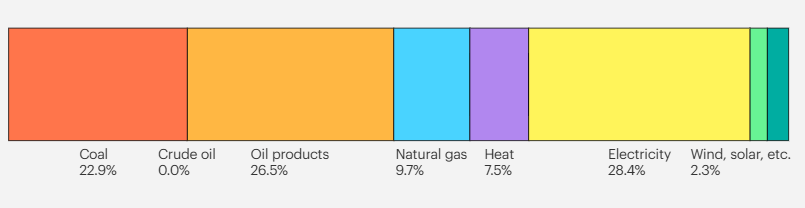
One of every four tonnes of coal used globally is further burned to generate electricity (for both domestic and industrial purposes) in China. As of 2022, China's energy consumption was divided into 22.9 per cent towards coal, 26.5 per cent towards oil products, 9.7 per cent towards natural gas, 7.5 per cent towards heat, 28.4 per cent towards electricity and 2.3 per cent towards wind, solar and others.
On the other hand, in 2024, China's total electricity consumption reached 9,852 TWh, representing a 6.8 per cent increase compared to 2023. The demand was majorly attributed to the manufacturing industries, holding a 17 per cent share.
China's past and current investment plan is combined with the vision of achieving net zero emissions by 2050.
The current and future energy investment till 2030, as per the report by the International Energy Agency, suggests that the top Asian Industrial hub (China) has evidently reflected an elevating trend in cleaner energy and technology investment.
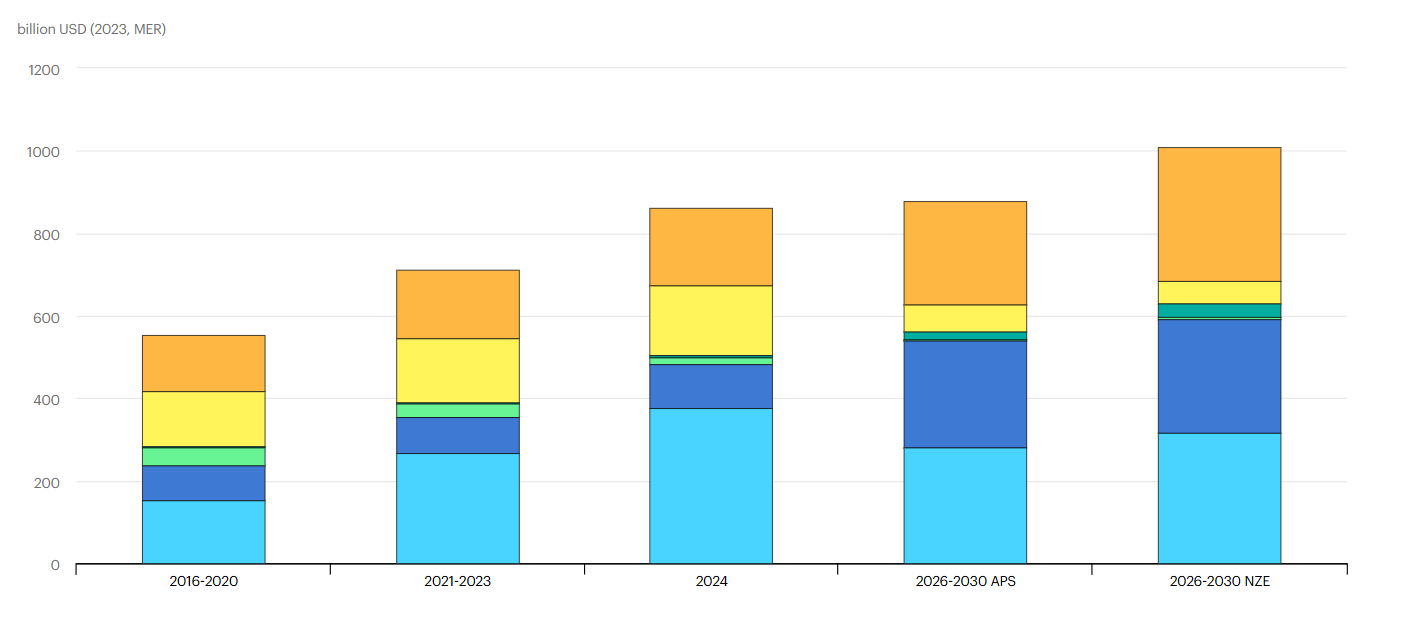
From 2016 to 2020, China's energy investment stood at USD 552 billion, which was divided between low-emissions electricity, grids and storage, fossil fuel power, clean supply, fossil fuel supply and end-use. From 2021 to 2023, China's energy investment stood at USD 709 billion, showing an upward trajectory. The same during 2024 stood at USD 856 billion.
In the future, between 2026 and 2030, China's forecasted energy investment will reach USD 874 billion APS (Announced Pledges Scenario). For the same timeframe, China is expected to pull a total energy investment of USD 1,008 trillion NZE (Net Zero Emissions).
Given China's investment, looking at the renewable energy power generation capacity, in 2024, 9,880 TWh of power was generated, showcasing a year-on-year growth of 6.4 per cent by a decrease of 0.5 per cent from 2023.
Renewable energy power generation also witnessed an increase of 19 per cent year-on-year, which accounted for 35.1 per cent of electricity consumption.
From 2023, China exceeded the installed renewable power generation capacity by 50 per cent, exceeding electricity consumption. The following year, China developed a new type of energy storage, aiding the rapid development trend and growing the capacity to 78 GW.
With this right approach by China to have a clean energy transition and achieve net zero emissions by 2050, dependable trust from different regions and countries is still required. Moreover, the investment to be made by China needs a strong GDP position, but with the ongoing trade tension for the imposed tariff, will the investment plan see a broader light in the near future?














_md.webp)
_md.webp)







