Can Europe secure 1Mt+ aluminium scrap for circularity goals while maintaining global competitiveness?
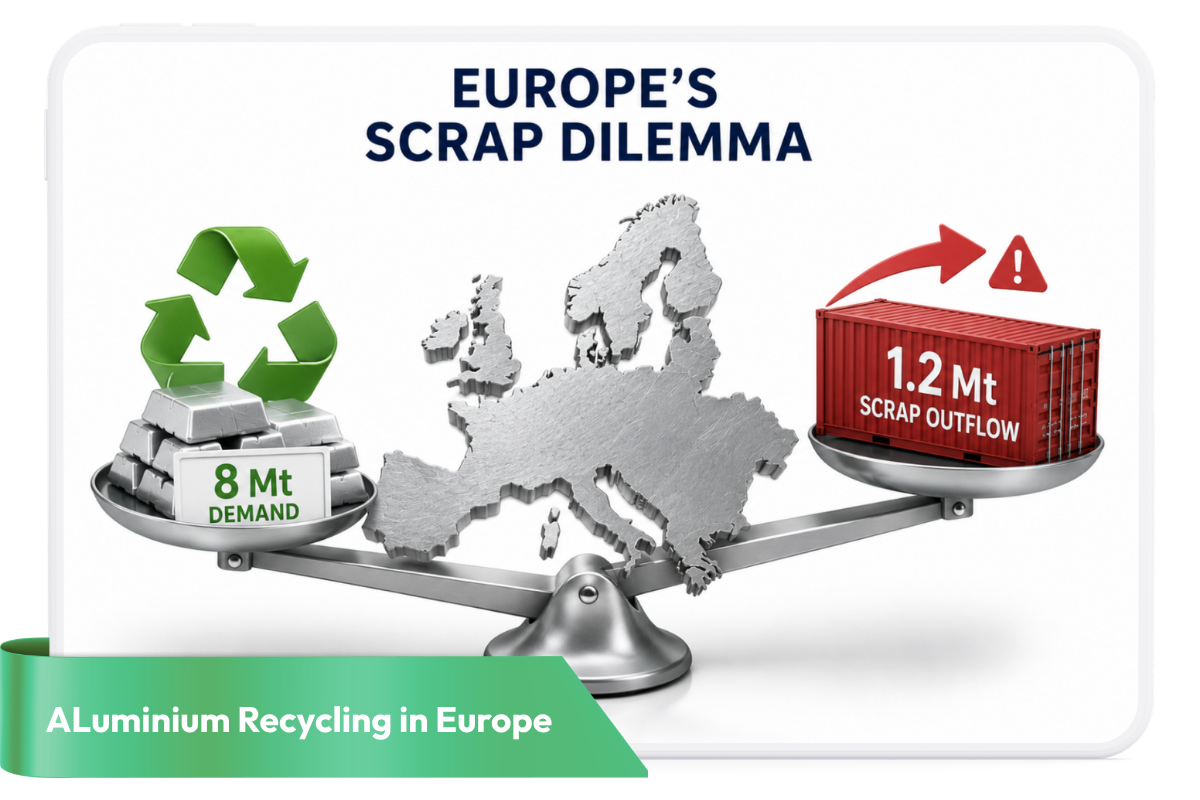
The image used in this article is generated with an AI tool and does not depict any real-time moment
Europe’s aluminium recycling industry is entering a defining phase. Demand for low-carbon aluminium is climbing rapidly across automotive, packaging, construction and clean energy sectors, while policymakers continue to champion circularity as a key pillar of climate action. Yet, despite recycling rates above 80 per cent in several segments and continued investment in recycling infrastructure, a rising share of valuable aluminium scrap is still leaving the continent.
That paradox is becoming one of the industry’s biggest focal points. Across the value chain, we notice a growing regard for Europe’s recycling success, which will be measured not only by how much scrap it collects, but by how much of that material it can keep, process and turn back into aluminium products at home.
As competition for low-carbon materials intensifies, can Europe hold on to one of its most strategic resources?
Recently, insights shared by leading industry experts reveal a sector navigating a complex mix of opportunities and challenges — from scrap leakage and regulatory uncertainty to rising energy costs, carbon policies and technological innovation — while striving to strengthen Europe's position in the global circular aluminium economy.
Delve deeper into the recycled aluminium and secondary aluminium market with our World Recycled ALuminium Market Analysis Industry forecast to 2032
Recycling success story overshadowed by scrap leakage
The European aluminium industry’s strongest concern today is not recycling performance but scrap availability. Several experts have highlighted an uncomfortable reality: Europe is collecting substantial volumes of aluminium scrap, but an increasing share of that material is being exported before it can be processed domestically.
Mario Conserva, President of FACE (Federation of Aluminium Consumers in Europe), described the situation as a strategic challenge for Europe’s industrial future.
“The current leakage of aluminium scrap, whereby we gift 1.2 million tonnes of this strategic resource to third countries annually, has reached a breaking point,” as they are raising the bar of competitiveness for Europe. “This volume represents nearly 25 per cent of Europe’s total recycling capacity, and we should improve it inside,” observed Mr Conserva.
He advocated for “adoption of a decisive and structural trade measure at the EU level”, such as “high export tariff (of 10 per cent) on aluminium scrap,” emphasising the need for secondary aluminium retention within Europe.
In 2025, secondary aluminium accounted for about 35 per cent of global aluminium output, while the global aluminium recycling market is projected to grow from 39.35 million tonnes in 2025 to 41.14 million tonnes in 2026, reflecting the increasing importance of recycled metal in meeting future aluminium demand.
Being “a strategic raw material that Europe does not have in sufficient supply,” this is essential as “scrap prices in the EU have risen by almost 80 per cent since 2019,” and traded over “90 per cent of the LME ingot price.” Hence, “the economic margin for converting scrap into secondary ingot collapses, undermining the viability of EU remelters and refiners’ prices; this is translating into postponed investments, curtailed recycling capacity and plant closures.”
In line with Mr Conserva’s opinion, Tom Jansen, VP and Head of Segments for TOMRA Recycling, stressed that “Europe must treat domestic scrap as a strategic asset.”
He warned that when high-value scrap leaves the region, European recyclers are left competing for limited feedstock, as “The main issue is less about the volume and more about the quality of the material remaining in Europe.”
According to him, Europe needs to move beyond viewing scrap exports as ordinary commodity trade and recognise them as the loss of a valuable low-carbon resource.
At the same time, he believes the solution lies not only in restricting exports but also in improving scrap quality and recovery rates. “Quality should be the priority. Expanding capacity is ineffective if the feedstock is poor,” he explained.
He added that greater investment in advanced sorting technologies, collection systems and material recovery would help keep more aluminium within Europe's circular economy while improving recyclers’ competitiveness.
Additionally, Karl Hoffmann, Director of Marketing & Sales at Hertwich Engineering, described the European aluminium recycling market as being at a critical juncture, shaped by both opportunity and constraint.
According to Hoffmann, “the European aluminium recycling market is currently going through an exciting yet challenging phase, "driven by growing demand from sectors seeking low-carbon aluminium solutions. However, he cautioned that the industry is simultaneously facing pressure from the continued export of valuable scrap resources.
The European Union exports 1.2 to 1.3 million tonnes of scrap during a year, which reflects 15 per cent of the volume collected domestically. In Q1 2026, the European Union exported 328,134 tonnes of aluminium scrap, 69 per cent of which was destined for Asian countries, according to Eurostat data.
Europe recovered around 7 million tonnes of aluminium scrap in 2025. Recovery rates remain impressive, with about 95 per cent of aluminium reclaimed from end-of-life vehicles and building applications, and 76 per cent recovered from used beverage cans. However, despite policy measures bringing about strong collection, the industry’s underlying challenge remains unresolved since the recovered scrap continues to be exported.
In light of this, the European Parliament has approved new trade rules under the 2025 EU-US trade agreement.
The EU can suspend tariff preferences granted to the US if Washington continues imposing tariffs above 15 per cent on EU steel and aluminium derivative products beyond December 31, 2026. The mechanism would allow the EU to act if rising imports from the US threaten the competitiveness of Europe’s aluminium industry, amongst others.
Why does scrap continue to leave Europe?
Demand for recycled aluminium climbed from 6.6 million tonnes in 2021 to 8 million tonnes in 2025, marking a growth of 21.1 per cent. The increase was driven by tighter recycled-content requirements, decarbonisation initiatives, and the wider use of recycled aluminium across the automotive, construction and packaging sectors.
Adding another perspective to it, Ivan Mayorov of CANCOM Austria AG pointed out that scrap exports are not driven solely by price differences but also by inefficiencies within the market itself. He noted that “aluminium scrap leakage is also often driven by information asymmetry and inefficient market matching,” suggesting that recyclers and consumers are not always effectively connected within Europe.
Mayorov argued that improving transparency and digitalisation across the scrap value chain could help retain more material within the region without necessarily resorting to restrictive trade measures.
According to him, “better visibility into available materials, quality and potential use cases, which reduces the likelihood that valuable scrap is exported or underutilised,” while more efficient market platforms can reduce unnecessary exports driven by supply-demand mismatches.
The CANCOM-RecAL partnership has accelerated material analysis and screening while cutting energy use by up to 95 per cent through recycled aluminium, earning RecAL the 2025 ÖGUT Environmental Award for circular economy innovation.
Technology as part of the solution
The challenge of limited scrap availability places greater importance on technology.
Jason Zhang, International Business Director of Luyou Equipment, highlighted that Europe's recycling sector faces a unique combination “where scrap availability is limited but recycling rate requirements are high.”
Zhang is confident that "Luyou Equipment is highly suitable" for the European market, with its ability to “separate high-value materials,” maintaining compliance standards with “EU CE certification” of many of its products and “high reliability and low operational losses,” processing “every tonne of scarce scrap material.”
He explained that recyclers can no longer rely solely on increasing scrap volumes and must instead focus on extracting more value from the material already available. Zhang pointed out the core challenges faced by the European market, viz., “limited scrap, high electricity costs, high labour costs, and strict environmental regulations.”
Luyou incorporates advanced sorting, shredding and separation systems, enabling recyclers to achieve higher purity levels, lower contamination rates and better metal recovery from increasingly complex scrap streams.
Join our exclusive webinar 'Hedging for recyclers - Become an expert in 6 hours' to stay ahead in the competitive market
Energy costs continue to weigh on recyclers
While scrap availability remains a central concern, rising energy costs continue to challenge European recyclers.
Highlighting broader concerns with power costs as the main hurdle in the aluminium value chain, Karl Matthiasson, a visionary leader at the helm of DTE, warned that energy prices are likely to remain elevated.
"Energy costs will continue to be high and, if anything, pressures facing producers and recyclers will intensify," he stated.
Similar concerns were raised by Mr Ruggero Zambelli and Mr Paolo Gamberini of Raffmetal.
They observed, “Reducing energy intensity is a key priority for us given the inherently energy-intensive nature of aluminium melting.”
ETS, CBAM and policy pressures reshape competitiveness
Another challenge is the growing cost burden facing European recyclers under the revised EU Emissions Trading System (ETS).
Emanuele Manigrassi, Director Climate & Energy at European Aluminium, warned that "Europe could face double pressure: higher costs for recyclers within the EU, while valuable scrap is pulled toward higher-paying international markets."
Discussing the broader policy landscape, Manigrassi argued that recyclers are being exposed to rising ETS and CBAM-related costs while scrap and recycled aluminium remain insufficiently covered by existing trade mechanisms. This creates “a clear risk of structural disadvantage for European recyclers.”
As Manigrassi summed up, “Europe is asking industry to recycle more aluminium, retain more strategic raw materials, and build a more circular, low-carbon economy.” Yet without better alignment between ETS, CBAM and recycling realities, achieving circularity goals may become significantly more difficult.
European Aluminium, therefore, is calling for “a dedicated benchmark design for aluminium recycling post-2030 and, in the short term, a freeze of the fallback benchmarks at 2021-2025 levels until 2030.”
Along those lines, Glen Hodgson, founder of independent consultancy Free Trade Europa, questioned whether current policy frameworks fully address industry realities.
According to Hodgson, “CBAM is designed for an idealised future rather than today's reality, and that gap undermines its effectiveness.”
He argued, “When rules are designed in isolation, they inevitably lead to misunderstandings, unnecessary costs, and excessive bureaucracy. CBAM is a clear example of this.” While CBAM may support long-term decarbonisation objectives, it does not directly resolve issues related to scrap retention, energy costs or industrial competitiveness. Thus, a “more practical, inclusive, and functional regulatory approach” is imperative.
Packaging sector, especially beverage can manufacturers, showcases circularity
The area where Europe continues to demonstrate success is beverage can recycling.
Chris Latham-Warde, Programme Manager at Every Can Counts, highlighted growing public support for recycling initiatives and deposit return schemes (DRS), noting that “59 per cent of Gen Z, 66 per cent of Millennials, 75 per cent of Gen X and 77 per cent of Boomers support deposit return schemes.”
The growing acceptance of DRS is increasingly reflected in recycling performance across Europe. Krassimira Kazashka, CEO of Metal Packaging Europe, pointed out that aluminium beverage cans in 2025 reached “a recycling rate of 76.3 per cent in 2023, supported by good recycling infrastructure.” Through the DRS, Germany and Finland achieved “recycling rates of 99 per cent.” Sweden’s container recycling rate reached 88.4 per cent in 2025, advancing towards the national target of 90 per cent. Hungary also recovered 116.5 million cans each month in Q2 2026.
She explained that the EU's Packaging and Packaging Waste Regulation (PPWR) is expected to further accelerate progress, requiring Member States to achieve a 90 per cent separate collection rate for beverage containers by 2029, encouraging wider adoption of proven collection systems.
MPE stresses the aluminium beverage can sector is targeting 100 per cent recycling by 2030, with the ultimate goal of establishing a fully functioning European can-to-can loop.
Explore the position of aluminium at the intersection of sustainability and strategy in Sustainability & Recycling: Aluminium's Dual Commitment
Policy debate: export restrictions or smarter incentives?
Europe’s aluminium recycling industry is no longer debating whether circularity matters, but how to secure the material needed to make circularity work at scale.
As demand for low-carbon aluminium accelerates, Europe's ability to retain, process and reuse its own scrap may ultimately determine whether it remains a leader in sustainable aluminium production or becomes increasingly dependent on external supply chains. The next phase of the recycling journey, industry experts suggest, will be defined not by collection alone, but by how effectively Europe transforms scrap into a strategic resource for its industrial future.

Unlock full access – sign up for FREE.
Key benefits
Why every aluminium recycler should understand hedging: Learn from Jorge Eduardo Dyszel in this exclusive webinar
Next articleEGA undrapes UAE's largest aluminium recycling plant, boosting low-carbon production and circular economy goals
Grow with
AL Circle