Beyond the smelter: Companies powering the US aluminum industry’s rebuild
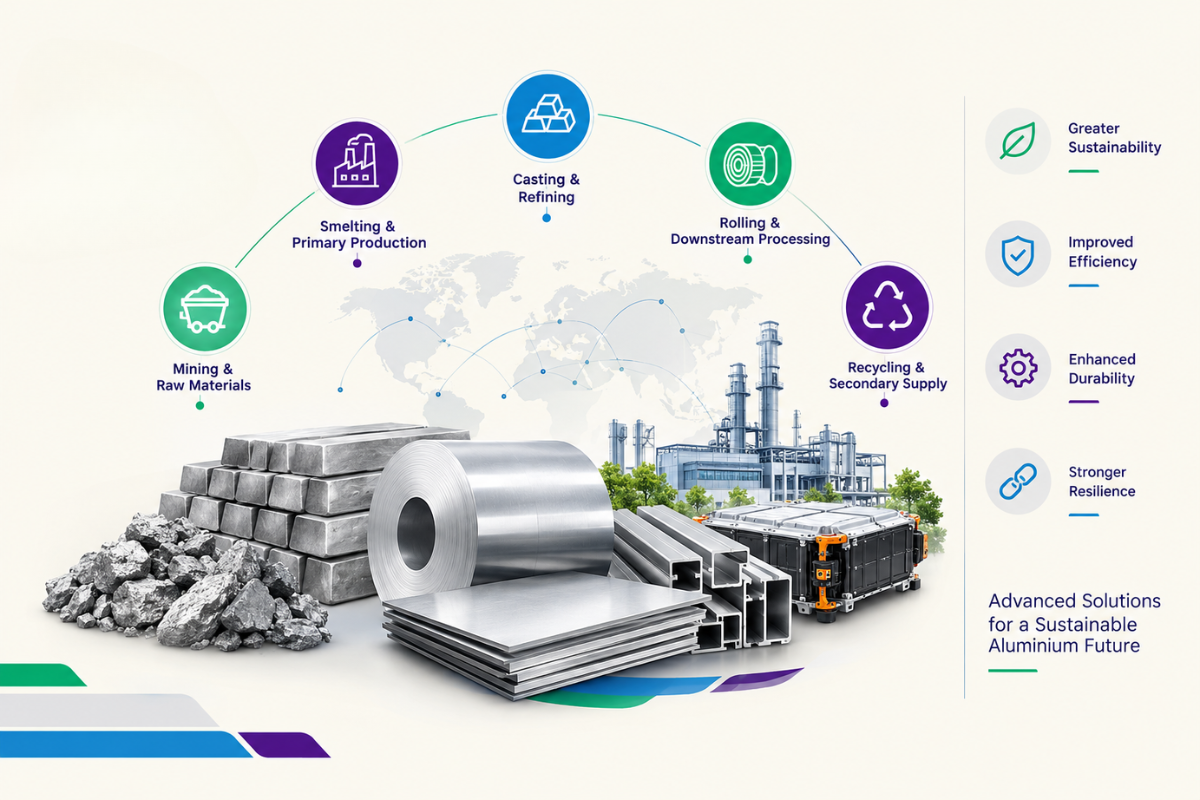
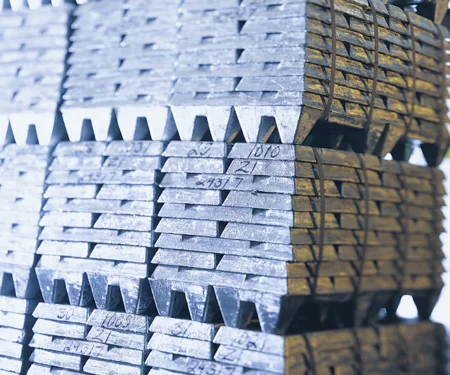
The image used in this article is generated with an AI tool and does not depict any real-time moment
For the past two decades, the US aluminium industry has been treading through a volatile path, with a domestic primary aluminium sector deteriorating at a rapid and alarming rate, and the number of operational smelters falling from around thirty to only four. Primary aluminum output was estimated at 680,000 metric tons with a domestic demand hovering around 5.8 million metric tons in 2025, leaving the country heavily reliant on imports. Although the annual capacity remained unchanged from that in 2024, at 1.31 million metric tons per year, some smelters were operating at reduced capacities, while some faced temporary shutdown. The situation was compounded by the Section 232 tariffs on aluminum products, further blocking the inbound trade.
The rebuilding of domestic capacity, therefore, is not only about restarting or constructing smelters. It also depends on the infrastructure and technology needed to transform molten aluminum into usable products, maintain ageing electrolysis assets, process scrap efficiently, and improve metal quality.
Against this backdrop, Almex USA, Storvik Group, Allied Mineral Products, Molten Metal Equipment Innovations (MMEI), and Zmag Ltd. emerge as the reliable companies supporting technology chain and extending their operational base beyond the US boundaries to foreign platforms.
Explore the production, demand and consumption forecasts of bauxite and alumina in our report: “Global Bauxite & Alumina Market Forecast to 2036: Supply–Demand, Trade Flows & Price Outlook”
Almex USA: Building the casthouse backbone
The planned $4 billion, 750,000-metric-ton Inola, Oklahoma smelter, being developed by Century Aluminum and Emirates Global Aluminum, is the centerpiece of the US primary aluminum rebuilding effort. Once new primary metal is produced, it will require casting and casthouse systems to turn it into products such as billet and slab — an area where Almex USA specializes.
Based in Buena Park, California, Almex supplies casthouse equipment and technology under its “Furnace to Finish Solutions” approach. Its portfolio covers melting, casting, purification, process automation, and inspection.
Products and technology
- Direct-chill (DC) billet-casting systems
- DC slab-casting systems and slab tooling
- MEGA™ DC casting machines
- Melting and homogenization furnaces
- EXCEL™ billet tooling systems
- FILTREX™ ceramic-foam filtration systems
- LARS® degassing and purification technology
- CASTRIGHT® III process-control and SCADA software
- Quality-testing, inspection and peripheral casting equipment
Almex states that its patented LARS technology delivers more than 75% degassing efficiency and over 99% inclusion-removal efficiency. These are company-stated performance claims.
In April 2024, Almex commissioned a complete aerospace-alloy billet casting line for Universal Alloy Corporation Europe in Romania. The installation included EXCEL tooling, a three-chamber LARS system, FILTREX filtration, a MEGA DC casting machine, water-management equipment and CASTRIGHT III automation, and SCADA integration.
Almex USA has a global, project-led trade scope, exporting DC billet and slab casting systems, LARS® degassing, filtration, furnaces, tooling, and process-control technology. Its 2024 commissioning of an aerospace-alloy billet casting line for Universal Alloy Corporation Europe in Romania demonstrates its ability to deliver complete U.S.-engineered casthouse systems internationally, including automation, installation, and commissioning support.
Almex also supplies Western Extrusions’ Texas casthouse and has a presence across five continents. The company has received the US Department of Commerce’s Excellence in Exports Award.
Storvik Group: Keeping ageing potlines productive
While new smelting capacity attracts attention, existing US assets also need maintenance and reliability improvements. Two US primary smelters were operating at reduced capacity in 2025, while Hawesville, Kentucky, and New Madrid, Missouri, had remained idled since 2022 and 2024 respectively.
Storvik Group’s potroom equipment, maintenance services and cast consumables are therefore relevant to efforts to improve utilization and support potential restarts. The Norway-based company says its engineered equipment can provide 3–10 times longer service life than standard alternatives.
Products and services
- Potroom and electrolysis maintenance
- Anode hanger and anode-yoke refurbishment
- Cathode pot-shell maintenance
- Mechanical engineering and maintenance services
- Robotic welding and automated material handling
- Vision systems and condition monitoring
Storvik completed major refurbishment work for Alcoa’s Mosjøen smelter involving nearly 8,000 anode yokes under contracts running through mid-2025. Later company case material describes an automated line using robotic welding, handling, vision, and condition monitoring that processed 8,600 anode yokes over 20 weeks.
The figures should not be combined without confirmation, as they may represent different project phases or reporting points.
In December 2024, Storvik also participated in EGA’s groundbreaking for 10 pilot reduction cells for its next-generation EX smelting technology at Al Taweelah in the UAE.
Storvik operates across Norway, the Czech Republic, Iceland, and the US, and has also established Alumotion in Canada.
Explore primary aluminium suppliers, product listings and trade opportunities on AL Biz
Allied Mineral Products: Protecting furnace performance
The economics of existing aluminum capacity also depend heavily on furnace performance. US primary aluminum’s estimated value reached $2.6 billion in 2025, according to the figures cited in the article, while the secondary sector processed around 3.6 million tons of scrap-derived metal.
Allied Mineral Products supplies refractory materials for the furnaces, holding systems, and transfer equipment used across these operations. Headquartered in Columbus, Ohio, the company manufactures monolithic refractory ceramics, precast shapes, and engineered furnace-lining solutions.
Products and technology
- Monolithic refractory ceramics
- Precast refractory shapes
- Furnace linings and heat-containment products
- Refractory solutions for melting, holding, and transfer equipment
- V-CAST®, DRI-VIBE®, and MATRICAST product families
- Custom-engineered refractory solutions
Its products are used across aluminum casthouses, secondary smelters, foundries, launders, ladles and melting, and holding furnaces, although individual applications should be checked against the relevant technical data.
In June 2024, Allied began a $23.5 million expansion of its Pell City, Alabama plant. The project includes a 200,000-square-feet production facility, cranes, drying ovens, and mixers, and was expected to create 13 manufacturing jobs, with completion projected for late 2025.
In July 2025, Allied acquired intellectual-property rights to ACTCHEM®, an abrasion-resistant technology family.
The company has the broadest confirmed international sales footprint among the US-based suppliers reviewed, selling to more than 100 countries through a network of over 160 sales representatives. It serves over 100 countries and operates manufacturing sites in Ohio, Alabama, and Texas.
MMEI: Making every metric ton of molten metal count
With US secondary aluminum production from purchased scrap reaching approximately 3.6 million metric tons in 2025, remelting has become a significant part of the domestic supply picture.
Ohio-based MMEI develops equipment for molten-metal circulation, transfer, degassing and scrap submergence. Its technology serves primary casthouses, secondary remelters, foundries, and die-casting operations.
Products and technology
- Metal-circulation pumps with advanced fluid-dynamic rotors
- Mini and Workhorse launder-transfer pumps
- Dosing Pump
- Speed Demon
- Rotary degassing stations
- Scrap-submergence systems
- Preheating systems
- Raptor quick-immersion transfer pumps
- Hydrogen analyzers
- Graphite machined components
- Molten-metal treatment equipment
MMEI manufactures molten-metal pumps, transfer systems, degassing stations, scrap-submergence systems, preheaters and hydrogen-analysis equipment in Ohio and supplies customers globally. Its international trade centers on specialized equipment and technical support for aluminium remelters, secondary smelters, foundries, and die-casting plants, with a focus on metal cleanliness, scrap recovery, transfer efficiency, and throughput.
Zmag: Improving scrap recovery and molten-metal movement
Zmag, represented in the US by Zmag America, focuses on permanent-magnetic technology for molten-metal handling and recycling. Its systems are designed to support aluminum remelting, scrap recovery, and low-contact metal movement.
Products and technology
- MagStir™ — non-contact molten-aluminum stirring and circulation
- Typhoon™ — chip melting, scrap submergence and alloying
- MagPump™ — magnetic molten-metal pumping
- zPMC™ — Zmag Permanent Magnetic Circuit technology
In an interview with AL Circle, Zmag America President Eishin Takahashi said MagStir can move more than 90 metric tons of molten aluminum per minute using about 10 kW of electricity. He compared this with typical large mechanical and electromagnetic pumps, which move around 15–20 metric tons per minute.
Zmag says Typhoon can deliver more than 99% recovery without consumable parts or downtime.
Zmag has an international trade scope centered on permanent-magnetic equipment for aluminium recycling and casthouse operations. It has installations worldwide, including at New Zealand Aluminum Smelters (NZAS), historically managed under Rio Tinto’s Pacific Aluminum arm.
For more in-depth insights and exclusive analysis on the global aluminium industry, explore the e-Magazine - Mine to Market: ALuminium Producers & Manufacturers 2026
Supporting the aluminum rebuild from furnace to finished product
The US aluminum capacity-rebuilding effort extends well beyond primary smelting. Almex supports casting and casthouse operations, Storvik focuses on potroom reliability, Allied protects furnace performance, while MMEI and Zmag target molten-metal handling, recovery, and recycling.
The common thread is efficiency. As the US works to rebuild primary production while expanding its use of secondary aluminum, the ability to cast consistently, extend equipment life, protect furnace campaigns, recover more scrap, and maintain molten-metal quality will become increasingly important.
For the domestic industry, adding metric tons is only one part of the equation. The supporting technology chain will determine how efficiently those metric tons can be converted into billets, slabs, foundry alloys, and downstream products.
Alba runs at 1.3 mtpa as Bahrain smelter navigates Middle East disruptions
Next articleVedanta Aluminium appoints finance veteran Abhinav Gupta as Jharsuguda CFO
Grow with
AL Circle