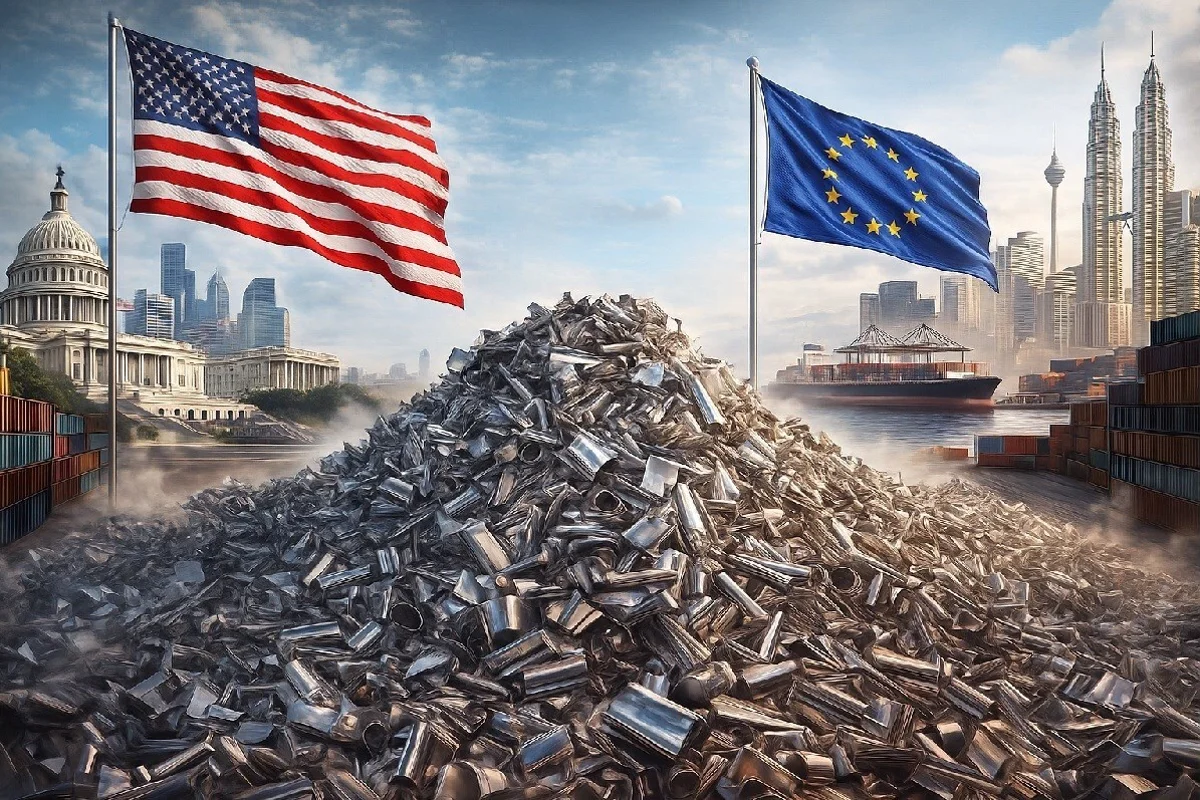
Aluminium scrap has quietly become one of the most protected raw materials in the world specially in United States and the European Union — not through restrictions, but through deliberate exemptions. Washington has carved scrap out of Section 232 tariffs even as it tightened duties on primary aluminium, lifting the tariff rate to 50 per cent by June 2025. The split treatment is intentional. The US has a domestic primary metal shortage of nearly four million tonnes a year, and secondary smelters can expand only if scrap continues to flow in duty-free.
Europe has taken a parallel — but more climate-driven — route. Aluminium scrap is excluded from the EU’s Carbon Border Adjustment Mechanism, which places carbon prices on primary and semi-finished imports but assigns zero emissions to recycled inputs. Brussels argues the exemption reflects scrap’s low carbon footprint, yet it also shields Europe’s secondary aluminium sector, which relies on affordable recycled feedstock for 75–80 per cent of its production.
Including scrap in CBAM would have raised domestic costs by EUR 50–200 per tonne (USD 58 – 232 per tonne) and undercut manufacturers already grappling with energy inflation. By leaving scrap outside the mechanism, the EU has effectively protected its secondary industry while pushing climate compliance costs onto primary metal instead.
Where the scrap comes from in US and EU?
As competition accelerates, the question becomes who is supplying all this scrap. For the United States, the answer remains close to home. Canada provided USD 733 million worth of aluminium scrap, which accounts to 306.278 thousand tonnes —in the first eight months of 2025, while Mexico shipped 430.223 thousand tonnes worth USD 463 million.
For the EU, Switzerland and the United Kingdom remain dominant suppliers, exporting USD 201 million (119.487 thousand tonnes) and USD 173 million (83.833 thousand tonnes) respectively.
Yet the paradox persists: the US and EU both want more scrap to feed secondary production, but neither produces enough domestically. Their policy choices — zero tariffs and zero-carbon treatment — are designed to keep external scrap competitive and accessible.
The result is a tight global market in which developing Asian economies must compete against two of the world’s largest industrial blocs simply to secure feedstock.
Where do Asia and Southeast Asia source their aluminium scrap?
The Asian and South Asian countries, meanwhile, rely heavily on the United States, which remains the dominant supplier in 2025 with an estimated 1.5–2 million tonnes shipped as exporters redirect material under high primary tariffs but low duties on scrap. The European Union follows, sending 1.26 million tonnes in 2024 — about three-quarters of it to Asia—and another 636,000 tonnes in the first half of 2025 despite tightening controls ahead of a proposed 30 per cent export levy for 2026. The United Kingdom adds a further 400,000–600,000 tonnes annually to India and neighbouring markets.
Germany, Canada, Saudi Arabia and Australia add meaningful volumes to Asia’s supply, while Thailand and Malaysia function as processing hubs, melting Western scrap and re-exporting it across the region. But these sources will struggle to fill the gap once the EU’s proposed 30 per cent export tariff takes effect.
That may lead to countries including India to buy scrap from Europe, even at a premium. It’s a clear irony: even as the US and EU shield scrap for themselves, they still supply the markets competing hardest for it—tightening the race for a resource the world is using faster than it can recover.
A shift in global trade: How Asia is absorbing the Shock
This strategic protection by the US and EU is forcing other markets — particularly in South and Southeast Asia — to compete harder for available scrap. With Western markets keeping scrap easy to import but increasingly difficult to export, Asian buyers are redirecting their sourcing patterns.
Malaysia imported 286.3 thousand tonnes by August 2025, worth USD 556 million, with nearly half originating from the United States in just six months. Thailand has surged even faster, taking 353,000 tonnes of US scrap in 2024 and another 249,000 tonnes in the first half of 2025. Indonesia’s volumes dipped from 124.24 thousand tonnes in 2023 to 115.27 thousand tonnes in 2024, but reliance on US-origin material remains, with 60,000 tonnes in 2024 and 36,700 tonnes by mid-2025. Vietnam continues to build modest but steady inflows with 8,610 tonnes so far this year.
But, India showed an aggressive buyer picture. Its aluminium scrap imports rose 23 per cent in value in the first six months of 2025, reaching USD 1.961 billion. Volumes grew to 875,466 tonnes, compared with 814,004 tonnes a year earlier, lifting India’s share among the world’s top importers from 30.8 to 37.3 per cent. In September alone, India brought in 200.668 thousand tonnes valued at USD 432 million.
China, meanwhile, imported 1.17 million tonnes in the first seven months of 2025—an 8.4 per cent rise—driven by plans to expand its secondary aluminium capacity to 15 million tonnes by 2027.
These countries are actively importing aluminium scrap, as it feeds a broad range of industries—from automotive and EV manufacturing, where it is used for cylinder heads, wheels, engine blocks and battery casings, to construction, which relies on extruded profiles for doors, windows and facades. Scrap also supports foundries producing castings for machinery, transport and engineering equipment, supplies the electrical sector with material for conductors, busbars and housings, and underpins the packaging industry through the production of foil, cans and multilayer laminates.
The Domestic gap: Can scrap supply ever catch up with demand?
Both the US and EU recognise that long-term security cannot rely solely on imports. The US aluminium can recycling rate remains stuck at 43 per cent — far below the 75 per cent global average — leaving over USD 1 billion worth of recoverable metal in landfills every year. Industry plans for 2025 and beyond, centre on extended producer responsibility laws, bottle-deposit expansion in more than ten states, AI-enabled sorting systems and investments in Zorba/Twitch processing capacity added through major acquisitions like Toyota Tsusho–Radius Recycling.
Europe’s answer is built into the Green Deal. By 2030, the bloc wants recycling to supply at least one-quarter of its critical minerals demand. Over EUR 11 billion (USD 12.7 billion) has been channelled into optical sorting, municipal recovery systems and circular product design. But concerns over scrap leakage have already triggered export surveillance in mid-2025 and proposals for a 30 per cent export tariff by spring 2026. Brussels knows that secondary aluminium output — around five million tonnes today—cannot grow without keeping more scrap at home.
The global picture is increasingly clear: every major region wants more scrap than it can produce. Even China, with strict caps on primary smelting capacity, is racing to build the world’s largest secondary aluminium system because it cannot meet demand through mining and smelting alone. With demand rising faster than domestic recovery, the competition for scrap is becoming a defining feature of the aluminium market.
As the US and EU protect their access to scrap and Asian demand accelerates, global competition for recycled aluminium is only set to intensify. The real issue is no longer production but control — so the question now is: who ultimately wins the scrap race?













_md.webp)