Aluminium extrusion 2035 demand nears 44.22Mt: Industry experts decode next decade drivers
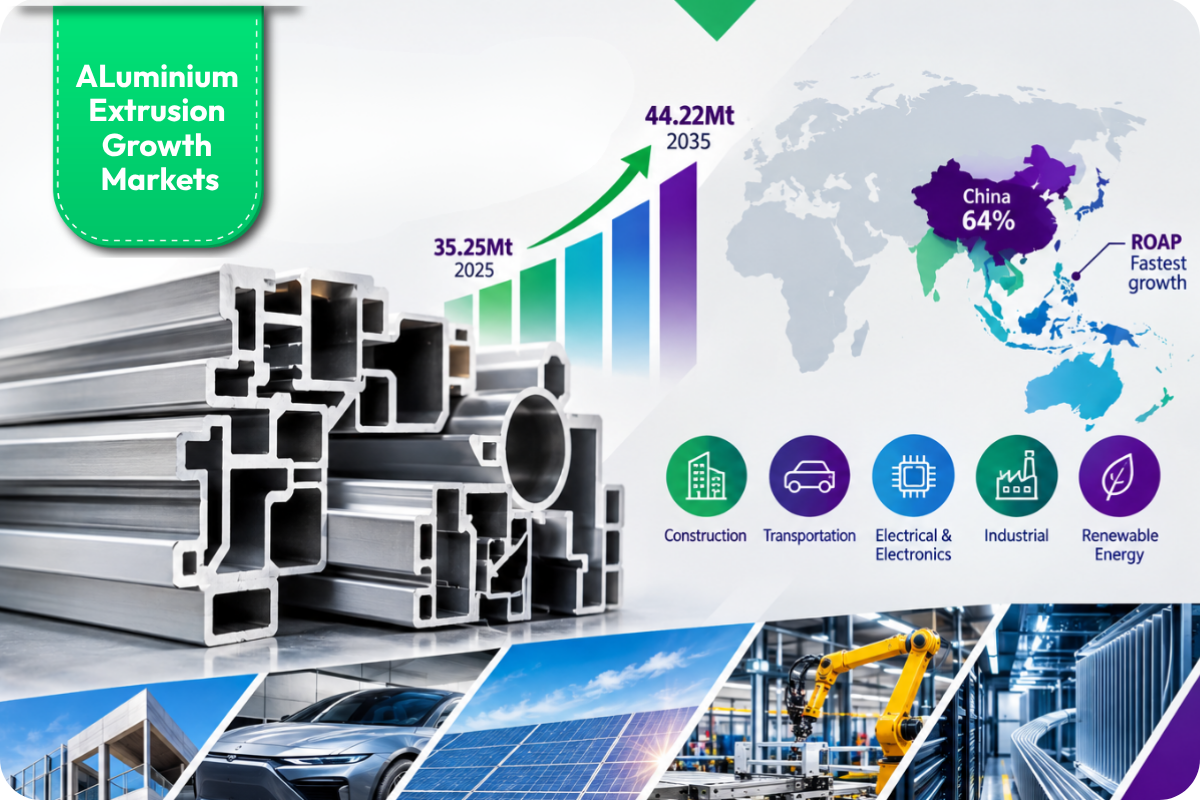
The image used in this article is generated with an AI tool and does not depict any real-time moment
Global aluminium extrusion demand is entering a phase with consumption projected to rise from 35.25 million tonnes in 2025 to 35.93 million tonnes in 2026 and 44.22 million tonnes by 2035, representing a 2.29 per cent CAGR. While building and construction will remain the largest end-use sector and China will continue to dominate the global market, the next decade is expected to bring stronger momentum from transportation, electrical and electronics, industrial applications and emerging markets across Asia.
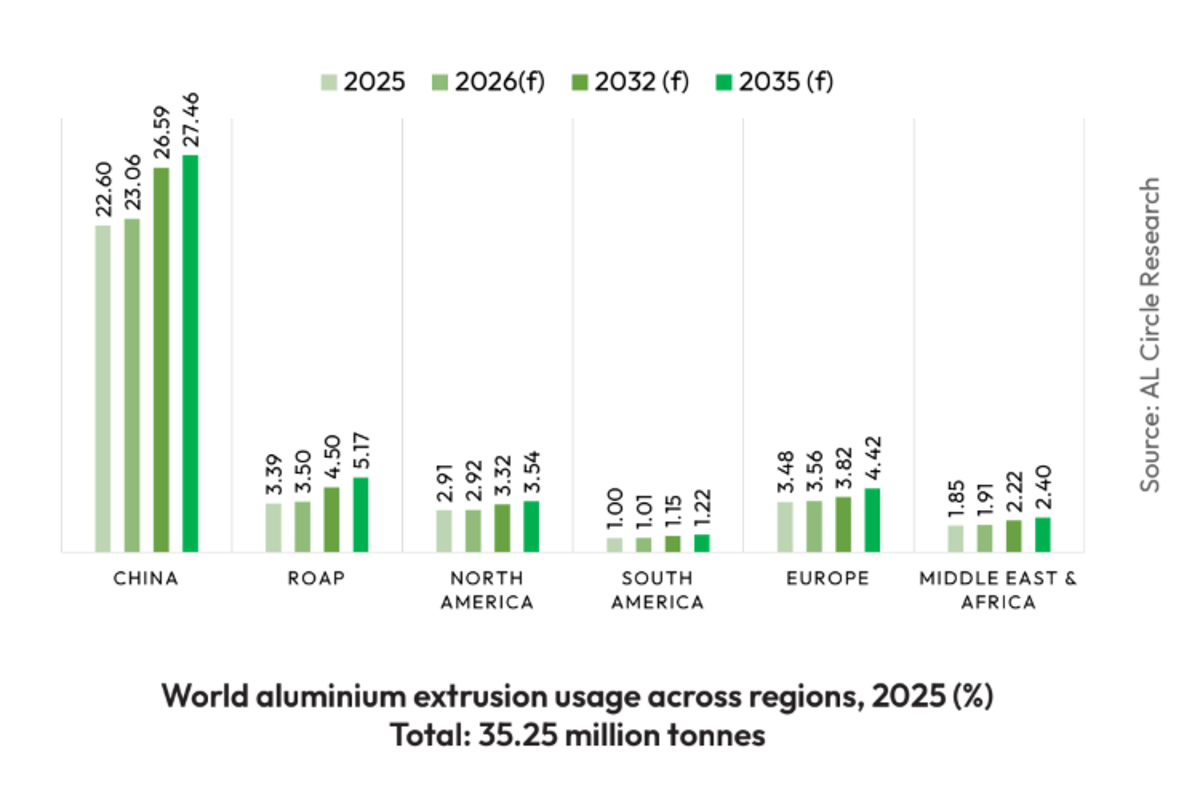
China accounted for 64 per cent of global aluminium extrusion usage in 2025, while the Rest of Asia Pacific (ROAP) represented 10 per cent, North America 8 per cent, Europe 10 per cent, the Middle East and Africa 5 per cent and South America 3 per cent. At the same time, the global extrusion industry had 49.9 million tonnes of capacity against 35.25 million tonnes of demand in 2025.
The mismatch between installed capacity and actual demand also means that future competitiveness will depend not only on capacity but also on capacity utilisation, product mix, productivity, automation and access to growing end-use markets.
President of the US-based Aluminum Extruders Council, Jason Weber’s observation in an AL Circle interview regarding the US market clearly stated, “The most immediate result would be greater utilisation of existing US extrusion capacity” more effectively rather than building new plants.
To know the global production, demand and consumption forecasts of aluminium extrusions, explore our report “The World of Aluminium Extrusions to 2035”
Construction leads, but others gain ground
Industry’s next phase in end-use sectors will not be dependent on construction alone.
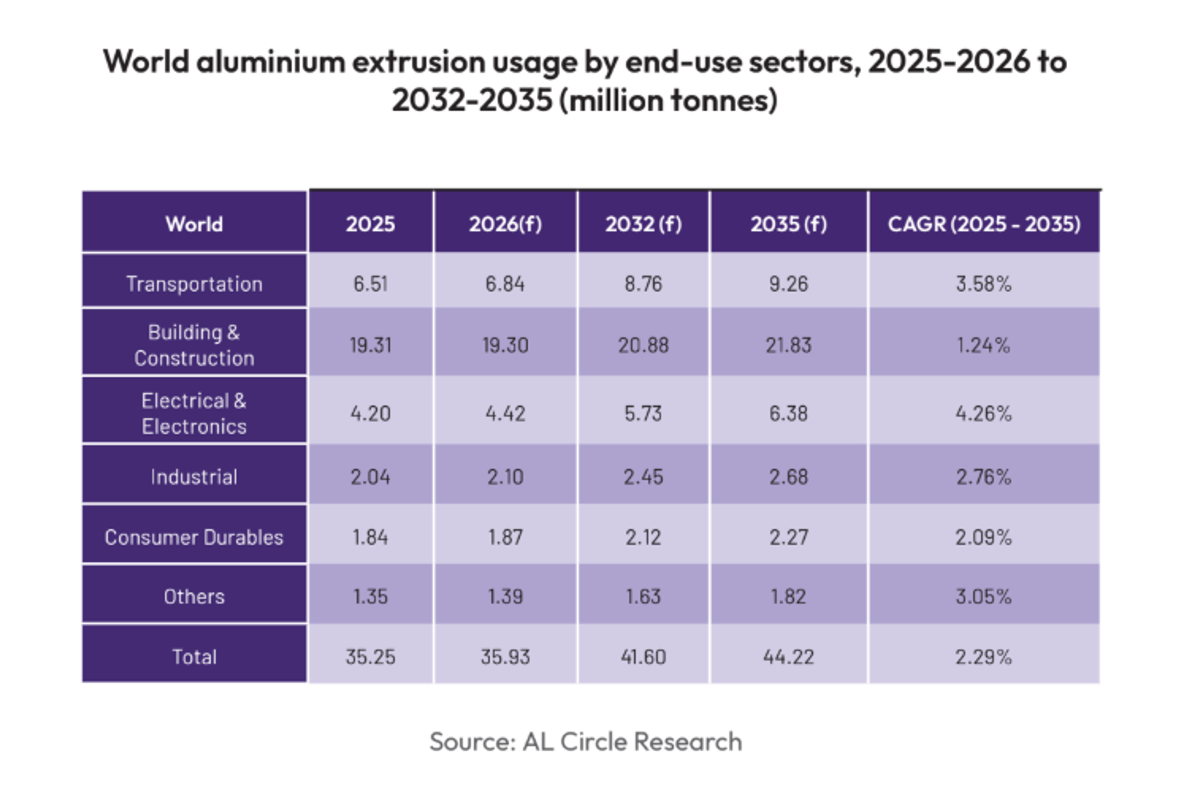
The figures point to a gradual structural shift from traditional architectural applications towards lightweighting, electrification, thermal management, automation and higher-value industrial applications. Building and construction will continue to dominate in absolute volume, but faster-growing segments are expected to capture a larger share of incremental demand.
Weber made a similar observation that “Building and construction will likely remain the industry’s largest underlying market through 2030.” However, he expects “future demand” to arise from “a broad mix of construction, transportation, power generation and industrial applications.”
The Australian market offers another illustration of this diversification. Gabriel Algar, Founder and Director of Extrut Aluminium based in Australia, noted, “Construction remains Australia’s largest consumer of aluminium extrusions, but the strongest growth is increasingly coming from renewable energy, industrial automation, defence and specialised infrastructure.”
His assessment echoes the point that traditional construction sits as the industry’s volume base, while new applications are expanding their markets.
China remains the centre of gravity
China dominates the global aluminium extrusion industry. It accounted for 22.6 million tonnes of aluminium extrusion usage in 2025, equivalent to 64 per cent of the global total of 35.25 million tonnes. Consumption is forecast to increase to approximately 23.06 million tonnes in 2026, and 27.46 million tonnes in 2035, translating into a 1.97 per cent CAGR between 2025 and 2035.
Yet China’s importance is no longer simply about supplying large volumes of conventional profiles.
In an exclusive interview with AL Circle, Diego Daluisio, President of Thermalex, based in Alabama, observed that China’s extrusion sector is undergoing a major transition, with its product mix moving towards “solar, electric vehicles, energy storage, and heat dissipation” rather than “commodity extrusion like building profiles.” He also noted that China’s export destinations are shifting toward “Southeast Asia, Australia and South America, as the US door narrows.”
That evolution is significant for the global market as it suggests that China’s enormous extrusion base is increasingly competing in technically demanding applications. As Daluisio put it, “the product going out the door is moving up the value chain”.
Connect with verified aluminium extrusion buyers and suppliers through the AL Biz marketplace.
ROAP set to record the fastest regional growth
The strongest regional growth in the forecast comes from Rest of Asia Pacific (ROAP).
ROAP extrusion consumption stood at 3.39 million tonnes in 2025 and is forecast to reach around 3.5 million tonnes in 2026 and 5.17 million tonnes in 2035. Its projected 4.32 per cent CAGR between 2025 and 2035 is well above the global average.
Huseyin Umut Ince, Executive Board Member of ALCOMET AD, Bulgaria, reinforced this outlook in an AL Circle interview, mentioning, “Southeast Asia, India and other emerging markets will see strong growth in aluminium extrusion consumption over the coming decade.” He linked expansion to industrialisation, infrastructure investment, urbanisation and the energy transition.
The forecast numbers support that view. ROAP’s 2025-2035 growth rate is more than twice the global CAGR, suggesting that the region will become increasingly important not only as a consumption centre but also as a competitive manufacturing base.
Australia demonstrates specialised demand expansion
According to Algar, construction remains Australia’s largest extrusion market, but the strongest growth drivers are “renewable energy, industrial automation, defence and specialised infrastructure.” Among the strongest-demand product categories are “High-value architectural systems, solar infrastructure, industrial framing systems and customised engineered profiles.”
He also stressed that “long-term competitiveness” would be determined by factors like “Automation, digital manufacturing, skilled people and continuous process improvement.”
That is consistent with the wider global trend. Growth is moving towards applications where aluminium’s lightweight properties, strength, corrosion resistance and design flexibility provide advantages beyond conventional building profiles.
North America and Europe favour higher-value extrusion
North America consumed 2.91 million tonnes of aluminium extrusions in 2025, with demand forecast around 2.92 million tonnes in 2026 and 3.54 million tonnes in 2035, with a 1.99 per cent CAGR.
Europe is expected to grow from 3.48 million tonnes in 2025 to 3.56 million tonnes in 2026 and 4.42 million tonnes in 2035, recording a 2.41 per cent CAGR.
European and North American markets are increasingly moving towards high-value, decarbonised and complex structural profiles, rather than competing solely on commodity extrusion volumes.
The industry experts echo that trend. Ince stated, “European customers increasingly value factors beyond the basic extrusion price,” including “Supply-chain reliability, shorter lead times, technical support, the ability to provide further processing” and carbon footprint. He expects a more regional supply-chain model to emerge, particularly for complex and value-added products.
Similarly, Weber noted, “Supply chains will likely become more regional. Extrusions are often highly customised, tooling-intensive, and expensive to transport.” He also highlighted the rising importance of recycled and lower-carbon aluminium, traceability and flexible manufacturing.
“Automotive is clearly going through a challenging period in Europe,” Ince believes that “EV platforms increase their share of production,” raising demand for aluminium extrusions. As Daluisio referred to the Australian extrusion growth drivers, Ince noted “attractive opportunities in solar and renewable energy, transportation, construction and a broad range of industrial applications.”
Weber echoed the point that with increased priority for lightweighting, efficiency and performance, “recoveries in automotive and general transportation should continue to strengthen extrusion demand” in the US.
Middle East and Africa maintain a smaller but faster-growing base
Middle East and Africa accounted for 1.85 million tonnes of extrusion usage in 2025, rising to 1.91 million tonnes in 2026and 2.4 million tonnes in 2035, with a projected 2.64 per cent CAGR between 2025 and 2035.
South America is forecast to grow from 1 million tonnes in 2025 to 1.01 million tonnes in 2026and 1.22 million tonnes in 2035, equivalent to a 2.06 per cent CAGR.
The Middle East’s development is increasingly tied to large infrastructure, tourism, urban development, sustainable and renewable-energy projects. Abdul Aziz AlGhamdi, General Manager at Saudi Arabia-headquartered ALUPCO, told AL Circle that this shift has resulted in an “increased demand for aluminium systems with improved thermal insulation, larger and more structurally capable profiles, enhanced corrosion resistance.”
As customer preference moves beyond basic extrusion products to “integrated, customised solutions,” demand for “aluminium components that support green building certifications such as LEED and local sustainability standards” continues to rise.
He added that shipping disruptions around the Strait of Hormuz and Bab el-Mandeb had prompted “aluminium extrusion producers in the Middle East to adopt more resilient supply-chain strategies.” ALUPCO, for example, increased stocks of billets and spare parts, maintained larger finished-goods inventories and explored more flexible shipping routes.
That is particularly relevant to a global extrusion market wherein regionalisation and supply-chain resilience are highly essential competitive factors.
AL Circle is coming up with a new Magazine “ALuminium’s Frontline: OEM Edition 2026.” Feature your brand and opinion in the edition.
The move towards higher-value extrusion goes beyond the press
The transition in global extrusion is also visible in downstream processing.
Dr Judy Runge is a metallurgical engineer and surface-science specialist and an independent consultant at her company, CompCote International, Inc., New York. She told AL Circle that anodic aluminium oxide (AAO) should be regarded as a manufactured product in its own right, with its structure capable of being engineered for different applications. She identified corrosion protection, wear resistance and fatigue resistance among the key functions of anodic oxide on extrusions.
She identified “the primary functions that the anodic oxide (AAO) performs” as “Decorative Corrosion Protection; Corrosion Protection; Wear Resistance; and Fatigue Resistance.”
For wear-intensive applications, she mentioned, “Thick, hard-anodised AAO is a staple finish for aluminium extrusions in various wear applications,” including automotive and industrial applications.
Runge’s observations underline another aspect of the market transition: as extrusion moves into more demanding applications, value is increasingly created not only through the profile itself but also through surface treatment, fabrication, finishing, quality control and application-specific engineering.
This is also reflected in the European outlook. Ince stated that ALCOMET’s strategy is not simply to add tonnage, but to expand its technical capabilities through “automation, productivity and competitiveness,” offering its customers “complex, high-value aluminium solutions from an integrated European production base.”

Outlook: From volume to value
Global aluminium extrusion demand is projected to add almost 9 million tonnes between 2025 and 2035, increasing to 44.22 million tonnes. With global capacity estimated at 49.9 million tonnes against 2025 demand of 35.25 million tonnes, the more important task is converting installed capacity into profitable, diverse and resilient output, whereby the shift to customisation and performance efficiency along with sustainability targets sit under the spotlight.
As Algar puts it, the future belongs to manufacturers that combine “world-class manufacturing with customer-focused engineering rather than simply supplying commodity products.”
Note: This is exclusive coverage by AL Circle and may not be reproduced, republished or shared without prior permission.
New 25,882 sqm plot expands ZF Steering Gear’s aluminium project site in Maharashtra
Next articleEmergency duty on aluminium extrusion imports declined; NZ extruders await federal scrutiny
Grow with
AL Circle